
Project Info
Project Name: Pujiang Platform Hill
Location: Chengdu, China
Architects: MVRDV

Pujiang Platform Hill is an ambitious urban project by MVRDV located in Chengdu, China, a city known for its rapid growth and evolving relationship between nature and development. Rather than treating infrastructure as a purely functional system, the project reimagines it as an inhabitable landscape that supports movement, social life, and ecological continuity. Pujiang Platform Hill stands as a hybrid between architecture, topography, and public space.

At its core, the project responds to the challenge of large scale transportation infrastructure intersecting with everyday urban life. Instead of hiding or minimizing this condition, MVRDV amplifies it. The architects shape the platform as an artificial hill, stacking circulation routes, public amenities, and green spaces into a continuous, walkable form. This approach turns what could have been a barrier into a connector.

The stepped geometry of Pujiang Platform Hill creates a gradual transition between different urban levels. Pedestrians, cyclists, and vehicles coexist within a carefully choreographed system of paths and terraces. Movement becomes an experience rather than a mere act of passing through. From street level to elevated viewpoints, the project offers multiple ways to navigate the city while encouraging slower, more engaged forms of mobility.
Landscape design plays a defining role in shaping the character of the project. Green roofs, planted slopes, and shaded platforms soften the infrastructural mass and introduce biodiversity into the urban fabric. Vegetation is not decorative but performative. It helps manage stormwater, reduce heat, and improve air quality while providing places for rest and gathering. The hill functions as a piece of environmental infrastructure as much as a spatial one.

Public life is embedded throughout the project rather than concentrated in a single plaza or park. Open terraces, seating areas, and flexible platforms invite informal activities such as walking, resting, exercising, or meeting friends. These spaces are designed to accommodate daily routines as well as spontaneous events, making Pujiang Platform Hill a social condenser within a rapidly developing district.

Material choices reinforce the project’s clarity and robustness. Concrete, steel, and durable paving are used with precision, forming a neutral backdrop for greenery and human activity. The architecture does not seek monumentality through ornament, but through scale, repetition, and legibility. Every layer of the hill is readable, allowing users to understand where they are and how the space works.
One of the project’s most compelling qualities is its ability to reconcile density with openness. By stacking functions vertically, Pujiang Platform Hill frees up ground space while offering expansive views across the surrounding city and landscape. Elevated paths provide moments of pause and observation, reconnecting people with the broader geography of Chengdu.

Pujiang Platform Hill also reflects MVRDV’s ongoing interest in creating architecture that is both conceptual and practical. The project demonstrates how bold form can emerge directly from urban logic and environmental considerations. It is not a sculptural object placed in the city, but a system that evolves from the needs of movement, climate, and public use.
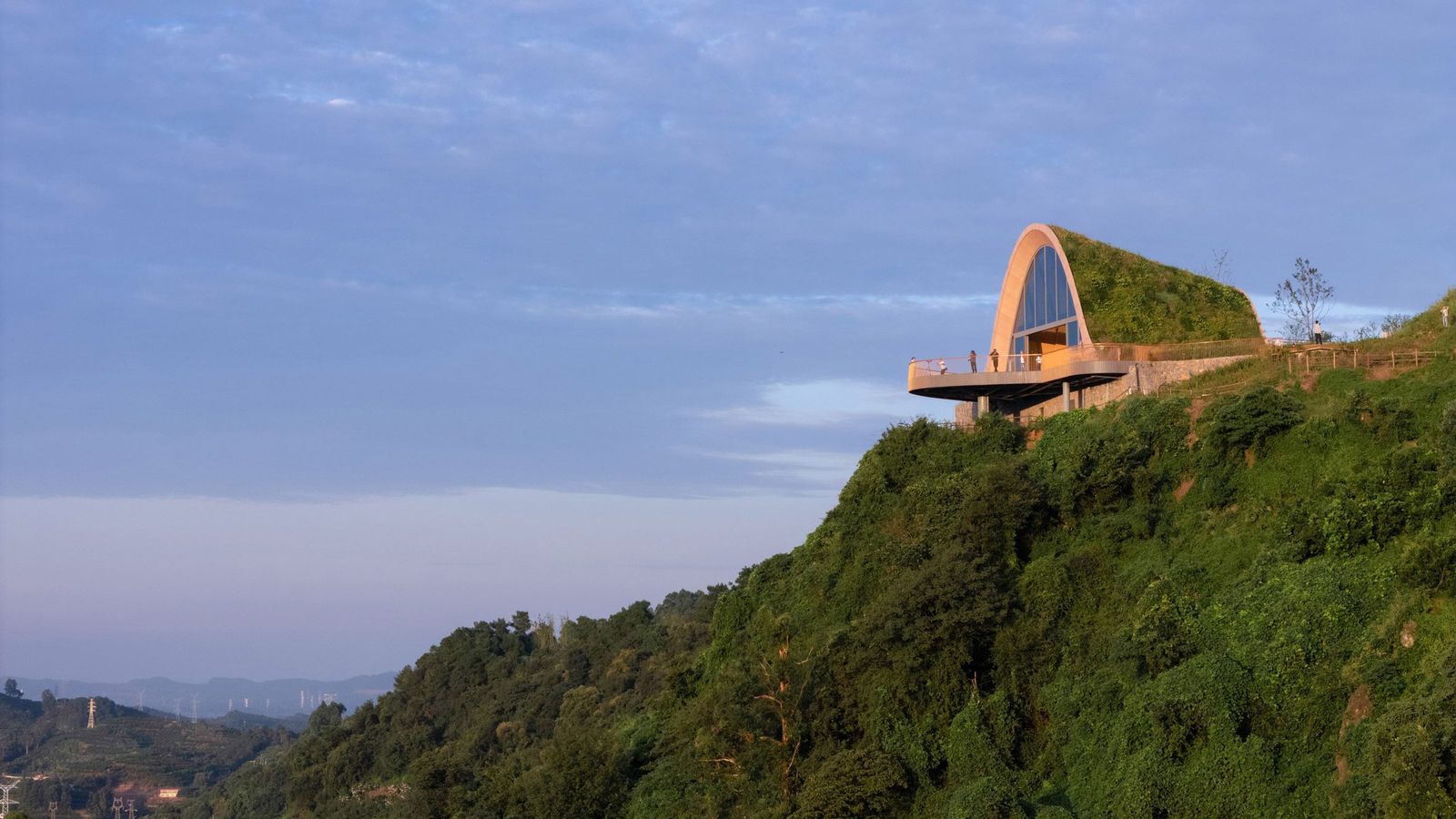
Arched pavilion bridges infrastructure with accessible public gathering space

As cities across China and beyond continue to densify, projects like Pujiang Platform Hill suggest alternative futures for infrastructure. Instead of separating transport, landscape, and public life, they can be layered together into cohesive, human centered environments. In this sense, the project is not only a local intervention, but a prototype for future urban development.

Pujiang Platform Hill ultimately reframes how infrastructure is perceived and experienced. It shows that even the most technical urban systems can become generous, social, and ecological spaces when architecture is guided by imagination and responsibility.
Save this story. A free account keeps your reading list and the 07:00 email in one place.
CREATE FREE ACCOUNT →SIGN IN