
The Room That Design Forgot
For decades, the bathroom existed in a peculiar limbo within residential architecture. Allocated the smallest footprint, tucked into leftover circulation zones, finished with whatever tile was on sale at the supply house. We've observed this pattern across hundreds of projects: the living room gets the statement sofa, the kitchen gets the marble island, and the bathroom gets whatever's left in the budget. That calculus is beginning to invert.
What we're seeing now is not merely cosmetic upgrade but a fundamental reappraisal of the bathroom as spatial architecture. The room is being treated with the same tectonic rigor, material intention, and programmatic complexity as any other zone in the house. Four approaches stand out for their willingness to challenge convention without lapsing into spa-resort pastiche.
Steel and Stone in Tension
The first strategy engages materiality through contrast rather than harmony. Brushed stainless steel fixtures, historically relegated to industrial or commercial contexts, are now appearing in residential washrooms not as novelty but as structural anchor. Laufen introduced its Rivo basin in brushed stainless steel, a piece that reads as both utilitarian object and refined form. The surface resists the visual softness that often accompanies bathroom design, instead offering a cool, almost monastic restraint.
Paired with dynamic tiling and veined marble, the steel becomes part of a larger compositional strategy. The interplay is not about softening the metal but about creating spatial tension. Timber screens punctuate the room, introducing warmth without resorting to cliché. A wall-mounted steel vase by Eitan Boiarsky functions as sculptural detail, not decorative filler. The result is a washroom that feels assembled, not decorated.
This approach recalls the early work of Carlo Scarpa, who understood that materials speak most eloquently when placed in deliberate opposition. The bathroom, in this reading, becomes a study in juxtaposition: hard and soft, reflective and matte, engineered and organic.
Chromatic Structure
The second strategy uses tile not as surface treatment but as spatial organizing device. Florim's SensiColore series, developed by Matteo Thun and Benedetto Fasciana, offers large-format porcelain in saturated hues: moss green, burgundy, deep wine. These are not accent colors. They are the architecture.
In one configuration, the tiles define a sunken bathing zone, wrapping floor and wall to create a chromatic enclosure. The effect is immersive, almost grotto-like, but without the kitsch that often accompanies that comparison. The color palette is borrowed from nature but abstracted through industrial production, a duality that keeps the space grounded in contemporary material culture.
Kaldewei's Nuio Duo bathtub, designed by Stefan Diez, sits within this tiled volume. The tub itself is understated, allowing the surrounding surface to assert spatial hierarchy. This is a reversal of typical bathroom logic, where the fixture is hero and the backdrop is neutral. Here, the wall claims primacy.
The strategy has precedent in the chromatic experiments of Luis Barragán, whose houses in Mexico City used saturated plaster to define rooms as emotional territories. The difference is one of material: where Barragán used handcraft, contemporary production allows for precision and repeatability without sacrificing intensity.
Walnut and Water
The third approach introduces warmth through unexpected wallcovering. Canaletto walnut paneling, typically reserved for libraries or studies, now lines bathroom walls. The gesture is disorienting in the best sense: wood in a wet room challenges functional orthodoxy, even when the material is engineered for moisture resistance.
Florim's Crea wall paneling replicates the grain and texture of Canaletto walnut in large-format porcelain. The result is a surface that reads as wood but performs as ceramic, a hybrid that collapses the boundary between natural and synthetic. Agape's Cenote bathtub, designed by Patricia Urquiola, occupies the center of the room as freestanding sculpture. The walnut backdrop transforms the fixture from appliance into art object.
A similar logic governs the use of Schotten & Hansen's Ridgeline paneling, which mimics split wood and weathered oak. The surface is rough, almost brutal, a far cry from the polished marble typically associated with high-end bathrooms. Kohler's Reverie freestanding bath anchors the space, flanked by floor tiles inspired by Josef and Anni Albers' geometric studies. The Albers reference is more than stylistic homage; it signals a commitment to treating the floor plane as compositional field.
This convergence of wood texture and geometric rigor recalls the domestic interiors of Charlotte Perriand, who understood that tactile richness and formal clarity are not opposing values. The bathroom, in this framework, becomes a room for contemplation, not just hygiene.
Symmetry as Ceremony
The fourth strategy treats the bathroom as temple, deploying symmetry and axial planning to elevate routine into ritual. A central basin becomes the focal point, flanked by built-in shower mixers that recede into the wall plane. Zucchetti's Octo thermostatic mixers, designed by David Lopez Quincoces, are discreet to the point of invisibility, allowing the spatial composition to dominate.
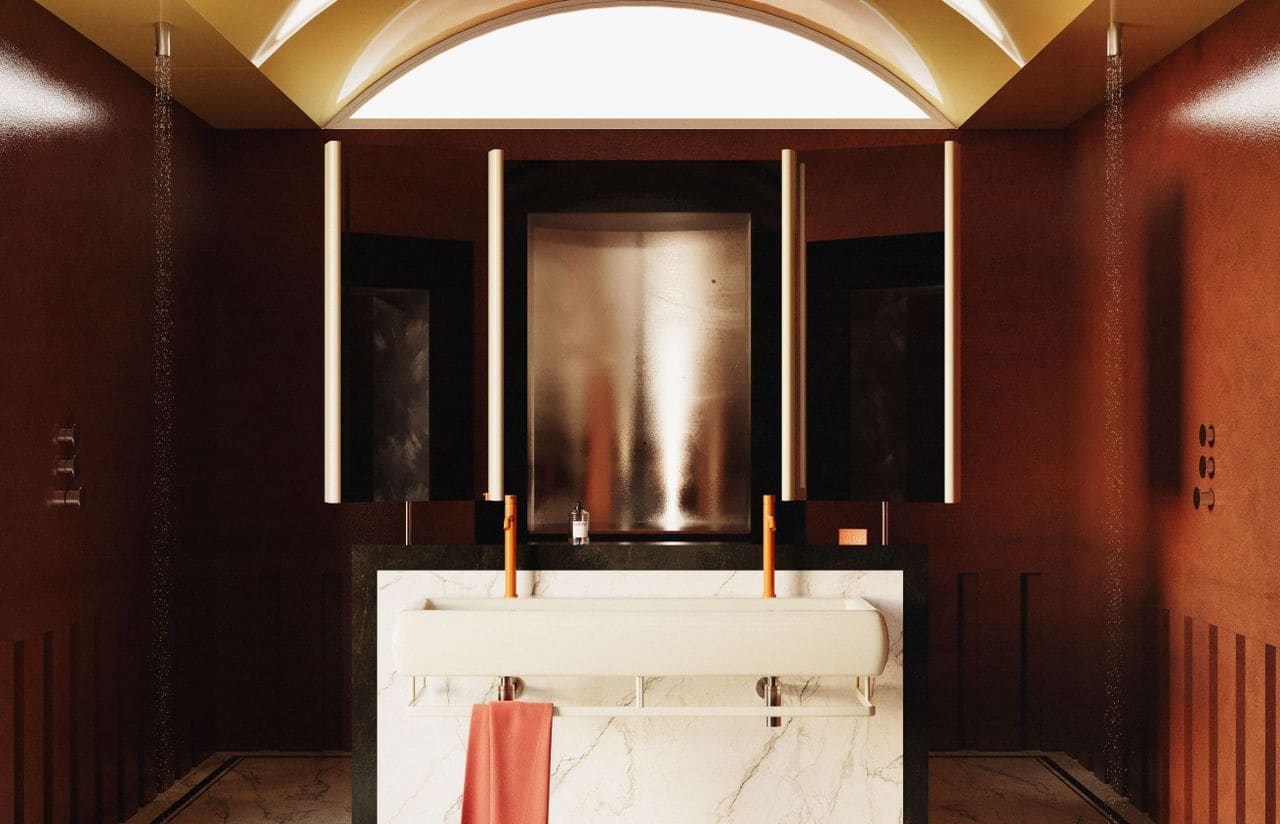
Ceramica Cielo's Teseo washbasin, designed by Andrea Parisio and Giuseppe Pezzano, sits at the room's center, framed by twin mirrors. The arrangement is frontal, almost ecclesiastical. Marazzi's Grande Lume slabs in Magma, a porcelain surface that mimics volcanic stone, clad the walls in a monolithic finish. The color is neither warm nor cool but somewhere in between, a neutral that feels both ancient and contemporary.
This symmetrical planning recalls the work of John Pawson, whose bathrooms for private clients often employ axial rigor to transform functional space into meditative environment. The difference here is one of material: where Pawson favors limestone and travertine, the contemporary palette includes engineered stone and high-performance porcelain.
The use of symmetry is not about formality for its own sake but about creating spatial clarity. In a room defined by repetitive, mundane tasks, the architectural gesture offers a framework for attention. The act of washing becomes, if not sacred, at least deliberate.
Material Intelligence
What unites these four approaches is a shared commitment to material intelligence. The bathroom is no longer a space for leftover finishes or afterthought selections. Instead, it becomes a testing ground for how materials perform under conditions of moisture, heat, and daily use. Brushed steel resists fingerprints. Large-format porcelain minimizes grout lines. Engineered wood-look tile offers warmth without maintenance anxiety.
This is not about luxury for its own sake but about understanding that material choice shapes experience. A cold tile floor changes how you enter the room. A wood-paneled wall changes how light reflects. A symmetrical plan changes how you move through the space. These are not trivial decisions.
At World Archi Design, we've been tracking this shift for several years, and what emerges is a broader pattern: the bathroom is being reclaimed as legitimate architectural territory. The room is small, the program is constrained, but the opportunities for spatial invention are significant. The question is no longer whether the bathroom deserves design attention but what kind of attention it deserves.
Beyond the Spa Aesthetic
One risk in elevating the bathroom is the temptation to mimic hospitality design. The spa aesthetic, with its pebble floors and bamboo accents, has become shorthand for wellness, but it's a limited vocabulary. The strategies outlined here resist that trap, opting instead for architectural rigor over thematic decoration.
The use of steel, saturated tile, walnut paneling, and axial symmetry all signal a different ambition: to treat the bathroom as a room, not a retreat. The space is domestic, not commercial. It is private, not public. And it is designed for daily use, not occasional indulgence.
This distinction matters. The spa borrows from the language of escape, implying that everyday life is something to be temporarily transcended. The bathroom, by contrast, is embedded in the everyday. It is where we begin and end each day, where we confront our own physicality in unguarded moments. To design it well is to acknowledge that the mundane deserves care.
Forward
The bathroom's evolution from functional necessity to designed environment reflects a larger shift in how we value domestic space. As homes become more compact and urban living more dense, every square meter must justify its existence. The bathroom, once the room we tried to make smaller, is now being reconsidered as space worth inhabiting.
This does not mean every bathroom needs walnut paneling or a sunken tub. But it does suggest that the room merits the same level of attention, the same material rigor, the same spatial thought as any other part of the house. The fixtures matter. The finishes matter. The way light enters and how sound behaves and where you place the towel bar all contribute to the experience of the room.
We expect this trend to continue, not because bathrooms are fashionable but because they are essential. The room is too important, too frequently used, to remain an afterthought. What we're witnessing is not a trend but a correction, a long-overdue recognition that the bathroom is, in fact, a room.
Save this story. A free account keeps your reading list and the 07:00 email in one place.
CREATE FREE ACCOUNT →SIGN IN