

Abstract
Robotics is transforming the construction industry by addressing longstanding challenges related to safety, cost overruns, labor shortages, and productivity. This journal explores how robotics is applied across the construction lifecycle - from factory-based prefabrication to dynamic, on-site tasks - examining specific technologies, use cases, lessons learned, and future directions. Through detailed examples, we illustrate how robotic systems such as autonomous bricklayers, mobile construction robots, and collaborative machines are improving efficiency and quality while reshaping workflows and workforce roles.
1. Introduction
Construction is one of the largest economic sectors globally, yet it has historically lagged in productivity growth compared to other industries like manufacturing. Traditional construction processes often involve repetitive manual labor, risk of safety incidents, schedule delays, and material waste. In response, the integration of robotics offers a paradigm shift: automating repetitive tasks, enhancing precision, and extending human capabilities.
This journal examines robotics across two primary domains:
1. Prefabrication - where building elements are manufactured off-site under controlled conditions.
2. On-site Assembly - where robots operate in dynamic, unpredictable environments to assist or autonomously perform construction tasks.
2. Prefabrication: Robotics in Controlled Production Environments
Robotic prefabrication brings manufacturing-grade automation into construction, shifting work from unpredictable job sites to optimized factory environments. This shift changes not only productivity but also design logic, supply chains, and workforce roles.
2.1 Multi-Robot Production Lines for Modular Construction
Modern prefab factories resemble automotive assembly plants. Instead of a single robot performing isolated tasks, coordinated robot cells handle sequential stages of construction:
Robotic Cutting and Shaping Cells:
Industrial robotic arms equipped with multi-axis saws and CNC milling heads cut timber, steel studs, and composite panels. These robots read directly from BIM models, translating digital designs into physical components with sub-millimeter accuracy.
Impact: Dimensional accuracy improves fit-up on site, reducing tolerance stacking and rework.
Automated Framing and Nailing Stations:
Gantry robots assemble wall frames using programmed nailing or screwing patterns optimized for structural load paths. Sensors detect misalignment in real time and adjust placement.
Example: In high-volume housing factories, robotic framing lines have doubled throughput while reducing defects such as warped frames and uneven stud spacing.
Integrated MEP Embedding:
Advanced robotic stations embed electrical conduits, plumbing channels, and service openings into wall panels during fabrication.
Result: On-site trades spend less time drilling and cutting structural elements, improving safety and preserving structural integrity.
2.2 Robotic 3D Printing for Complex Geometry and Mass Customization
Robotic additive manufacturing enables geometries that are impractical with conventional formwork:
Topology-optimized Structural Elements:
Algorithms generate lightweight yet strong forms based on load paths. Robotic printers fabricate these shapes directly, reducing concrete volume while maintaining strength.
Lesson: Robotics unlocks design freedom, but only when architects and engineers adopt robot-aware design principles early in the process.
Hybrid Fabrication (Printing + Robotic Finishing):
Printed concrete surfaces are often rough. Secondary robotic arms perform milling, grinding, or surface finishing to meet architectural standards.
Benefit: This hybrid workflow bridges the gap between experimental printing and real-world construction quality expectations.
2.3 Quality Control and Digital Traceability
Robotic prefabrication integrates sensors and machine vision to create a digital audit trail:
In-line Inspection:
Cameras and laser scanners check alignment, fastener placement, and dimensional tolerances in real time.
Component Tracking:
Each panel or module can be tagged and logged with production data (time, machine used, tolerances achieved), enabling traceability throughout the building lifecycle.
Strategic value: This data supports warranty claims, performance evaluation, and future renovation planning.
3. On-site Assembly: Robotics in Unstructured Environments
Unlike factories, construction sites are constantly changing. Robots deployed here must adapt to uneven terrain, unpredictable obstacles, and coordination with human crews.
3.1 Adaptive Robotics and AI-driven Perception
Modern construction robots rely on AI and sensor fusion:
Vision-guided Assembly:
Robots use cameras and LiDAR to recognize partially completed structures and align components even when site conditions deviate from plans.
Example: Robotic positioning systems adjust panel placement based on actual slab deviations rather than assuming perfect geometry.
Self-correcting Path Planning:
Mobile robots dynamically reroute paths around debris, equipment, and workers.
Impact: This reduces downtime and improves safety in congested job sites.
3.2 Human-robot Collaboration on Site
Rather than replacing workers, robots increasingly function as intelligent tools:
Robotic Assistants for Overhead Work:
Cobots hold tools or materials overhead while workers perform precise fastening.
Outcome: Reduced fatigue and fewer musculoskeletal injuries.
Exoskeletons as Semi-robotic Systems:
Wearable robotic exoskeletons amplify worker strength and endurance, particularly in lifting and repetitive overhead tasks.
Lesson: Wearables represent a “middle ground” between full automation and manual labor, offering faster adoption with less workflow disruption.
3.3 Robotics in Hazardous and Extreme Environments
Robots extend construction capability into environments unsafe for humans:
Demolition Robots:
Compact tracked robots with hydraulic breakers operate in unstable structures where human access is dangerous.
Robotic Welding in Confined Spaces:
Robots perform structural welds in tunnels and tight cavities, ensuring consistency and reducing worker exposure to fumes and heat.
Strategic lesson: Early robotic adoption often succeeds first in dangerous tasks, where safety benefits justify investment.
4. Case Studies
4.1 Large-scale Housing Projects
5North Modular Housing Factory (Edinburgh, Australia)
An advanced robot-powered modular housing factory is being launched by 5North in Adelaide’s Edinburgh precinct. The factory integrates a production line with 14 KUKA industrial robots to fabricate structural wall panels, floors, and ceilings at high speed - reportedly producing enough components for up to six complete houses per day once fully operational by mid-2026. The system drastically shortens traditional build times and reduces heavy manual lifting, shifting labor toward robot supervision and oversight.
Photo Credit: KUKA Group
Hadrian X Robotic Bricklayer (Multiple Sites, Australia & USA)
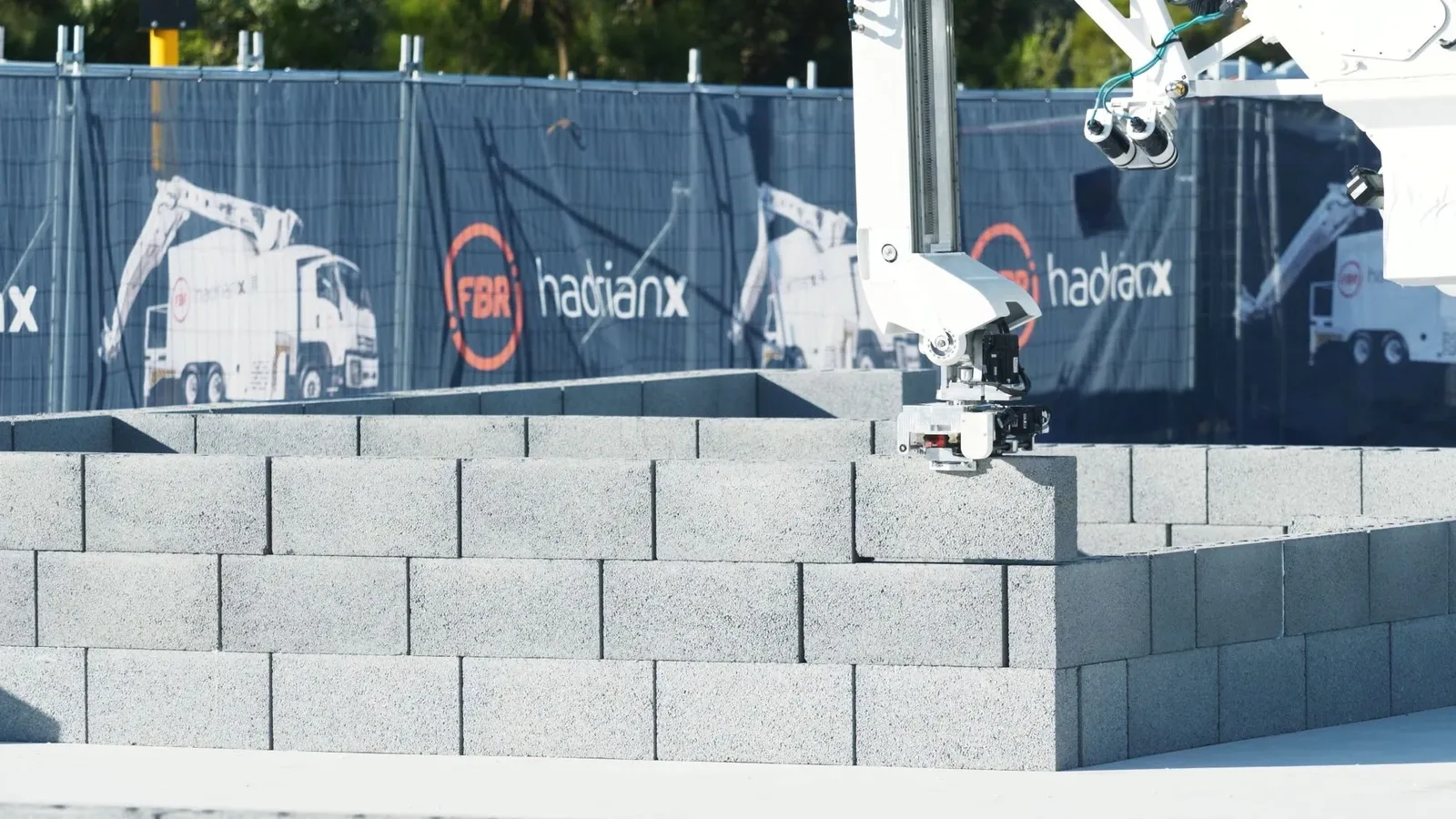
The Hadrian X robot, developed by Fastbrick Robotics, has been tested on real homebuilding sites. In 2025, it was piloted by PulteGroup, a major U.S. homebuilder, in Florida where it constructed a full residential structure in a single day by autonomously laying bricks and blocks based on a digital model. The Hadrian X uses a telescopic boom mounted on a truck and can lay hundreds of bricks per hour, with future rates targeted at 1,000 bricks per hour.

Luyten 3D Printed Home (Melbourne, Australia)
Australian robotics firm Luyten 3D collaborated with the University of New South Wales to construct the “Heptapod” home - the first building-code-compliant 3D-printed house in the Southern Hemisphere. Using a mobile robotic concrete printer, the structure’s walls were printed in approximately two days, then assembled on site in another day, demonstrating major labor and time savings compared to traditional workflows.

4.2 Infrastructure and Heavy Civil Works
Built Robotics Autonomous Earthmoving Equipment (North America)
Companies like Built Robotics retrofit conventional excavators, bulldozers, and trenchers with AI guidance and autonomous navigation systems. These autonomous earthmoving machines have been deployed on earthwork and site preparation tasks in large civil projects, improving efficiency and reducing operator exposure to hazardous conditions.

Drone Mapping and Inspection Programs (Global Projects)
Unmanned aerial vehicles (UAVs) equipped with high-resolution cameras and LiDAR are widely used on major infrastructure jobs, including highway expansions and bridge construction, to generate as-built models, monitor progress, and detect potential structural issues long before traditional surveys would. Multiple real construction firms use DJI drones integrated into BIM workflows for precise, repeatable site documentation.

Robotic Rebar Tying with TyBOT (USA)
On reinforced concrete infrastructure projects, robots like TyBOT automate rebar tying - a traditionally labor-intensive, repetitive task. Field deployments have shown significant reduction in tie-wire consumption, faster installations, and redeployment of skilled labor to higher-value tasks.

4.3 Commercial High-rise and Specialty Construction
Canvas Drywall Finishing Robots (San Francisco International Airport & Urban Projects)
The Canvas drywall robot - an AI-enabled system that scans walls and applies compound to finish drywall surfaces - has been tested on large commercial sites, including the Harvey Milk Terminal at San Francisco International Airport and office buildings adjacent to the Chase Center arena. These robots improve finish quality while reducing worker fatigue from repetitive overhead tasks.

HP SitePrint Robotic Layout (U.S. & Global Projects)
HP’s SitePrint system autonomously prints complex floor layouts directly onto slabs with precision unmatched by manual chalk lines or laser layouts. Field adoption on commercial and industrial projects has reduced layout time and errors, streamlining early-stage construction coordination between trades.

ABB-assisted 3D Printing for Public Buildings (Germany)
In Germany, industrial ABB robotic arms equipped with specialized concrete extrusion heads have been used to 3D print structural walls for public facilities (e.g., a Red Cross headquarters), showcasing how robotic printing moves beyond prototypes into real building applications.

5. Lessons and Strategic Implications
5.1 Integration Requires Process Redesign
Robotics is not a plug-and-play solution. Successful integration often requires:
+ Upfront planning: Digital models must be accurate and robot-ready.
+ Workforce training: Workers need new skills to operate, program, and maintain robots.
5.2 Safety and Standards Are Critical
On dynamic construction sites, safety protocols must adapt to robotic presence:
+ Sensor systems to detect human proximity.
+ Clear operating zones to prevent collisions.
5.3 Data and Digital Twins Amplify Value
Robotics generates large datasets - from site scans to machine telemetry. When integrated with digital twins and BIM (Building Information Modeling), this data:
+ Improves coordination.
+ Enables predictive maintenance.
5.4 Economics Vary by Project Type and Scale
Robotic investment pays off more quickly in:
+ Repetitive tasks
+ Large-scale or long-duration projects
+ Prefab-friendly workflows
Smaller, bespoke projects may see slower ROI initially.
6. Conclusion
Robotics in construction is rapidly evolving from niche experiments to strategic capabilities that improve safety, quality, speed, and sustainability. From factory-based prefabrication lines producing modules with precision to autonomous and collaborative machines reimagining on-site tasks, robotics is reshaping the future of building.
However, maximizing the potential of robotics requires careful integration, digital readiness, and a workforce prepared for technological collaboration. As technologies mature, the boundary between human and robotic labor will continue to shift - not to replace human ingenuity, but to amplify it.
Save this story. A free account keeps your reading list and the 07:00 email in one place.
CREATE FREE ACCOUNT →SIGN IN