
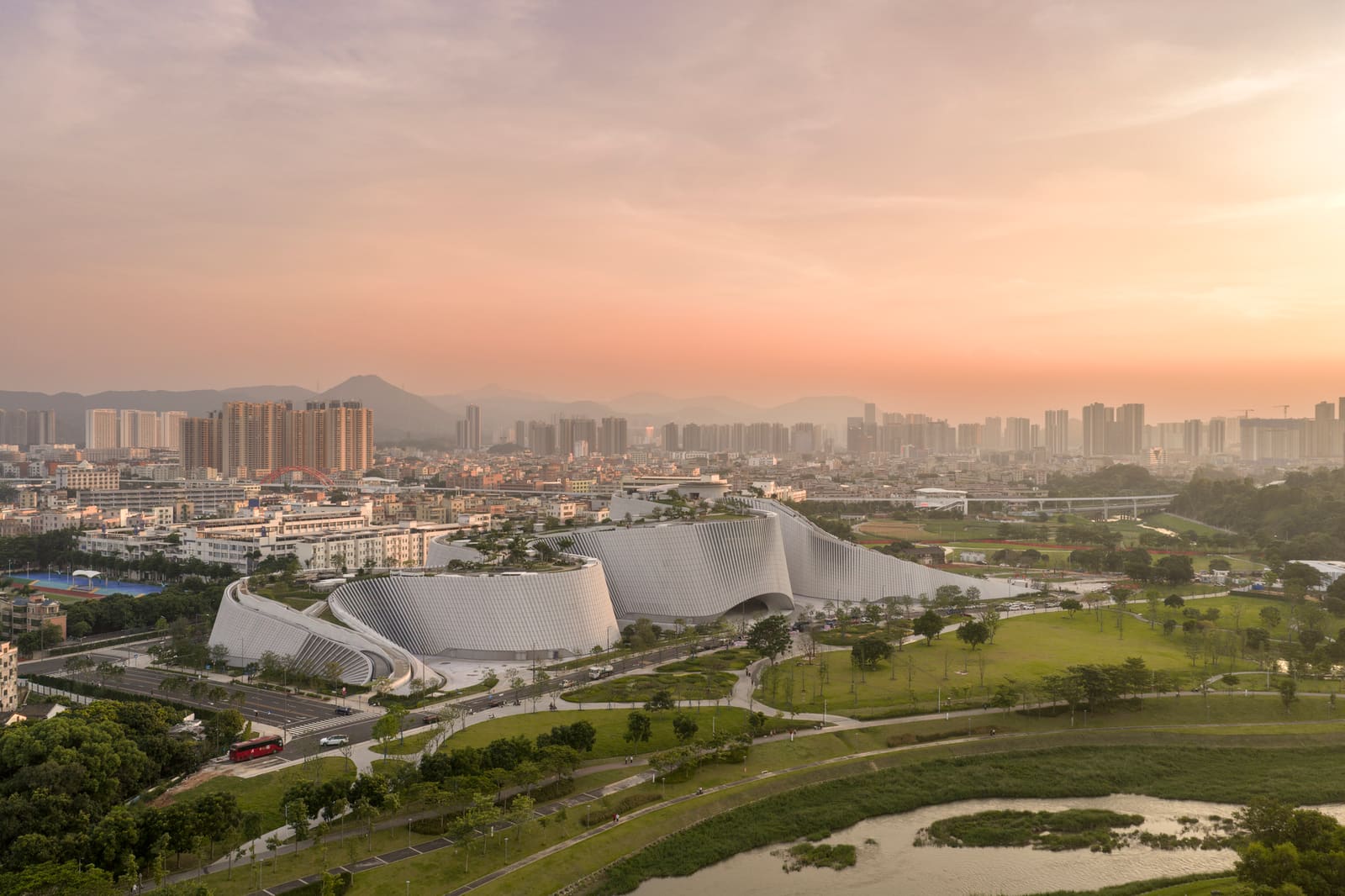
A Question of Scale and Ambition
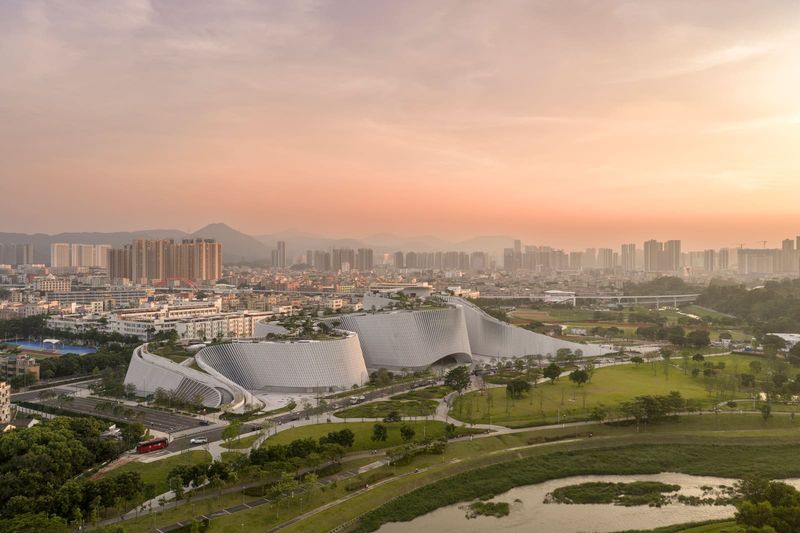
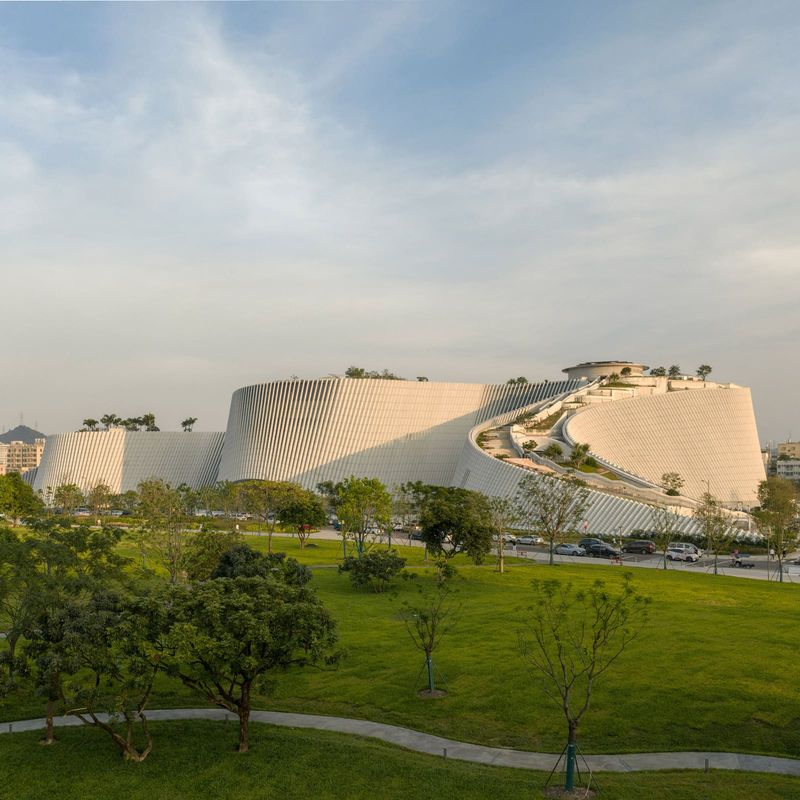
When a city commissions a natural history museum large enough to rival the world's most established institutions, the gesture speaks to more than cultural aspiration. It announces a shift in how knowledge infrastructure is understood within rapidly urbanizing regions. Shenzhen's new natural history museum, delivered in 2022 through a collaboration between 3XN, B+H Architects, and ZHUBO Design, occupies 105,300 square meters and claims the title of South China's largest facility dedicated to natural history. At World Archi Design, we've been tracking how emerging metropolises deploy cultural architecture not merely as repositories but as instruments of regional identity, and this project offers a case study in that phenomenon.
Commissioned by the Shenzhen Government and the Bureau of Public Works, with operations now under the Shenzhen Municipal Bureau of Culture, Radio, Television, Tourism, and Sports, the museum represents a significant public investment in scientific exhibition infrastructure. The building's footprint alone places it among the largest purpose-built natural history museums globally, a fact that raises immediate questions about program, circulation, and the relationship between exhibition density and visitor experience.
Collaborative Authorship and Technical Coordination
The project emerged from a tripartite collaboration that paired 3XN's conceptual design practice with B+H Architects' experience in large-scale institutional work and ZHUBO Design's local engineering expertise. ZHUBO handled both structural engineering and MEP systems, a dual role that suggests a high degree of technical integration from early stages. This kind of partnership, common in China's mega-projects, often results in buildings where envelope performance and spatial logic are tightly coupled, though it can also produce a certain formal conservatism when local regulatory frameworks constrain innovation.
The photography by Adam Mørk, known for his clean, almost clinical documentation of contemporary architecture, hints at a building that privileges clarity of form over ornamental complexity. Mørk's lens tends to favor projects with strong geometric parti and restrained material palettes, which suggests the museum adopts a modernist vocabulary rather than the more expressive, biomorphic strategies we've seen in recent science centers.
Program and the Politics of Public Space
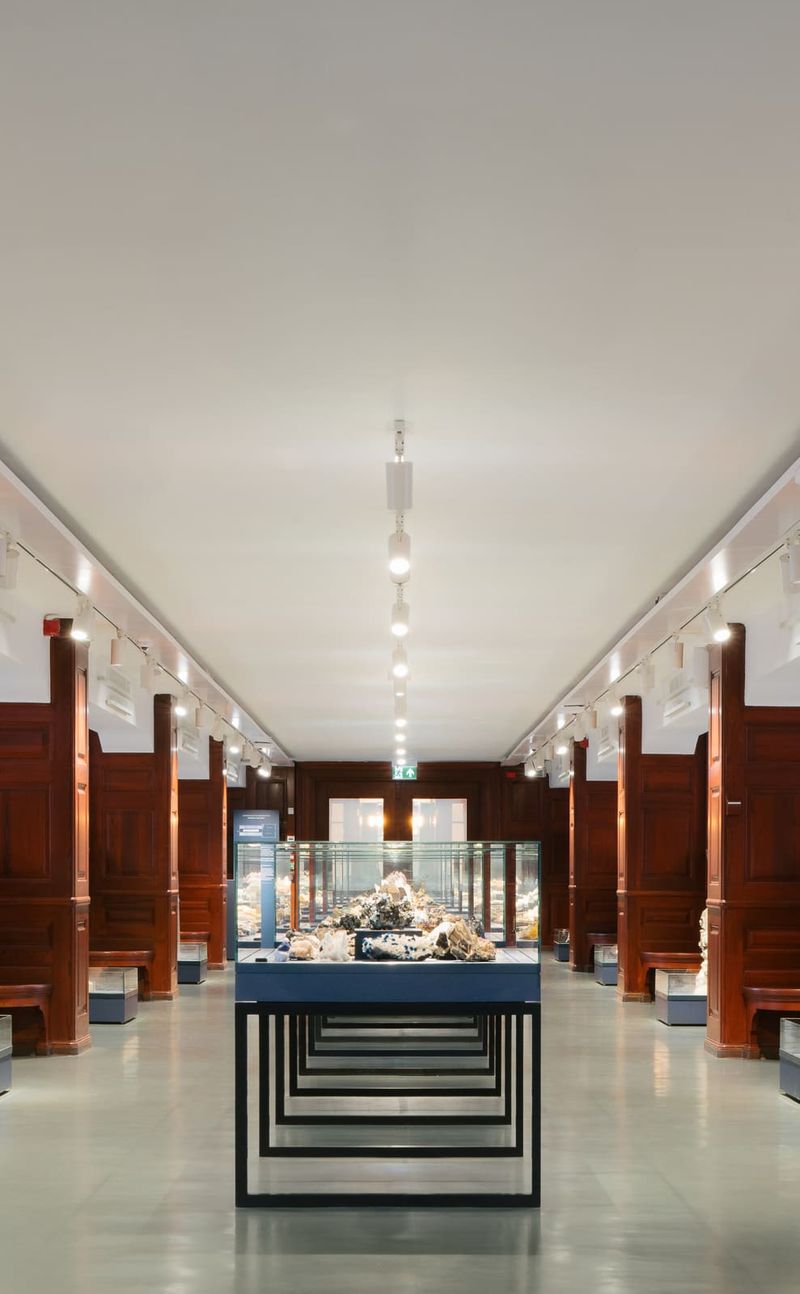
Natural history museums occupy a peculiar position within the typology of cultural institutions. Unlike art museums, which can modulate their spatial character to suit curatorial trends, natural history facilities must accommodate fixed requirements: climate-controlled storage for specimens, large-span galleries for skeletal displays, and robust infrastructure for interactive exhibits. At 105,300 square meters, Shenzhen's museum has the spatial capacity to house extensive collections, but the real challenge lies in choreographing visitor movement through what could easily become an overwhelming sequence of galleries.
The museum's location in Shenzhen, a city that has transformed from a fishing village to a tech hub in less than half a century, adds another layer of meaning. Natural history museums traditionally anchor their narratives in deep time and regional biodiversity. In a city with such a compressed history, the institution must negotiate between global scientific discourse and local ecological context. Does the museum emphasize the Pearl River Delta's unique ecosystems, or does it adopt a more encyclopedic approach? The architecture's role in framing that question is significant.
Material and Tectonic Strategy
Without access to detailed construction documentation, we can infer certain decisions from the project's scale and collaborative structure. A building of this size, delivered within China's accelerated construction timelines, likely employs a concrete frame with prefabricated cladding elements. The involvement of ZHUBO Design in both structural and MEP coordination suggests a rationalized approach to services integration, potentially with exposed ductwork or double-height mechanical zones to minimize floor-to-floor heights while maintaining generous gallery volumes.
The envelope's performance is critical in Shenzhen's humid subtropical climate. High-performance glazing, solar shading devices, and thermal mass strategies would be necessary to manage cooling loads in a building with significant public occupancy. If the design follows the trajectory of other recent Chinese museums, we might expect a hybrid ventilation strategy: natural ventilation in circulation spaces and transitional zones, with tightly controlled environments in exhibition galleries.
Precedents and Regional Context
The museum joins a lineage of large-scale natural history institutions that includes the American Museum of Natural History in New York, London's Natural History Museum, and more recent projects like the Shanghai Natural History Museum by Perkins and Will. The Shanghai precedent, completed in 2015, offers a useful comparison: its spiraling plan and cellular structure broke from the axial, Beaux-Arts layouts of 19th-century museums. If Shenzhen's museum adopts a similarly contemporary spatial strategy, it could signal a broader shift in how these institutions organize knowledge and visitor experience.
Regionally, the project contributes to the Pearl River Delta's cultural infrastructure boom. Guangzhou, Hong Kong, and Shenzhen have all invested heavily in museums, concert halls, and libraries over the past two decades, creating a dense network of cultural nodes within a single megalopolitan region. This concentration raises questions about differentiation: how does each institution carve out a distinct identity when they operate within overlapping catchment areas?
The Institutional Envelope and Public Interface
One of the most consequential design decisions in any museum is how the building meets the ground plane. Does the entrance sequence privilege monumentality or accessibility? Are the public spaces, cafes, and shops positioned to function independently of ticketed exhibition areas, allowing the building to serve as urban infrastructure even outside operating hours? The museum's size suggests the potential for a multi-level lobby or atrium, a common strategy in Chinese cultural buildings that allows for flexible programming and ceremonial events.
The relationship between the museum and its site also warrants consideration. Shenzhen's urban fabric is characterized by superblocks and wide arterials, a car-oriented urbanism that often isolates large institutions from pedestrian life. If the museum is surrounded by landscaped grounds, as is typical, the challenge becomes one of permeability: how do you make a 105,300-square-meter building feel porous rather than fortress-like?
Looking Forward
As natural history museums reckon with their colonial legacies and the urgency of climate science, new institutions like Shenzhen's have the opportunity to rethink both content and form. The building's success will depend not only on its architectural merits but on how effectively it engages contemporary debates about biodiversity, extinction, and the Anthropocene. Architecture alone cannot resolve these questions, but it can create the spatial conditions for more nuanced public engagement with them.
At this scale, the museum is less a singular building than a small city unto itself. Whether it achieves the synthesis of education, spectacle, and urban vitality that defines the best museum architecture remains to be seen. But its ambition, and the regional context it inhabits, make it a project worth watching as it enters its operational life.
Save this story. A free account keeps your reading list and the 07:00 email in one place.
CREATE FREE ACCOUNT →SIGN IN