
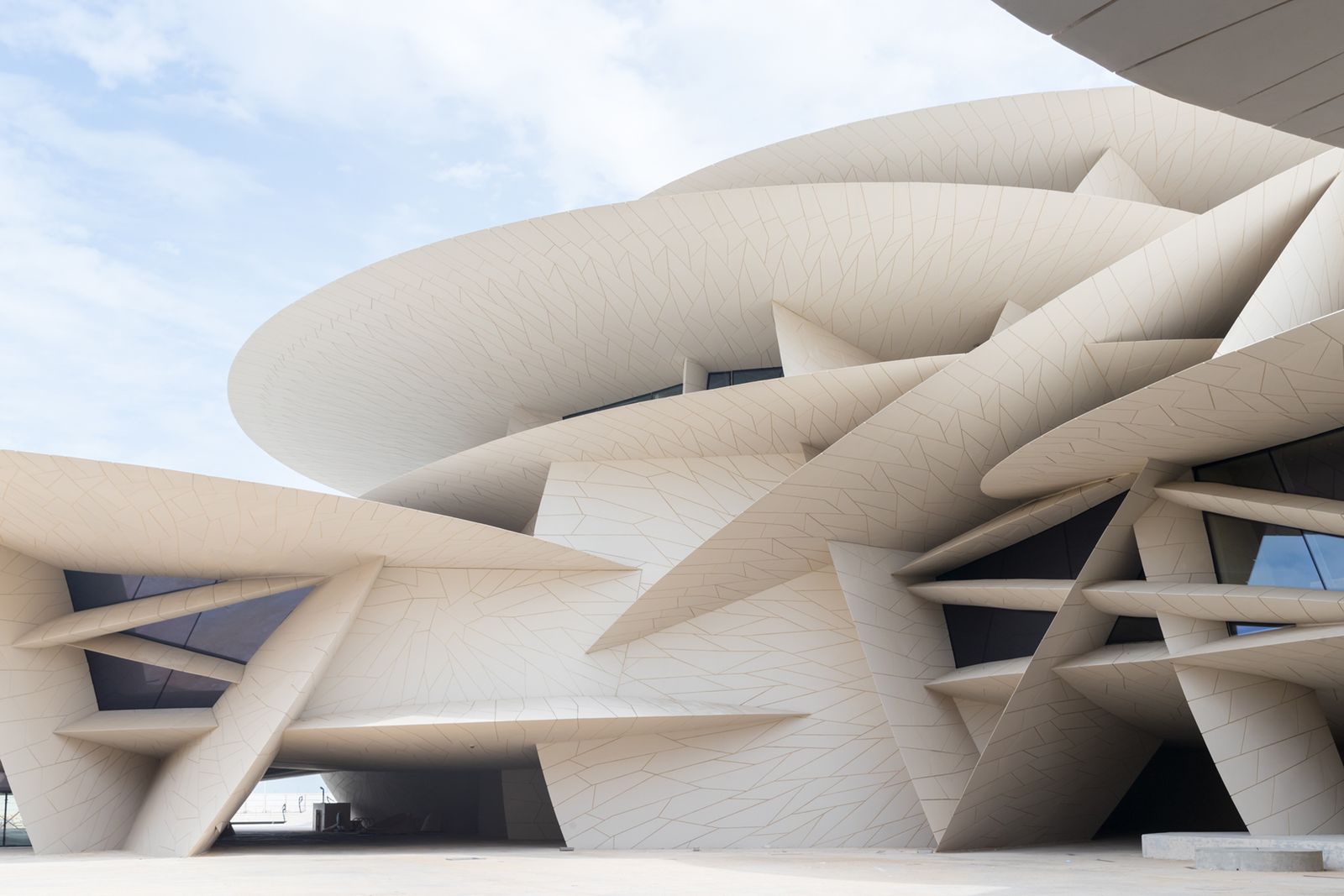
There are buildings that rise as landmarks - and then there are those that reshape the cultural narrative of a nation. The National Museum of Qatar (NMoQ), designed by Ateliers Jean Nouvel, is firmly in the latter category.
Set along Doha’s waterfront, its striking profile of interlocking sand-colored disks looks almost alien, yet it belongs unmistakably to the land. Inspired by the desert rose, a natural crystal formation found beneath the Qatari sand, the museum opened in 2019 as a new home for the country’s history, artifacts, and ambitions.
But beyond its bold silhouette, the museum offers something even more profound: a blueprint for how contemporary architecture can balance innovation, heritage, and environmental responsibility. In a world where cultural projects often tip toward spectacle or function, this building demonstrates that it is possible to have both.

Design That Speaks the Language of Place
Too often, cultural buildings could exist anywhere - global icons without a local soul. The National Museum of Qatar is the opposite.
Jean Nouvel rooted the design in the physical and cultural DNA of Qatar. The interlocking disks echo the delicate, fractal geometry of the desert rose, while the sand-hued exterior blends with Doha’s landscape. Even the historic palace of Sheikh Abdullah bin Jassim Al Thani sits at the heart of the museum, carefully restored and embraced by the new structure like a relic cradled in protective hands.
This is a museum that doesn’t just display history - it embodies it. Visitors move through a narrative, where architecture itself becomes part of the storytelling.

Innovation Is More Than Shape-shifting
The National Museum’s form is radical, even audacious. Its tilted, overlapping disks appear to float, defying gravity and convention. But unlike many avant-garde buildings, this innovation isn’t just visual- it’s deeply functional.
The museum’s spaces rise and fall in a fluid journey, with light and shadow constantly shifting as visitors move from gallery to gallery. The design guides the visitor’s experience, turning a walk through history into a cinematic narrative.
Behind the scenes, advanced engineering and cutting-edge materials like glass fiber reinforced concrete (GFRC) make the impossible possible, supporting vast cantilevers and complex geometries. This is architecture that pushes technical limits, not for its own sake, but to serve storytelling and human experience.

Honor the Past While Building the Future
In many cities, historic structures are sacrificed to make way for the new. Doha chose a different path.
At the museum’s core, the old royal palace has been preserved and integrated into the modern design. Visitors move through cutting-edge galleries before arriving at this restored building, which stands as both destination and origin point.
It’s a powerful reminder that modernity doesn’t have to erase tradition. Instead, the past can be the foundation upon which new cultural identities are built.

Let the Climate Shape the Architecture
The Qatari desert is harsh. Summer temperatures soar, and sun exposure is relentless. Rather than treat this as an obstacle, Jean Nouvel used it as a design driver.
The disks aren’t just aesthetic gestures - they act as deep overhangs, shading walls and pathways while framing courtyards and gardens. Glazing is strategically recessed to reduce heat gain, and local desert plants require minimal water, creating a landscape that is as sustainable as it is symbolic.
The result? A museum that is climate-responsive by design, reducing reliance on mechanical cooling systems and earning LEED Gold certification.
A Museum as a National Statement
Finally, the National Museum of Qatar demonstrates that architecture can be more than a building - it can be a national symbol.
For Qatar, this museum is a declaration of identity, a statement to the world that says: we are proud of our past, ambitious for our future, and mindful of our environment. It is both a gift to citizens and an invitation to global visitors, cementing Doha’s role as a cultural hub on the world stage.

The Legacy of the Desert Rose
The National Museum of Qatar isn’t just a feat of design and engineering. It’s a case study in how architecture can create meaning. It proves that the buildings we construct today can tell stories, preserve history, and respond to urgent environmental realities - all while pushing the boundaries of innovation.
As cities around the world rush to build museums, cultural centers, and public landmarks, this desert rose offers a clear lesson: great architecture doesn’t just rise from the sand - it grows from the soul of its place.
And in Doha, that soul has never shone brighter.
Save this story. A free account keeps your reading list and the 07:00 email in one place.
CREATE FREE ACCOUNT →SIGN IN