
From Postcards to Monumental Prints
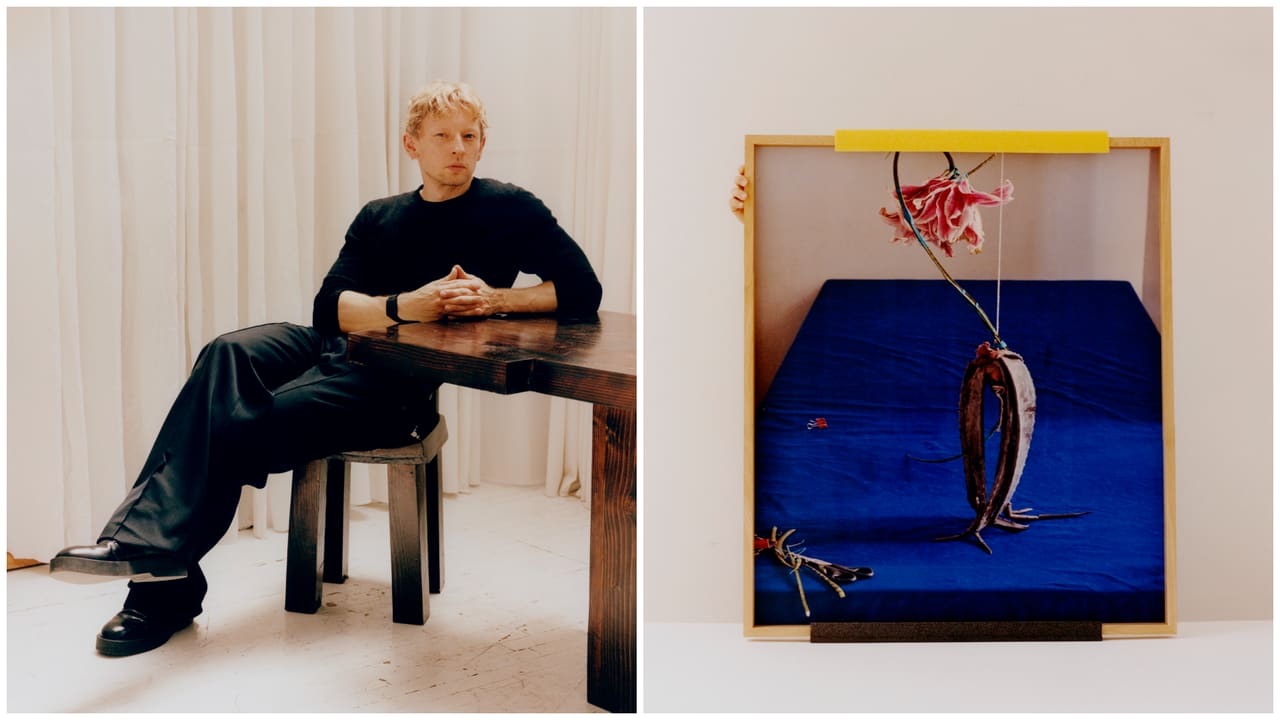
There is a particular kind of alchemy in making nothing into something, in stretching a dried stem and a rubber band into an image that commands wall space the way sculpture does. Dominik Tarabański has been pursuing that transformation since 2018, when what began as improvised floral postcards sent home to his mother evolved into a body of work now exhibited in contexts far removed from the intimacy of their origin. His photographs, many exceeding two metres in height, deploy the visual language of Dutch still life painting while operating firmly within the territory of contemporary material practice.
Tarabański was born in 1982 in Radymno, a small town in southeastern Poland near the Ukrainian border, and studied photography in Łódź and Warsaw before relocating to New York in 2012. The move, he has said, felt as extreme as leaving for the moon; a three-week reconnaissance trip was enough to decide. Fashion photography funded the transition and kept him moving between New York, Paris and London, but the still lifes he constructed by hand, away from crowded commercial sets, form the core of his practice.
The Intersection of Synthetic and Organic
What Tarabański describes as the foundation of his work is a deliberate collision between the synthetic and the organic. He bends, pins, tapes and suspends botanical matter into configurations that defy the logic of natural growth, then photographs them at the precise moment before structural failure. The resulting images recall the impossible bouquets of seventeenth-century Dutch flower painting, in which blooms from different seasons appear together in a single vase, but Tarabański's interventions are more explicitly violent. His subjects are not arranged; they are contorted, held under visible tension by rubber bands, tape and wire.
The aesthetic is one of controlled precariousness. Knotweed, orchid and lily are pinned into geometries that test their physical limits, and the photograph captures the instant before collapse. The scale of the finished prints amplifies this tension. At over two metres tall, they occupy the wall with sculptural presence, demanding sustained attention in a way that smaller works do not. The viewer is made acutely aware of the fragility encoded in the image, the sense that the arrangement existed only briefly and could not have been held much longer.
Material Economy and Cultural Disposition
Tarabański is cautious about attributing too much of his practice to his Polish origins, wary of the clichés such narratives invite. But he acknowledges a disposition shaped by place and upbringing. He traces his optimism and sensitivity to his mother, the same figure who received those early floral postcards. He also identifies what he calls a "very Polish" economy of means, an efficiency born from a culture accustomed to making do with limited resources. This ethic manifests in his work as a privately held discipline, the kind that operates when no one is watching, and in his insistence on maintaining fluency in contemporary Polish despite years abroad.
Since arriving in New York, Tarabański has taken up compulsive hiking, seeking out trails wherever he travels. The wildness threaded through his botanical work, the organic material pushed to extremes, functions as a counterbalance to the pressure and hard surfaces of urban life. He speaks of pursuing delicacy as a deliberate response to a world he perceives as increasingly harsh, a choice to work in petals and stems rather than concrete.
Between Stems and the Architecture of Pressure
Tarabański's most recent series, Between Stems, makes pressure its explicit subject. The work was shown earlier this year at FOG Design+Art in San Francisco, presented by LA gallery Marta alongside pieces by Minjae Kim. Here, the tension in the images is no longer subtext but the central formal inquiry. How much weight can a stem bear before it gives? At what point does botanical matter shift from resilient to fractured? The photographs document that threshold, the moment when structure yields to load.
A solo exhibition is planned for autumn 2026 in New York, also with Marta, and will draw on Little Roses, a parallel series that ranges in scale from hand-sized pieces to works taller than the artist himself. The variation in size suggests a flexibility in approach, a willingness to let the material dictate the format rather than imposing a consistent scale across the body of work.
The Precedent of Dutch Still Life
The formal debt to Dutch flower painting is impossible to ignore, but it is worth noting what Tarabański retains from that tradition and what he discards. The Old Masters assembled their bouquets from sketches and studies made at different times of year, constructing impossible arrangements through patient observation and technical skill. The final paintings were as much about time as they were about flowers, collapsing seasons into a single frame and encoding mortality through the inclusion of wilting petals and decaying leaves.
Tarabański's method is more direct. He works with physical matter in real time, forcing it into positions it cannot hold indefinitely, then captures the result before it falls apart. The photograph becomes a document of a fleeting event rather than a composite built from memory. The tension is literal, visible in the tautness of rubber bands and the bend of stems. Where the Dutch painters encoded vanitas symbolism through subtle visual cues, Tarabański makes precariousness the explicit subject.
The Residency at Bergdorf Goodman
The Roses for Mother series, which initiated Tarabański's exploration of botanical still life, is currently on view at Bergdorf Goodman as part of Gabriella Khalil's design residency, running through the end of August 2026. The retail context is unconventional for fine art photography, but not without precedent. Department stores have long served as sites for design intervention, and the high-ceilinged, well-lit spaces can accommodate large-scale work in ways that smaller galleries cannot.
The inclusion in a design residency rather than a traditional photography exhibition underscores the interdisciplinary nature of Tarabański's practice. His work operates at the boundary between photography, sculpture and installation, and resists easy categorization. The prints function as images but also as objects, their scale and materiality as important as the compositions they depict.
What Holds and What Gives
At World Archi Design, we have long tracked the ways in which material limits inform creative practice. Tarabański's work offers a particularly clear articulation of that relationship. By pushing botanical matter to the edge of structural failure, he makes visible the forces that typically remain invisible: the tension held within a stem, the load distributed across a petal, the point at which organic architecture collapses under its own weight.
The photographs are not scientific documents, but they share with scientific imaging a commitment to revealing what the unaided eye might miss. They ask us to look more carefully at the mechanics of fragility, to recognize that beauty and precariousness are not opposites but conditions that frequently coexist. In an era when much of our built environment is engineered to conceal its structural logic, there is something clarifying about work that makes tension legible, that shows us exactly where the breaking point lies.
Photo: Jingyu Lin
Save this story. A free account keeps your reading list and the 07:00 email in one place.
CREATE FREE ACCOUNT →SIGN IN