
A Geography That Shapes Making
There is a reason why certain landscapes attract makers. The quality of light, the proximity to raw materials, the social distance from commercial centres - all of these factors can recalibrate how an artist sees and works. Deià, a hilltop settlement on Mallorca's western flank, has been one such place since the early twentieth century. Perched within the Serra de Tramuntana range, the town occupies a dramatic threshold: steep ridges on one side, the Mediterranean on the other, and between them a cascade of sand-coloured stone houses that climb toward a medieval church.
The drive from Palma traces this shift in terrain. Flat almond groves give way to switchbacks that wind through intensely green slopes. Eventually, the sea appears at the base of a cliff, stretched across the horizon like a length of silk. By evening, the surrounding peaks glow in gradients of pink and ochre - a chromatic sequence that has informed generations of painters, writers, and now, contemporary craft practitioners.
At World Archi Design, we've been tracking how historic artist enclaves are being re-activated not as museums of bohemian nostalgia, but as working sites for disciplines that blur the line between art, design, and material research. The new residency programme at La Residencia - a collaboration with the Loewe Foundation Craft Prize - offers a model worth examining.
From Medieval Fortress to Modernist Refuge
Deià's topography was originally strategic. Founded during the Moorish period, its elevated position provided sightlines across the coastline, offering protection from piracy and invasion. By the nineteenth century, European aristocrats discovered the town's mild microclimate and clean mountain air, using it as a site for convalescence. The Polish composer Frédéric Chopin spent months in nearby Valldemossa recovering from tuberculosis, a detail that anchored the island's reputation as a place of recuperation and reflection.
The town's transformation into an artistic hub began in earnest in the 1930s when British poet and novelist Robert Graves settled there. His presence drew a constellation of creative figures - Anaïs Nin, Pablo Picasso, and others - who found in Deià's isolation a productive remove from the pressures of metropolitan cultural circuits. The pattern persisted through the postwar decades, with artists and writers treating the town as both subject and studio.
What distinguishes the current residency initiative is its focus on craft - a category that has historically occupied an ambiguous position within the art world, often marginalised in favour of painting and sculpture. The Loewe Foundation Craft Prize, established to elevate contemporary making practices, selects finalists working in diverse media: metal, glass, ceramic, textile, wood. The residency at La Residencia extends that mission by providing time, space, and context for experimentation.
Kaori Juzu and the Alchemy of Enamel
The inaugural resident, Kaori Juzu, is a Fukuoka-born artist and jewellery designer whose work was shortlisted for the prize in 2023. Her practice centres on bent copper and powdered enamel, materials she manipulates through a process of fusion and repeated firing. The enamel - powdered glass - is sifted over shaped metal surfaces and subjected to heat multiple times, building depth and chromatic complexity with each pass through the kiln.
Her submission to the Loewe Foundation consisted of 108 miniature compositions arranged in a grid on a white canvas. Each element measured roughly the diameter of a coin, yet contained a distinct formal language: colour-saturated planes that recall the graphic exuberance of the Memphis Group, rendered in metal rather than laminate. The number 108 carries significance in Japanese Buddhism; temple bells are rung that many times on New Year's Eve to mark the passage of time and the purification of desires.
During her two-month stay in Mallorca, Juzu shifted her palette. The vivid primaries and pastels of her earlier work gave way to earthier tones - olive greens, the nacre of oyster shells, the muted ochres of sun-baked clay. She attributes this shift, in part, to the landscape. Each morning, before the hotel's gardeners arrive to clear the terraced olive groves, she collects fallen leaves and wilted blooms. These she arranges on the flagstone floor of her studio, creating two-dimensional compositions that function as chromatic studies for subsequent metal pieces.
This method - drawing colour and form directly from the immediate environment - echoes older traditions of site-responsive making, from Japanese ikebana to the botanical studies of early modernist textile designers. What makes Juzu's approach contemporary is her willingness to treat these arrangements as provisional, ephemeral sketches rather than finished works. The studio becomes a laboratory for testing relationships between organic form and industrial material.
The Architecture of Creative Retreat
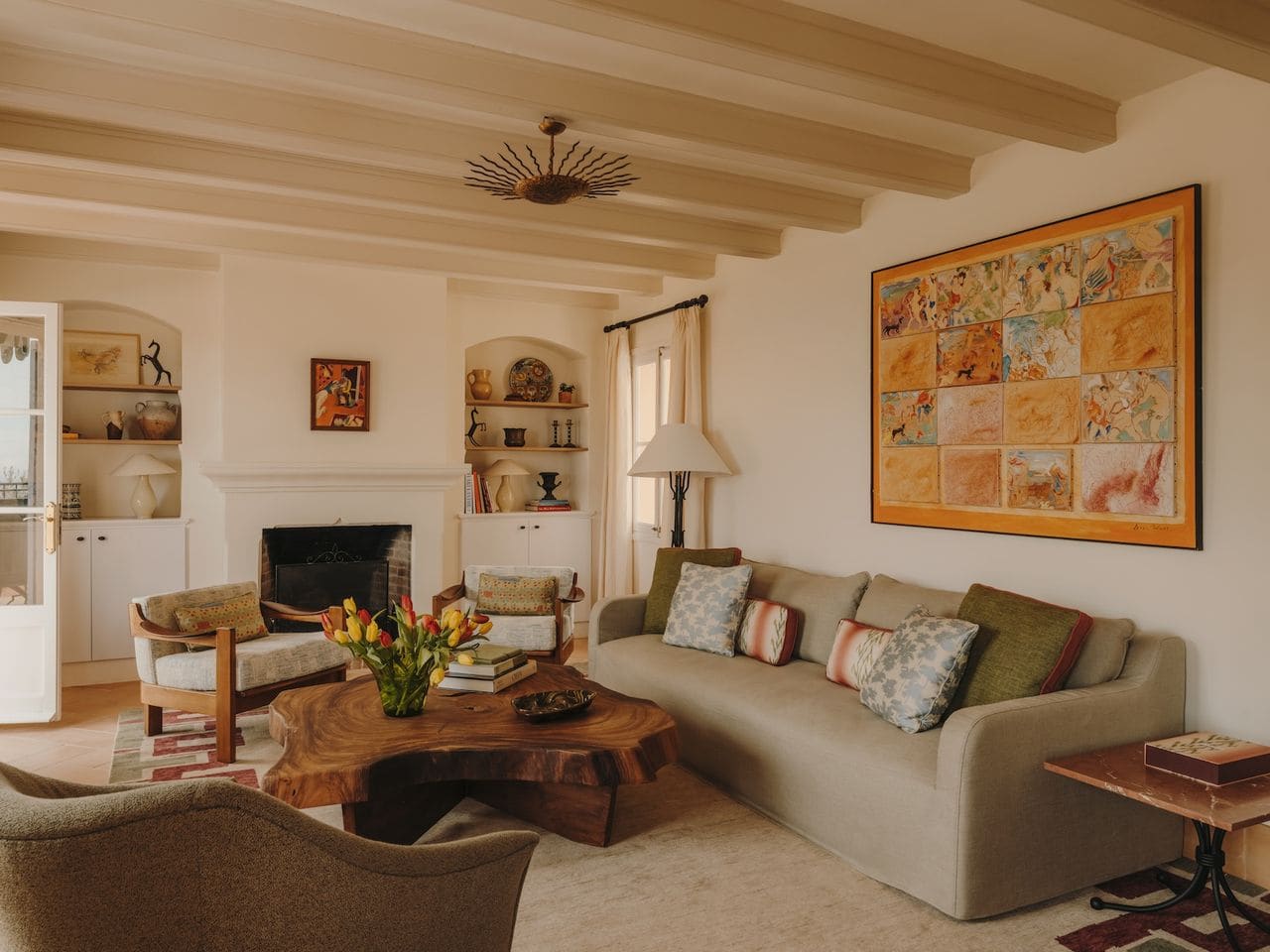
La Residencia itself is a study in adaptive reuse. The property comprises two sixteenth-century manor houses, linked by terraced gardens that step down the hillside. The interiors blend exposed stone walls, terracotta floors, and beamed ceilings - vernacular elements that anchor the hotel within Deià's architectural language - with a curated collection of contemporary art. The Miró restaurant, named for the Catalan painter and sculptor, houses a significant body of his work, turning the dining room into an informal gallery.
The artist's studio, located within the hotel grounds, offers a different kind of space. High ceilings, ample natural light, and direct access to the gardens create conditions that favour sustained concentration without claustrophobia. This balance - between immersion and openness - is critical for residency programmes. Too much isolation can stifle; too much distraction can fragment. The studio at La Residencia manages to provide both solitude and permeability, allowing residents to engage with the landscape and the hotel's cultural programming without obligation.
The decision to house the residency within a luxury hotel, rather than a dedicated artist colony, is unconventional. It raises questions about access, audience, and the commodification of creative labour. Yet it also offers practical advantages: robust infrastructure, curatorial support, and the potential for unexpected encounters with guests and visiting artists. The model suggests that residencies need not conform to a single typology - monastic retreat, academic fellowship, or institutional incubator - but can instead adapt to hybrid contexts.
Material Continuity and the Loewe Foundation's Expanding Network
Following Juzu's residency, La Residencia will host Deirdre McLoughlin, a ceramic artist, and Dahye Jeong, who works in textiles. Both were finalists in previous editions of the Loewe Foundation Craft Prize. This rotation ensures continuity while also allowing for material diversity. Ceramic practice, with its reliance on local clay bodies and firing temperatures, will engage differently with Mallorca's resources than textile work, which might draw on the island's historic linen and cotton trades.
The residency is part of a broader initiative by La Residencia to position itself as a node within contemporary art networks. From 2023 to 2024, the hotel partnered with Galleria Continua, hosting a series of artists including Daniel Buren and Arcangelo Sassolino as part of the gallery's MITICO programme. Emerging practitioners such as Liang Fu and Berta De La Rosa also participated, creating site-specific interventions across the property.
These partnerships reflect a shift in how hospitality brands engage with culture - not as passive patrons or corporate sponsors, but as active collaborators in the production and circulation of work. The risk, of course, is that such arrangements become exercises in brand-building rather than genuine artistic support. The test will be whether the residency produces work that circulates beyond the hotel's walls, entering exhibitions, collections, and critical discourse on its own terms.
Precedents and Parallels in Mediterranean Craft Residencies
Deià is not the only Mediterranean site to leverage its geographic and cultural capital in service of contemporary craft. The ceramics centre at La Borne in central France, while not coastal, has operated for decades as a hub for potters working in salt-glazed stoneware. The Penland School of Craft in North Carolina, though an ocean away, shares a similar ethos: immersive making in a landscape that informs material choices.
Closer to Mallorca, the island of Hydra in Greece has long attracted artists, and in recent years has seen a proliferation of residencies focused on sculpture and installation. What distinguishes the La Residencia programme is its institutional backing - both Belmond's hospitality infrastructure and the Loewe Foundation's curatorial apparatus - combined with a focus on craft rather than fine art. This specificity matters. Craft practices often require specialised tools, materials, and technical knowledge that are difficult to transport or replicate. A residency that can provide kilns, metalworking equipment, or weaving looms becomes not just a retreat but a resource.
What the Programme Signals About Craft's Institutional Future
The partnership between La Residencia and the Loewe Foundation Craft Prize is emblematic of a broader shift in how craft is being institutionalised. For much of the twentieth century, craft occupied a marginal position within the art world - celebrated in guild circles and design museums, but rarely afforded the same critical or commercial attention as painting and sculpture. That has begun to change. Auction houses now feature dedicated craft sales. Biennales include ceramicists, glassblowers, and textile artists alongside video and installation practitioners. And brands, particularly those with roots in material culture - fashion houses, furniture makers, luxury hospitality - are investing in craft programming.
This shift raises important questions. Does institutional support elevate craft, or does it risk diluting its distinct identity? Can a residency funded by a luxury brand maintain critical independence? And what happens when the economic structures that support craft - small-scale production, regional material sources, traditional apprenticeships - are replaced by global networks and elite patronage?
We don't yet have definitive answers, but the Deià residency offers one possible path forward: a model that honours craft's historical rootedness in place while also connecting practitioners to international circuits of exhibition and discourse. The success of the programme will depend not on the prestige of its participants, but on whether it produces work that challenges, rather than merely decorates, the spaces it inhabits.
Looking Forward: The Next Cohort and the Question of Legacy
As McLoughlin and Jeong prepare for their residencies, the question of legacy looms. Will this programme endure beyond its initial cohort? Will it expand to include other disciplines - woodworking, glassblowing, basketry - or remain focused on the categories represented in the Loewe Foundation Craft Prize? And perhaps most importantly, will the work produced in Deià find audiences beyond the hotel's guests and the foundation's network?
The answers will depend, in part, on how the programme evolves. Residencies are not static; they require ongoing adjustment, feedback, and reinvestment. The best ones create conditions for risk-taking and failure, not just polished outcomes. They foster dialogue between residents, past and present, and build networks that outlast individual stays.
For now, the residency at La Residencia represents a promising experiment: a contemporary iteration of Deià's century-long tradition as a refuge for makers, adapted for an era in which craft is increasingly recognised not as a minor art, but as a vital mode of thinking through materials, processes, and the possibilities of the handmade in an industrialised world. Whether that experiment succeeds will depend on the work that emerges - and whether it can hold its own, not just in the warm coastal light of Mallorca, but in the harsher glare of the wider art world.
Save this story. A free account keeps your reading list and the 07:00 email in one place.
CREATE FREE ACCOUNT →SIGN IN