
The Collision Point
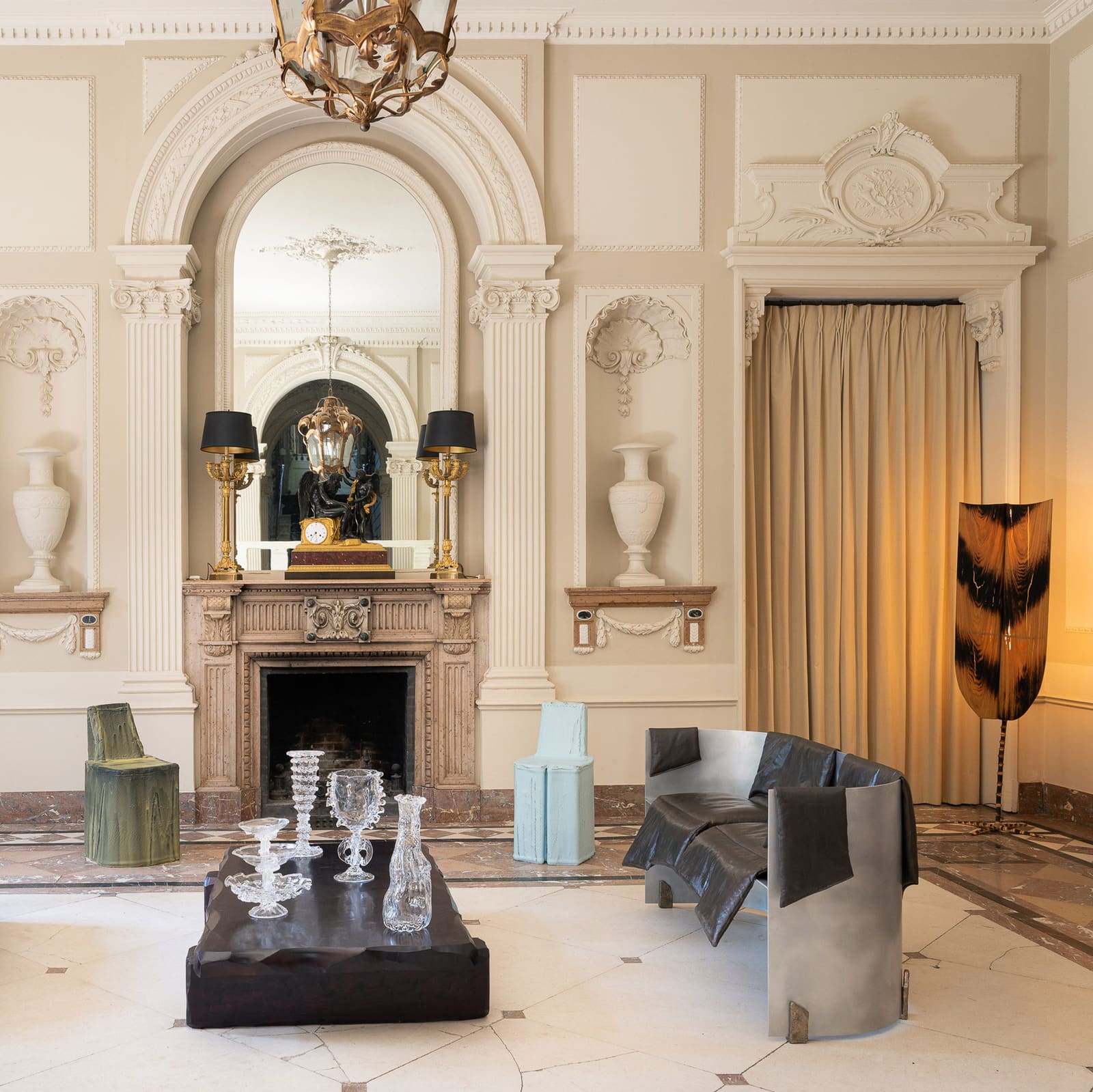
There is a moment, walking through certain European villas, when you realize the rooms themselves are arguing with you. Not the people inside them, but the architecture: the cornicing insists on one century, the furniture on another, and your eye ricochets between them, unable to settle. At Chateau de Spycker, a neo-gothic villa outside Bruges, Antwerp-based gallery Uppercut has leaned into that dissonance, installing six contemporary designers across three stately rooms where every surface already has an opinion.
The approach is deliberate. Director Scott Lippens describes the thinking behind this year's summer show, titled God Speed, as inspired by the layered interiors of Fondazione Dries Van Noten in Venice. Rather than clear the stage, Uppercut left the antiques in place: gilded chairs, marble fireplaces, figurative sculpture. The contemporary works, many of them aggressively material-focused, now share the floor. The result is not harmony but productive tension, the kind that forces you to look twice at both eras.
This marks the fourth annual summer exhibition Uppercut has mounted at the 19th-century chateau, which Lippens' family acquired nearly two decades ago and converted into a guesthouse. Previous editions confined themselves to a single room. This year the show expands through the entry hall, dining room, and drawing room, a spatial ambition that reflects the gallery's own trajectory from a fifth-floor Antwerp apartment to a dedicated space opening nearby.
Material as Method
Uppercut's roster tilts heavily toward designers who treat process as subject. Danish designer Alexander Kirkeby contributes elaborate glass vessels, their surfaces worked into textures that catch light unevenly. French designer Nicolas Zanoni presents furniture made from melted polystyrene, a material choice that foregrounds transformation: industrial waste recast as sculptural seating. In the drawing room, dominated by green walls and patterned textiles, Zanoni's multitextural pieces sit on antique rugs, their rough surfaces a deliberate counterpoint to the room's original softness.
Belgian designer Linde Freya Tangelder, whose studio Destroyers/Builders has built a practice around folding and reforming metal, shows a reworked aluminium bench alongside a coffee table that serves as a plinth for Kirkeby's glassware. South Korean designer Yoon Shun contributes lighting and furniture that demonstrate his signature techniques: handcarving and charring oak until the wood takes on a blackened, almost geological quality. The charring is not decorative; it alters the material's behavior, its porosity and finish.
New York-based Greek designer Kiki Goti offers hand-blown glass vases, displayed on a marble-topped console table where their irregular forms contrast with the symmetry of the architecture. British designer Joel Muggleton, working under the studio name LS Gomma, presents Drunken Vessels: sculptural forms made from metal mesh and PU rubber, installed in the dining room alongside antique figurative sculpture. The pairing is instructive. The vessels sag and lean, their mesh skins barely containing the rubber within. The antique sculptures, by contrast, are all control and poise. Neither cancels the other out; instead, they clarify each other's commitments.
Scenography as Curation
Lippens describes his curatorial process as intuitive but increasingly disciplined. The install for God Speed, he notes, was worked out in under four hours, a speed that suggests both confidence and a clear internal logic. The gallery's background is unconventional: Lippens studied fashion design before pivoting into collectible design through a side venture buying and selling mid-century furniture. That fashion training, he suggests, informs his material focus. Texture, drape, finish: these are the terms through which he evaluates work.
The chateau itself is an unlikely venue for a gallery founded in 2023, but its history as a summer residence for an aristocratic family lends it a certain spatial generosity. Lippens' mother, fashion buyer Caroline Grootaert, oversaw the renovation that converted it into a guesthouse, preserving much of the original detailing. The decorative wall mouldings, the gilded furniture, the marble fireplaces: all remain, and all now function as a kind of secondary exhibition, one that predates Uppercut by more than a century.
The question the show raises is not whether contemporary design belongs in such spaces, but what happens when you refuse to sanitize the context. Many galleries that stage shows in historic interiors opt for minimalism, clearing away period details to create a neutral backdrop. Uppercut does the opposite, allowing the ornate to remain ornate. The effect is less about reverence than about testing the work. Can Zanoni's melted polystyrene hold its own against green silk walls? Can LS Gomma's rubber vessels coexist with antique bronze? The answer, in most cases, is yes, but the adjacency forces both parties to justify themselves.
Expanding Ambitions
Uppercut's growth mirrors a broader shift in the collectible design market, where young galleries increasingly operate across multiple venues and formats. The gallery has presented work at Matter and Shape in Paris and at Collectible fairs in New York and Brussels, building visibility outside its Antwerp base. The decision to open a dedicated gallery space nearby suggests a move toward permanence, even as the summer shows at Chateau de Spycker continue as annual events.
The chateau exhibitions serve a different function than a conventional gallery show. They are time-limited, site-specific, and freighted with the expectations that come with historic interiors. Visitors arrive with certain assumptions about what belongs in such spaces, and Uppercut's task is to unsettle those assumptions without resorting to shock tactics. The work must be strong enough to command attention in rooms that are already visually saturated.
At World Archi Design, we have tracked the rise of venue-specific exhibitions that use architecture as active collaborator rather than passive container. The trend is particularly pronounced in Europe, where access to historic buildings offers designers a chance to test their work against centuries of accumulated style. The risk is that the architecture overwhelms the design, reducing contemporary work to mere accent. Uppercut avoids that trap by selecting pieces with enough material presence to hold their ground.
The Argument for Clash
The show's title, God Speed, suggests motion, departure, a blessing offered to travelers. It is an odd fit for an exhibition of largely static objects, but perhaps the speed in question is conceptual: the rapid shift in context that occurs when you place a charred oak lamp next to a gilded mirror, or a metal mesh vessel on a dining table set for an aristocratic meal that will never be served.
There is a case to be made that the best contemporary design does not need the validation of historic interiors, that it should stand on its own terms in purpose-built spaces. But there is also a case for the kind of confrontation Uppercut stages, where the past is not backdrop but participant. The decorative mouldings, the marble, the antique sculpture: these are not neutral. They carry associations, expectations, class markers. Placing Zanoni's melted polystyrene beside them is not an act of integration but of juxtaposition, and the friction that results clarifies what each era values.
The exhibition runs through late August, after which the chateau will return to its function as a guesthouse and the contemporary works will disperse. The pairing is temporary, but the question it raises lingers: what do we gain by seeing new work in old rooms, and what do we lose by keeping them apart?
Save this story. A free account keeps your reading list and the 07:00 email in one place.
CREATE FREE ACCOUNT →SIGN IN