
The Geography of Memory
There's a particular quality to summer light on barrier islands. It refracts differently through salt air, casting everything in a haze that feels at once sharp and dreamlike. For those who've spent time on the Venetian Lido, that atmospheric memory lingers long after the ferry ride back to the city. It's this phenomenon, not the place itself, that anchors a current Manhattan exhibition pairing Galerie56 with Milan's Nilufar gallery. Running through mid-October, the presentation uses design objects as architectural notation, sketching the contours of a hotel that exists only in collective imagination.
The premise might sound precious, but the execution avoids easy nostalgia. Rather than staging a literal recreation, the exhibition treats the early 20th-century resort culture of the Lido as a conceptual framework. We're looking at how hospitality spaces have historically functioned as stages for design experimentation, and how certain objects carry the DNA of those experiments forward across decades.
Conjuring Space Through Object Relationships
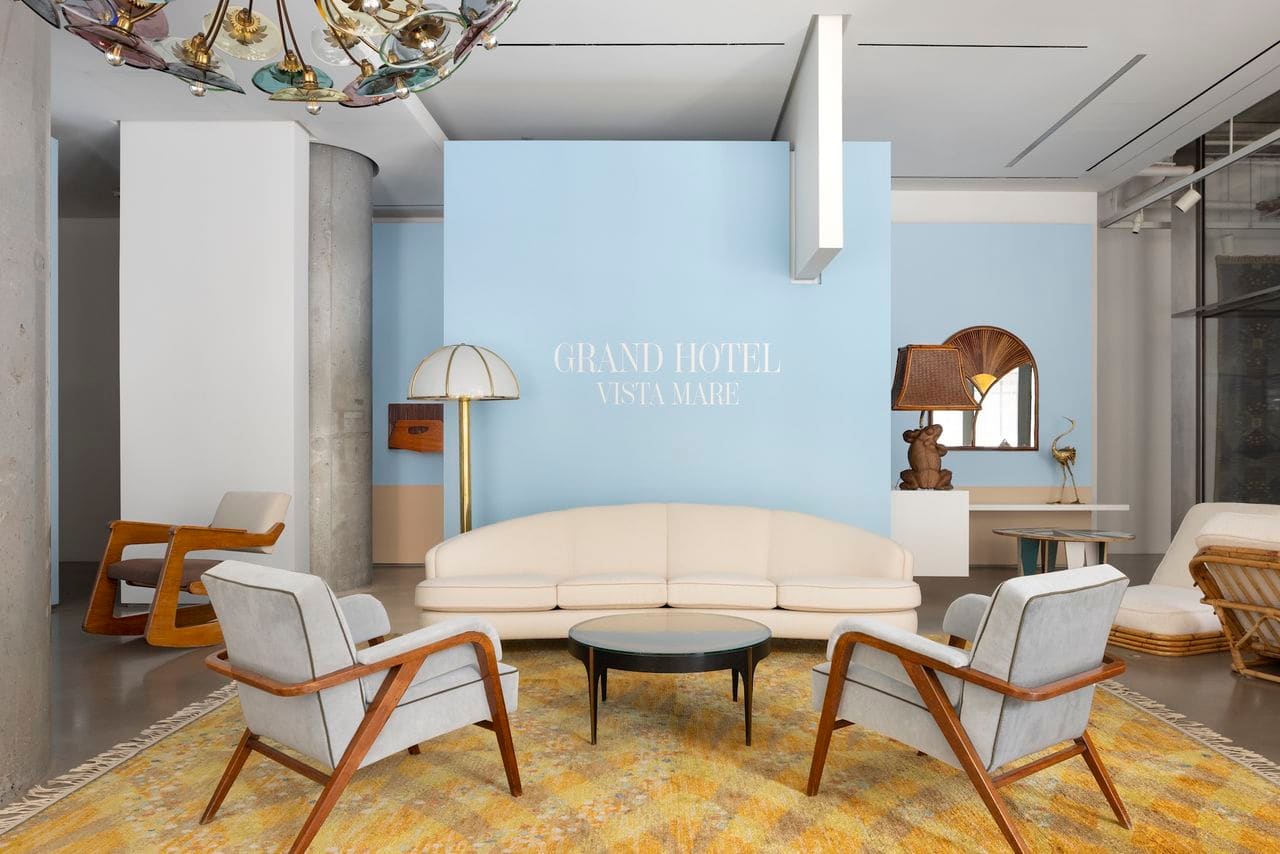
Walk into the Church Street space and the curatorial logic becomes immediately legible. A Carlo Mollino dining table, originally conceived in 1956 and topped in Formica, occupies what reads as a notional lobby. The material choice matters here. Mollino's deployment of Formica, a substance more commonly associated with American diners and mid-century kitchens, in a high-design context speaks to his interest in democratizing materials while maintaining sculptural rigor. The table's biomorphic base, characteristic of Mollino's furniture vocabulary, creates a tension between the industrial surface and the hand-carved supports.
Flanking this anchor piece, a pair of Luis Barragán's 'Miguelito' chairs introduce a different material philosophy. The Mexican architect's approach to wood, stripped of ornament and relying on proportion and joinery for visual interest, offers a counterpoint to Mollino's more expressive forms. This juxtaposition isn't accidental. It mirrors the way cosmopolitan resort hotels of the early 20th century became crucibles for international design exchange, spaces where Viennese modernism might encounter Italian futurism over cocktails.
Textile as Terrain
Opposite the entrance, a Barbro Nilsson rug from the 1940s functions as something more than floor covering. The Swedish designer's knotted textile work, produced during her tenure at the Märta Måås-Fjetterström workshop, employed traditional techniques to create decidedly modern compositions. Here, its golden expanse reads as sand, a chromatic and textural cue that reorients the entire space. This is a clever deployment of what architects call "material narrative," the way a single surface treatment can shift the perceived context of everything around it.
The round Fontana Arte cocktail table positioned nearby extends this reading. The Milanese lighting and furniture manufacturer, founded in 1932, built its reputation on technical innovation in glass. Their tables from this era often featured thick glass tops supported by minimal brass frameworks, creating objects that seemed to float. Paired with a Gabriella Crespi floor lamp, the vignette evokes midday at the beach without resorting to literal representation. The lamp's form suggests a parasol, but abstracted to the point where it remains a lighting fixture first, metaphor second.
Crespi's Theatrical Objects
The exhibition includes a substantial selection of Crespi's work, and this concentration rewards sustained attention. Her trajectory, from sculptor to furniture and lighting designer during the 1950s and 60s, paralleled broader shifts in Italian design culture. The carved-wood frog lamp on display exemplifies her willingness to embrace whimsy without sacrificing craft. The piece required significant technical skill, yet it refuses to take itself too seriously. This balance, evident across her body of work, made her objects particularly suited to hospitality environments where a degree of playfulness was expected.
Her brass drawers created for Christian Dior represent a different facet of her practice. Commissioned work for luxury fashion houses demanded precision and a certain restrained glamour. The gleaming metal surfaces and geometric divisions speak to the modernist impulse toward rationalization, even as the material choice, brass, carries connotations of Old World opulence. It's this duality that makes the piece interesting. Contemporary designers working in the hospitality sector might take note: luxury doesn't require historical pastiche, but it does benefit from material richness and attention to detail.
The metallic floor lamp that rises from the floor like a marine buoy demonstrates Crespi's engagement with industrial forms. The fixture's segmented vertical structure and reflective finish give it a nautical quality, yet it functions perfectly well in a terrestrial interior. This kind of cross-contextual design, where objects reference one environment while inhabiting another, was a hallmark of post-war Italian modernism.
Precedents and Cameos
Gio Ponti's presence in the exhibition, though less dominant than Crespi's, provides essential historical grounding. His work bridged pre-war classicism and post-war experimentation, and his involvement in hotel design, most famously the Parco dei Principi in Sorrento, established templates that influenced generations of hospitality interiors. Any conversation about Italian design and resort culture necessarily passes through Ponti's practice.
Lina Bo Bardi's inclusion introduces a geographic and philosophical expansion. The Italian-born Brazilian architect's work synthesized European modernism with Brazilian vernacular traditions, creating a hybrid vocabulary that challenged the universalizing tendencies of International Style orthodoxy. Her furniture designs, often incorporating local materials and craft techniques, remind us that modernism wasn't a monolithic movement but rather a series of regional dialogues.
Martino Gamper, representing a contemporary perspective, bridges historical and current practice. His approach to furniture often involves remixing and recombining existing pieces, a method that echoes the exhibition's own curatorial strategy of creating new narratives through object relationships.
The Oldest Object in the Room
Carlo Bugatti's 1902 mirror and shelf, the exhibition's earliest piece chronologically, deserves particular scrutiny. Created a decade before Thomas Mann stayed at the Hotel des Bains and wrote Death in Venice, the work captures the Art Nouveau fascination with organic forms and decorative excess. The stenciled iris border, embossed copper details, and mother-of-pearl inlays represent a level of craft intensity that would become economically unfeasible within a few decades.
The hinged cupboard concealing miniature drawers and turned columns adds functional complexity to what could have been purely decorative. Those columns, deliberately evoking Piazza San Marco, make the Venetian reference explicit. Yet the overall composition, with its scroll-shaped frame and asymmetrical elements, feels surprisingly contemporary. This temporal slippage, where century-old objects read as current, happens when formal innovation outpaces stylistic trends. Bugatti's work operated at that level.
Hospitality as Design Laboratory
The exhibition's underlying thesis, that hotels historically functioned as experimental spaces for design, merits examination. Grand hotels of the late 19th and early 20th centuries served as showcases for new materials, manufacturing techniques, and spatial configurations. They were semi-public spaces where designers could deploy ambitious concepts with the backing of commercial clients interested in differentiation and prestige. This dynamic produced some of the era's most innovative interiors.
The Lido hotels, in particular, occupied a unique position. As seasonal destinations, they could embrace a degree of fantasy and theatricality that permanent urban hotels might avoid. The temporary nature of guests' stays permitted more experimental design choices. Visitors expected, even desired, environments that departed from everyday domestic norms. This permission structure, where novelty was not just accepted but commercially valuable, created conditions favorable to design innovation.
Contemporary hospitality design has largely moved away from this model. Branded hotel chains prioritize consistency and recognizability over experimentation. The boutique hotel movement of recent decades attempted to revive the earlier ethos, with mixed results. Many such projects mistake stylistic eclecticism for genuine innovation, assembling collections of fashionable objects without the underlying conceptual framework that gave historical precedents their coherence.
Material Storytelling
At World Archi Design, we've been tracking how exhibitions use spatial arrangement and object selection to construct narratives that transcend individual pieces. This presentation succeeds because it resists the temptation to over-explain. The curatorial hand is evident but not heavy. Objects are allowed to establish their own relationships, with just enough contextual scaffolding to guide interpretation without dictating it.
The decision to focus on Italian design, broadly defined to include Barragán's chairs and Bo Bardi's work, acknowledges that national design traditions have always been porous and hybrid. The Lido itself, as a destination for international travelers, was never purely Italian. It was a contact zone where different design cultures intersected and influenced one another. The exhibition's object selection reflects this cosmopolitan reality.
The Question of Permanence
One tension the exhibition doesn't fully resolve involves the relationship between ephemeral hospitality spaces and permanent design objects. Hotels are constantly renovated, their interiors stripped and replaced according to shifting tastes and commercial pressures. Yet the furniture and lighting designed for those spaces often outlasts the interiors they originally inhabited. Mollino's table, Crespi's lamps, Bugatti's mirror, all have survived the hotels they might have once furnished.
This raises questions about context and meaning. Does an object designed for a specific architectural and social environment retain its full significance when transplanted to a gallery or private collection? Or does it become something else, a fragment severed from its original discourse? The exhibition proposes that these objects carry their contexts with them, embedded in their forms and materials. Whether one accepts this proposition depends partly on how much agency one grants to objects themselves, independent of their settings.
Forward Implications
For architects and designers working in hospitality today, this exhibition offers both inspiration and challenge. The inspiration lies in seeing how previous generations used hotels as platforms for formal and material experimentation. The challenge involves finding equivalent opportunities in a contemporary industry increasingly dominated by risk-averse corporate clients and algorithmic market analysis.
Perhaps the lesson isn't to literally recreate the Lido's design culture, but to identify analogous conditions where experimentation remains commercially viable. Smaller independent hotels, private clubs, temporary installations, even high-end residential projects might provide the creative latitude that mainstream hospitality has largely abandoned. The objects in this exhibition remind us that enduring design often emerges from specific, even idiosyncratic, conditions rather than attempts to appeal to the broadest possible audience.
The exhibition remains on view through October 17, offering New Yorkers a compressed Italian summer without the transatlantic flight. Whether it succeeds as a substitute for Venice itself is debatable, but as a meditation on how design objects construct atmosphere and memory, it operates at a level of sophistication rare in commercial gallery presentations. The Lido may have lost its grand hotels to time and changing tastes, but the design intelligence that animated those spaces continues to circulate, finding new contexts and generating new meanings with each iteration.
Save this story. A free account keeps your reading list and the 07:00 email in one place.
CREATE FREE ACCOUNT →SIGN IN