
The Morphology of Memory
There exists a particular tactile memory shared by anyone who spent hours crouched over electric racing circuits in the late twentieth century: the snap of track segments locking together, the magnetic pull of miniature vehicles gripping their grooves, the freedom to tear down and rebuild layouts at will. Davide Groppi's wall-mounted lighting system extracts that morphological logic and applies it to interior illumination, creating a product that behaves less like a fixed fixture and more like a kit of spatial parts.
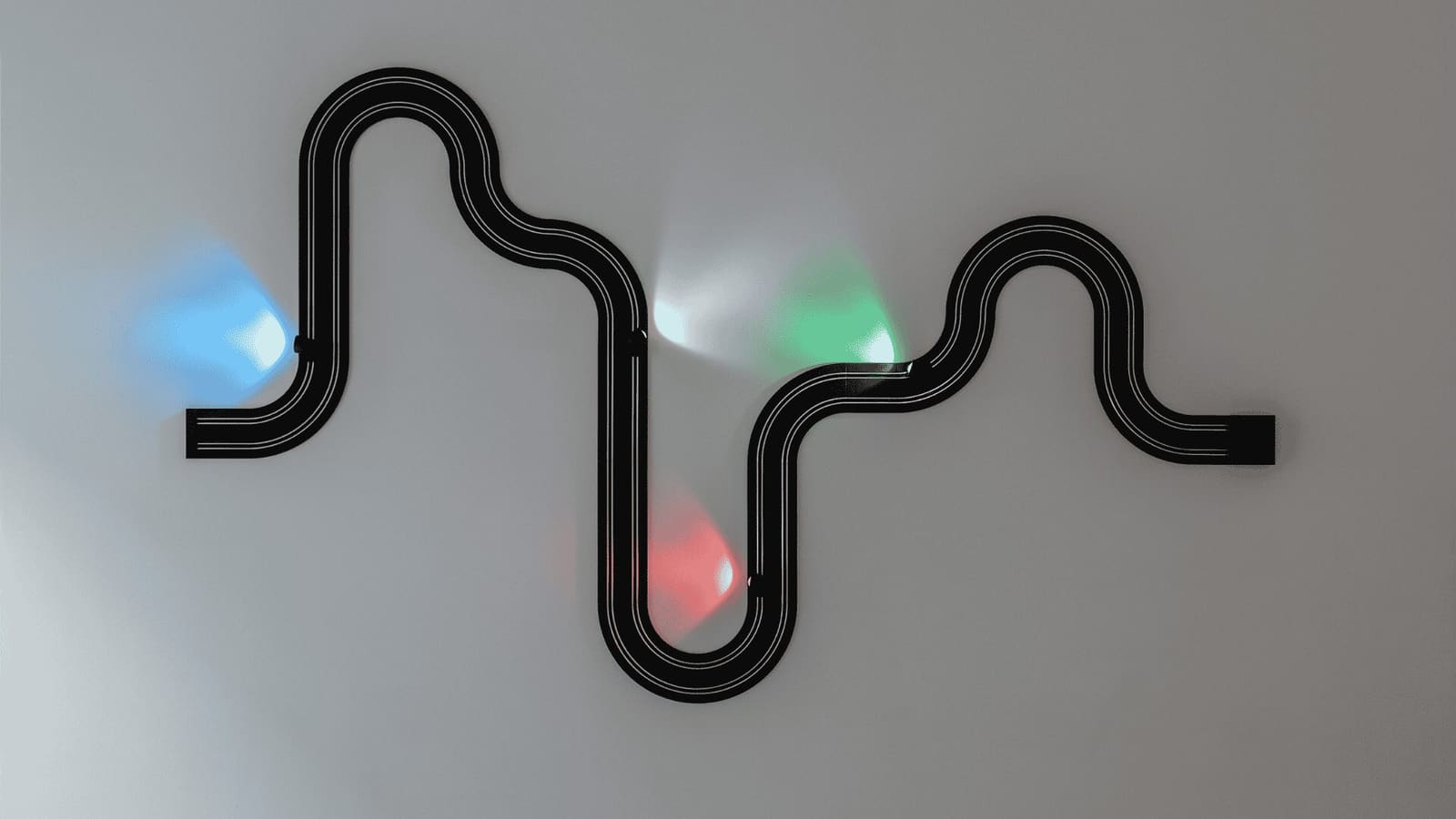
The system, launched in 2025, comprises interlocking polyethylene modules finished in textured matte black. Users assemble straight sections and curves into circuits spanning up to five meters, anchoring the composition to vertical surfaces. Small spotlights attach magnetically at any point along the track, drawing power from a 24-volt current embedded within the structure. The result is a lighting topology that can be dismantled, rearranged, and recomposed as spatial needs shift.
What distinguishes this approach from conventional track lighting is the degree of user agency built into the system. Rather than sliding luminaires along a fixed rail, occupants place light sources with the same improvisational freedom a child exercises when designing a racing circuit. The magnetic attachment mechanism eliminates fasteners and allows repositioning in seconds. Each spotlight head pivots independently, enabling precise beam direction and layered lighting scenarios.
Material Vocabulary and Structural Logic
The component set includes two short straight modules, four longer sections, and six curves, supplemented by two power-supply end pieces and four magnetic spotlights available in green, white, blue, and red. The polyethylene surface texture deliberately mimics the ribbed finish of toy track segments, reinforcing the formal reference while meeting contemporary fire-safety and durability standards for interior lighting products.
Track capacity accommodates up to eight spotlights simultaneously, though users may deploy fewer depending on ambient light requirements and desired visual density. An optional remote driver allows concealed power supply, useful in installations where visible wiring disrupts architectural continuity. The modular grammar supports both minimal linear compositions and sprawling multi-directional configurations that wrap corners or frame architectural features.
This flexibility recalls the adaptive reuse strategies embedded in systems like USM Haller furniture or Vitsœ shelving, where standardized components yield infinite permutations. In lighting design, such modularity has precedents in Flos's track systems and Artemide's magnetic rails, but those products prioritize technical efficiency over participatory reconfiguration. Davide Groppi's system foregrounds the act of assembly itself, treating layout design as an ongoing creative task rather than a one-time installation decision.
Interaction as Design Principle
The magnetic attachment mechanism serves a dual function: it simplifies reconfiguration while transforming the fixture into a tactile object that invites handling. This emphasis on physical interaction aligns with a broader shift in contemporary design toward products that resist static arrangement. We see similar tendencies in modular seating systems, reconfigurable partition walls, and furniture that users are expected to disassemble and rebuild as living patterns evolve.
By borrowing the interaction model of a toy, the system lowers the threshold for spatial experimentation. Adjusting lighting typically requires tools, electrical knowledge, or professional assistance. Here, repositioning a light source becomes a casual gesture, no more complicated than moving a book on a shelf. The adjustable spotlight heads extend this flexibility, allowing users to redirect beams without dismounting the fixture.
This participatory dimension has implications for residential and commercial interiors alike. In domestic settings, the system accommodates changing functional needs as rooms shift between work, leisure, and rest. In retail or gallery contexts, it supports evolving display strategies without infrastructure overhaul. The product anticipates impermanence, designing for users who expect their environments to remain provisional.
Formal Precedent and Tectonic Translation
Racing circuits are fundamentally about circulation: closed loops, branching paths, intersections. Translating that spatial logic into a wall-mounted system requires collapsing three-dimensional movement into a two-dimensional plane. The original toy operates horizontally on tabletops; the lighting version operates vertically on walls, reorienting the circuit grammar from floor to facade.
This shift echoes architectural strategies seen in projects like Renzo Piano's Pompidou Centre, where mechanical systems are expressed as external circulation diagrams, or OMA's Casa da Música, where interior circulation becomes visible sculptural form. Davide Groppi's system applies similar logic at the scale of the fixture, making the electrical infrastructure legible and reconfigurable rather than concealing it behind drywall or ceiling cavities.
The textured polyethylene surface also performs a tectonic role, distinguishing the track from the wall it inhabits. Rather than blending into the architecture, the system asserts itself as an applied layer, a grafted circuit that retains its formal autonomy. This approach contrasts with minimalist lighting strategies that prioritize discretion and dematerialization. Here, the fixture is deliberately object-like, a compositional element that occupies the wall rather than disappearing into it.
Color, Composition, and Spatial Narrative
The availability of spotlights in four colors introduces a chromatic variable uncommon in ambient lighting. While tunable white-light systems have become standard in architectural practice, fixed-color accent lighting remains relatively rare outside theatrical or hospitality contexts. The green, white, blue, and red options allow users to compose multi-hued lighting arrangements, creating visual rhythms that echo the original racing aesthetic.
This chromatic flexibility supports spatial storytelling. A single circuit might deploy warm white for task illumination above a desk, blue for ambient wash along a bookshelf, and red as a focal accent near artwork. The magnetic system enables these compositions to evolve seasonally or in response to programmatic shifts, treating light as a variable rather than a constant.
Such versatility aligns with emerging interest in circadian lighting and mood-responsive environments, though the system operates through manual adjustment rather than automated sensors. The user remains the choreographer, selecting colors and positions based on intuition rather than algorithm. This manual agency distinguishes the product from smart-home lighting platforms, which prioritize convenience and automation over tactile engagement.
Design Lineage and Studio Philosophy
Davide Groppi's broader body of work often explores light as a medium for conceptual expression rather than purely functional output. Projects like Sampei, a floor lamp balanced on a tripod of thin metal rods, or Neuro, a suspended fixture resembling a neural network, prioritize poetic gesture over technical efficiency. The racing-track system represents a departure in formal language, its playful aesthetic contrasting with the studio's typically restrained palette.
Yet the underlying design philosophy remains consistent: light as a tool for creating spatial experience, not merely visibility. The system's modularity and interactivity extend this ethos, positioning illumination as something occupants actively shape rather than passively receive. This approach shares conceptual ground with works by designers like Ingo Maurer, whose fixtures often incorporate whimsy and user participation, or Olafur Eliasson, whose installations treat light as a sculptural material subject to continuous reinterpretation.
By translating a childhood toy into a functional lighting system, the studio also engages with themes of memory and material culture. The racing circuit becomes an archetype, a form whose original function is recognizable but transformed. This strategy of adaptive reference appears throughout design history, from Achille Castiglioni's Mezzadro stool (a tractor seat repurposed as furniture) to the Eameses' appropriation of fiberglass boat-building techniques for seating. In each case, the designer identifies a logic or material quality in one context and translates it into another, creating products that carry traces of their origins while serving new purposes.
Spatial Implications and Architectural Context
The system's five-meter maximum span positions it as an architectural element rather than a discrete fixture. At this scale, the track can traverse entire walls, defining zones within open-plan interiors or articulating circulation paths in corridors. The modular assembly allows the composition to navigate architectural obstacles, bending around columns or framing doorways.
This scalability makes the product suitable for both intimate residential applications and larger commercial installations. In gallery settings, the reconfigurable lighting could adapt to rotating exhibitions without permanent infrastructure changes. In hospitality environments, it could support flexible zoning as dining areas shift between lunch and evening service. The system anticipates spatial fluidity, designing for contexts where programmatic stability cannot be assumed.
Contemporary interiors increasingly prioritize adaptability, a response to economic pressures, remote work patterns, and evolving domestic arrangements. Furniture systems like Vitra's Alcove or Herman Miller's Living Office reflect similar concerns, creating environments that users can modify without architectural intervention. Davide Groppi's lighting system extends this logic to illumination, treating light as a variable layer that occupants control directly.
Beyond Functionality: Light as Play
The system's most radical proposition may be its treatment of lighting design as an act of play. By embedding interaction into the product's core logic, it challenges the assumption that fixtures should be installed once and left unchanged. Instead, it invites ongoing experimentation, positioning users as co-designers who continuously reshape their luminous environment.
This participatory model has implications beyond aesthetics. It suggests a different relationship between occupant and architecture, one where spatial qualities remain provisional and subject to revision. In an era of increasingly automated environments, where sensors and algorithms adjust lighting without human input, the system reasserts manual control as a valuable mode of engagement.
The racing-track reference also carries cultural resonance. For those who grew up with electric circuits, the product triggers associative memory, connecting childhood experience to adult spatial practice. For younger users unfamiliar with the toy, the system simply presents a flexible lighting tool whose formal language happens to derive from an earlier era of play. In either case, the design succeeds by making reconfiguration intuitive, lowering the barrier between intention and spatial transformation.
At World Archi Design, we have tracked the growing interest in participatory systems across furniture, lighting, and architectural components. Products that empower users to modify their environments reflect broader cultural shifts toward customization, impermanence, and user-driven design. Davide Groppi's wall-mounted circuit contributes to this trajectory, demonstrating that even a fixture as ostensibly static as lighting can become a dynamic, reconfigurable element within contemporary space.
Save this story. A free account keeps your reading list and the 07:00 email in one place.
CREATE FREE ACCOUNT →SIGN IN