
The Emotional Vocabulary of Glass
There's a paradox at the heart of materiality: the most expressive substances often carry histories that dwarf the individual maker. Venetian glass, for instance, arrives weighted with centuries of guild secrets, chromatic bravado, and virtuosic technique. Yet when Peter B Staples stood in a Murano workshop for the first time, he wasn't thinking about tradition. He was thinking about heartbreak.
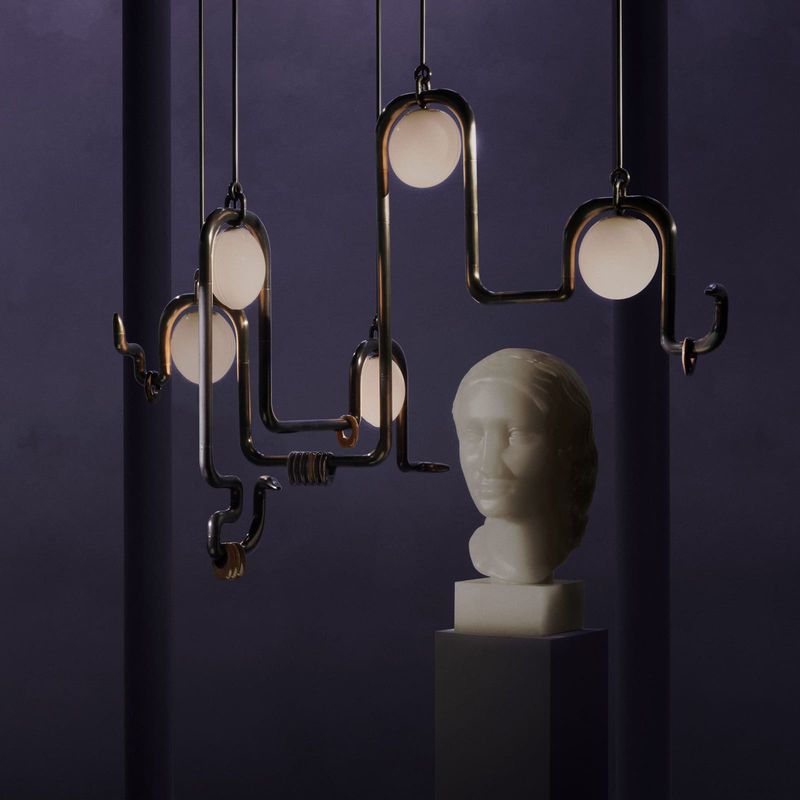
Blue Green Works, the studio Staples co-founded with James McAvey, has never been easy to categorize. Since its launch, the practice has moved fluidly between references: military tattoos from the 1930s, the stripped geometries of Horace Gifford's Fire Island modernism, symbols of power rendered as lighting objects. Staples himself resists definition, preferring to let each collection articulate its own logic. But the studio's newest series, titled "Garden," marks a departure not just in material but in emotional register.
The collaboration began with an invitation. A fourth-generation Murano fabricator had encountered Blue Green Works in print and reached out. The timing was serendipitous, or perhaps inevitable. Staples was preparing to travel to Venice when he learned his mother had died. He diverted to the Midwest, to the Gustav Stickley Craftsman house where he grew up, where his father still lives. A few weeks later, he resumed the journey to Italy. Over the next seven months, he shuttled back and forth across the Atlantic, spending extended periods alone in Venice, working directly with furnace masters.
"I needed a medium that was expressive like nothing else I had worked with," Staples has said. The clarity of glass, its capacity to hold light and motion in suspended animation, offered something his previous vocabulary couldn't. Where earlier Blue Green Works fixtures distilled ideas into simplified forms, this project demanded expansion, a borrowing of what Staples describes as "the emotional vocabulary of another language."
Against the Grain of Murano
Murano glass is synonymous with color, with saturated cobalt blues and emerald greens, with murrine patterns and lattimo opacity. The island's workshops have long prized technical mastery, the kind that produces flawless surfaces and dramatic silhouettes. Staples went in the opposite direction.
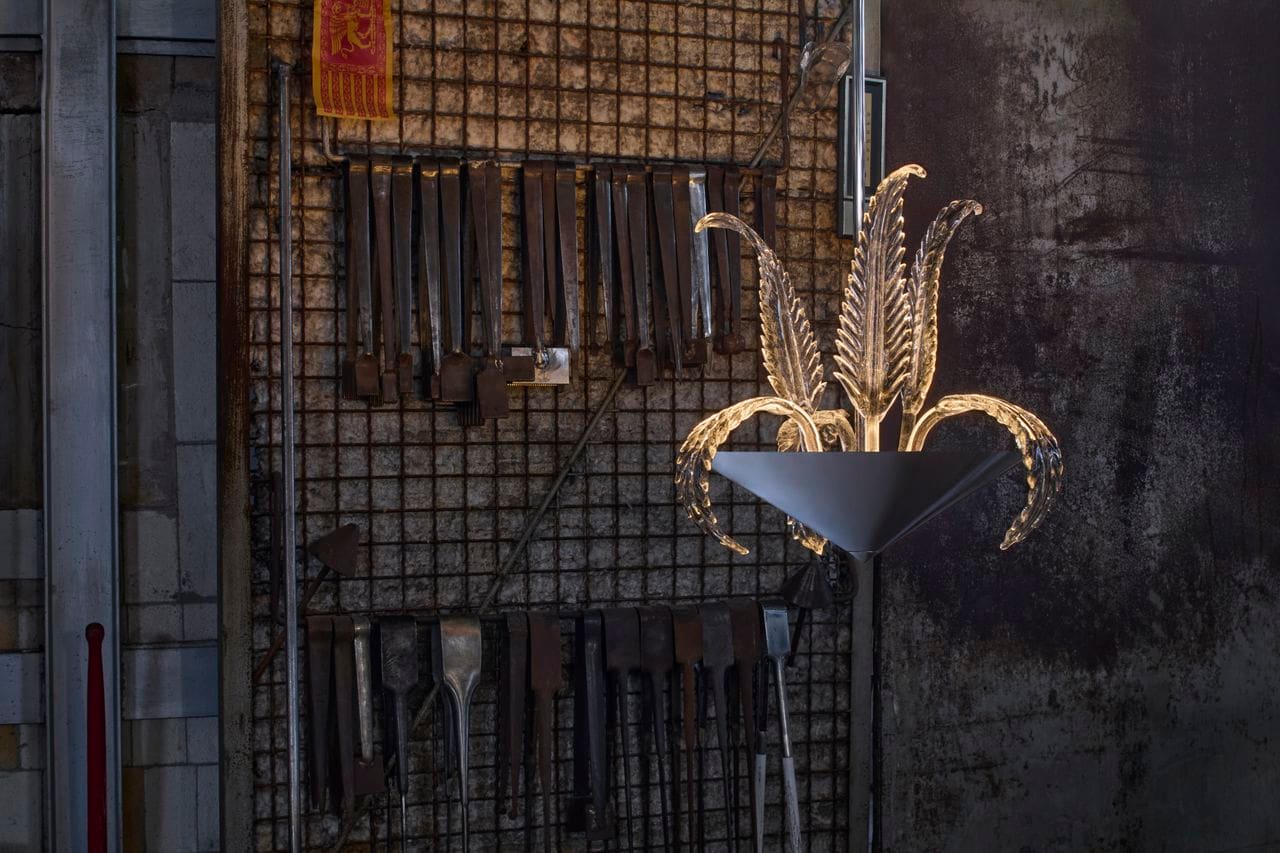
The "Garden" collection is composed almost entirely of clear glass, arranged into delicate leaves and feather-like forms that drift outward in multiple directions. Each element reveals its construction openly: edges remain visible, joints unconcealed. There's an intentional fragility here, a refusal of the slick sturdiness that defines much Venetian production. The "Fountain" and "Landscape" chandeliers exemplify this approach, with tentacle-like appendages that seem to flutter despite their material solidity.
This choice to expose vulnerability rather than conceal it aligns with a broader shift we've been tracking in contemporary lighting design. Where mid-century modernism often emphasized seamless integration and industrial precision, a younger generation of makers is increasingly interested in traces of the hand, in what architect Juhani Pallasmaa calls "the poetics of construction." Staples pushes this further: his Murano pieces aren't just handmade, they're visibly contingent, as if each component might tremble under the wrong light.
The technical challenge was considerable. Murano artisans are trained to eliminate imperfections, to achieve surfaces that read as effortless. Convincing them to preserve the raw, unpolished qualities Staples wanted required sustained dialogue. It's worth noting that this kind of cross-cultural material negotiation has precedent: when Finnish architect Alvar Aalto first worked with Iittala glassworks in the 1930s, he similarly pushed craftsmen toward organic, irregular forms that contradicted prevailing taste. The difference is that Aalto was seeking warmth and biomorphic softness; Staples is after something closer to exposure, a formal language for grief.
Stillness and Motion
One of the collection's central tensions is the way it renders living movement in static form. Glass leaves and feathers, frozen mid-drift, suggest animation without ever achieving it. This is a tectonic problem as much as an aesthetic one: how do you design an object that holds contradictory states in balance?
Staples addresses this through careful attention to massing and fenestration, though those terms apply differently to lighting than to architecture. Each chandelier is composed of multiple components that extend into space at varying angles, creating a sense of dispersal. Light passes through and around the clear glass, casting fragmented shadows that shift as the viewer moves. The effect is kinetic without being literal, a quality that recalls the hanging glass installations of Roni Horn or the suspended wire sculptures of Ruth Asawa, both of whom explored how serial repetition and spatial distribution can generate implied motion.
There's also a temporal dimension embedded in the work. Because each piece is fabricated individually to order, no two will be identical. Moulds exist for certain metal armatures, but the glass components themselves are blown and shaped by hand for each commission. This positions the "Garden" collection within the lineage of bespoke craft production, closer to the model of studio furniture or one-off ceramics than to industrial lighting. It's a deliberate rejection of scalability, and it has economic implications: these are luxury objects, accessible only to clients willing to wait and pay for singular works.
Yet the intimacy of the process seems essential to the collection's meaning. Staples describes the time spent in Venice as solitary and strange, a period of mourning conducted in a city built on water and impermanence. The glass itself becomes a repository for that experience, a way of externalizing what couldn't otherwise be articulated. This is design as memorial practice, though without the overt commemorative gestures that term usually implies.
Vernacular Histories, Personal Futures
Blue Green Works has always operated at the intersection of American vernacular and personal narrative. Staples' training at The Future Perfect and Apparatus Studios provided technical grounding, but his design sensibility is more idiosyncratic, shaped by what he calls "decades of work and rooms as inspiration." The studio's earlier collections mined specific cultural artifacts: trophies, tattoos, modernist beach houses. Each project functioned as a kind of material essay, using lighting fixtures to think through histories of taste, masculinity, domesticity.
The "Garden" collection extends this method but shifts the register from cultural analysis to autobiography. The death of Staples' mother becomes not the subject of the work but its condition of possibility, the circumstance that necessitated a new formal language. This is a subtle but important distinction. The chandeliers don't depict grief; they enact it through material choices, through the decision to work with a substance known for brilliance and color but to strip it down to clarity and fragility.
It's also worth considering what this move to Murano signals for American design more broadly. In recent years, a number of U.S.-based studios have sought out European craft partnerships, often as a way to access techniques unavailable domestically. But these collaborations can sometimes feel extractive, treating centuries-old workshops as service providers rather than creative collaborators. Staples' account of his relationship with the Murano fabricator, whom he describes as a close confidante and hopes to remain connected with for life, suggests a different model, one built on sustained exchange rather than transactional production.
There's also a question of influence and precedent. Murano glass has been taken up by designers ranging from Carlo Scarpa to Ettore Sottsass, each bringing their own formal preoccupations to the material. Scarpa, working in the mid-20th century, emphasized geometric clarity and architectural logic; Sottsass, in the 1980s, leaned into color and postmodern wit. Staples' approach is quieter, more phenomenological. He's interested in what glass can do when it's not trying to dazzle, when it's allowed to be hesitant and unfinished.
Beyond the Toolbox
At World Archi Design, we've been tracking the ways contemporary designers navigate inherited craft traditions, and the "Garden" collection offers a case study in how personal circumstance can reshape material practice. Staples speaks of needing "a medium that was expressive like nothing else I had worked with," and of realizing that "the kind of emotion I needed to convey at this moment in my life was not something I had in my toolbox."
This acknowledgment of limitation, of not having the right tools, is rare in a field that often privileges mastery and control. It suggests that design can be a process of learning as much as making, of finding forms adequate to experiences that exceed familiar vocabularies. The decision to work with Murano glass wasn't purely aesthetic; it was strategic, a recognition that certain emotional registers require certain materials.
The collection comprises seven distinct works, each unique. The "Fountain" and "Landscape" chandeliers anchor the series with their feathery, multi-directional forms, but other pieces explore different configurations of clear glass and metal armature. What unites them is a consistent refusal of spectacle. These are not objects designed to dominate a room or announce their presence from across a gallery. They ask for proximity, for sustained looking, for the kind of attention that allows subtle variations in light and shadow to emerge over time.
This restrained approach stands in contrast to much of the contemporary lighting market, which tends toward either minimalist reduction or maximalist statement pieces. Blue Green Works occupies a middle ground: formally inventive but not showy, materially sophisticated but not precious. The studio's willingness to work slowly, to produce one-of-a-kind commissions rather than scalable product lines, aligns it more closely with the ethos of studio craft than with commercial design.
A Medium for What Cannot Be Said
As Staples reflects on the experience, he notes that the project differed from the start. "So often my work is about distilling ideas and references down to very simple forms. But this project was different." The implication is that grief, or loss, resists distillation. It requires a different kind of formal strategy, one that can hold complexity and contradiction without resolving them.
Glass, in this context, becomes a medium for what cannot be easily verbalized. Its transparency suggests openness, but its fragility implies precariousness. The feather and leaf forms evoke natural growth and decay, cycles of renewal and endings. And the decision to leave construction visible, to show how each piece is assembled rather than concealing the joints, underscores a commitment to honesty, to not smoothing over the difficult parts.
Looking forward, Staples indicates that the relationship with Murano will continue. "The more I sit with Murano glass, the more I find ways that can grow the vocabulary we're forming as a studio," he notes. This suggests that the "Garden" collection is less a conclusion than an opening, a new direction that will inform future work. Whether that means more glass, or whether the lessons learned in Venice will translate to other materials, remains to be seen.
What seems certain is that Blue Green Works has found a way to make lighting fixtures carry emotional weight without becoming maudlin or sentimental. The pieces are beautiful, yes, but their beauty is inseparable from their vulnerability, from the sense that they could break, that they are holding something fragile and precious in suspension. In a design landscape often dominated by certainty and bravado, that kind of quiet courage feels increasingly necessary.
Save this story. A free account keeps your reading list and the 07:00 email in one place.
CREATE FREE ACCOUNT →SIGN IN