
A Return Through Personal Narrative
Five years is a long interval in the design world - long enough for trends to cycle, for studios to pivot, and for anticipation to accumulate. Apparatus, the New York-based lighting and furniture studio founded by Gabriel Hendifar, has spent that time refining its architectural vocabulary and expanding its physical footprint, including a renovated Los Angeles space described as a "modernist grotto" and a new London location. But the real work, it turns out, was conceptual: Act V: Afsaneh marks the studio's most explicitly narrative collection to date, a shift from the abstracted geometries of earlier work into territory where symbolism, family history, and material craft converge.
The collection's title is a double reference. Afsaneh translates from Persian as "fable", but it is also the name of Hendifar's mother - a deliberate layering that situates the work between public mythology and private memory. This is not the first time Apparatus has drawn on Persian culture; earlier collections have nodded to ancient symbols and formal motifs. But Act V represents a departure in how those references are deployed: less as formal inspiration, more as narrative structure.
The Seed, The Flower, The Serpent
The collection is organised around a tripartite cycle - seed, flower, serpent - each stage rendered in distinct typologies. The Esfand sconces take their name from the Persian word for seed and are built around hand-blown glass orbs encased in lacquered settings. The lacquer palette runs from milk through honey to pomegranate, colours that reference both Persian miniature painting and the domestic rituals of Hendifar's upbringing. The lacquered elements are also offered as standalone table vessels, decoupled from their lighting function, a move that underscores the collection's interest in form as symbol rather than utility alone.
The pendants, called Gol - flower - feature large semi-translucent fibreglass domes bisected to reveal smaller speckled glass orbs within. The fibreglass tapers into polished aluminium, a material transition that reads as both botanical and tectonic. The formal logic here is clear: the outer shell protects and conceals; the inner orb glows. It is a straightforward metaphor, but one that gains complexity through scale and repetition. Installed in multiples, the pendants create a canopy effect, a luminous field that recalls both the hanging gardens of Persepolis and the clustered installations of Olafur Eliasson.
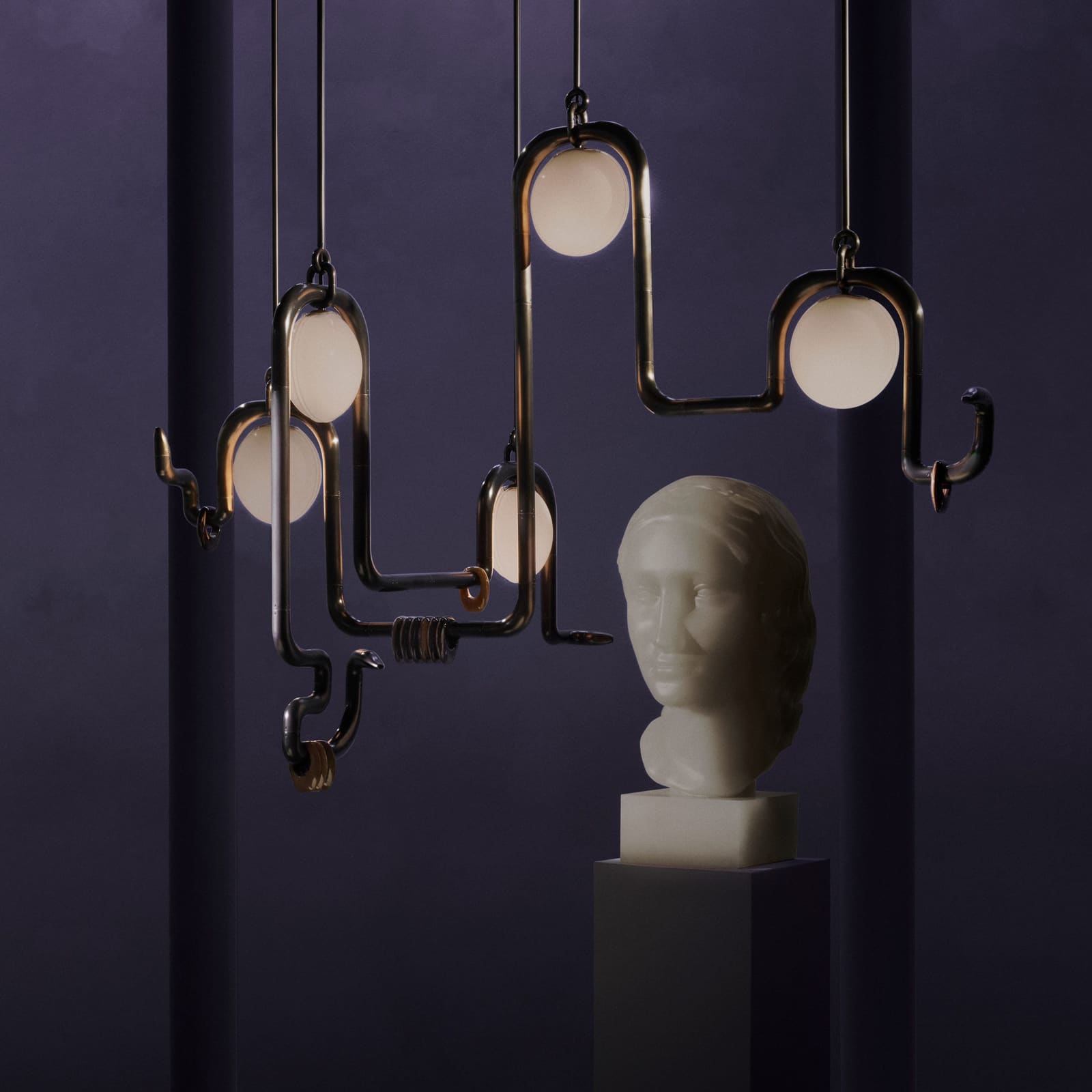
At the apex of the collection is Rahvi, the serpent. This modular chandelier is the most figurative piece Apparatus has produced - a sinuous brass armature formed through a water-shaping technique, with glass orbs nestled in the crooks of the metal. The serpent in Persian mythology is not merely a symbol of danger; it is also associated with wisdom and the accumulation of knowledge. Hendifar has leaned into that duality, designing Rahvi as a highly customisable system. Some configurations stretch across multiple suspension points, creating horizontal compositions that read as calligraphic gestures in three dimensions. A series of rings carved from onyx and tiger's eye can be slipped over the brass segments, adding weight and visual punctuation.
Material Continuity and Technical Exploration
Apparatus has always been a studio preoccupied with materiality - not in the fetishistic sense, but as a means of encoding meaning. Act V continues that tradition, combining what the studio describes as "ancient" materials with contemporary fabrication techniques. Bronze, brass, and blown glass are constants in the Apparatus lexicon, but here they are deployed with a new level of specificity. The water-formed brass of Rahvi, for instance, is a technique more commonly associated with metalwork for musical instruments or industrial prototyping. Applying it to a chandelier results in a form that feels both organic and engineered, a hybrid that resists easy categorisation.
The fibreglass of the Gol pendants is another departure. Fibreglass is typically associated with mid-century experimentation - think of the moulded chairs of Charles and Ray Eames or the sculptural work of Wendell Castle. But it has largely fallen out of favour in high-end design, displaced by more "authentic" materials like marble, wood, or hand-forged metal. By reintroducing fibreglass in a lighting context, Apparatus is making a subtle argument about materiality: that technique and intention matter more than pedigree.
Context and Precedent
The move towards narrative-driven design is not unique to Apparatus. We have been tracking a broader shift across studios - particularly those working in lighting and furniture - towards collections that operate as chapters in an ongoing story rather than standalone product launches. Studio Drift's Fragile Future series, which embeds real dandelion seeds in LED lights, is one precedent. Another is the work of Lindsey Adelman, whose branching chandeliers often reference biological forms and growth patterns. But where those studios tend towards the biomorphic, Apparatus is more interested in the mythological - a distinction that places Act V in closer dialogue with the theatrical installations of Studio Job or the allegorical furniture of Maarten Baas.
There is also a regional dimension to this work. Persian design has historically been reduced, in Western markets, to a handful of motifs: arabesques, tilework, carpets. Act V resists that flattening by engaging with Persian mythology at the level of structure rather than ornament. The collection does not look "Persian" in any superficial sense. Instead, it borrows the narrative logic of Persian fable - cycles of transformation, the interplay of light and knowledge, the figure of the serpent as both threat and guide - and translates that logic into spatial form.
Forward Installations
Apparatus has announced that Act V will be showcased through a series of installations in Miami, London, and Los Angeles. This is a deliberate strategy: rather than debuting the collection in a trade show or gallery context, the studio is opting for city-specific presentations that allow for deeper engagement with the work. The choice of cities is also telling. Miami and Los Angeles are markets with strong collector bases and a taste for design that operates at the intersection of art and function. London, meanwhile, offers access to a European audience that has historically been more receptive to conceptual design and narrative-driven work.
The collection also includes a custom incense developed in collaboration with Cinnamon Projects, a Los Angeles-based studio known for its experimental approach to scent. The incense is not an accessory; it is part of the collection's sensory architecture, designed to be burned in the table-like incense holder that accompanies the lighting. A series of short films produced with the Martha Graham Dance Company extends the work into yet another medium, using movement to explore the collection's themes of cycle and transformation.
A Studio in Transition
Act V: Afsaneh arrives at a moment when Apparatus is recalibrating its identity. The five-year gap since the last full collection has coincided with significant physical expansion and a shift in how the studio presents its work. The renovated Los Angeles space, with its grotto-like interiors, suggests a move towards environments that are as much about atmosphere as product. The new London location signals ambitions beyond the American market. And the collection itself - figurative, narrative, deeply personal - marks a departure from the more restrained, architecturally inflected work that defined Apparatus in its early years.
Whether this shift will resonate with the studio's existing audience remains to be seen. There is always a risk, when a studio moves from abstraction into narrative, of losing the formal rigour that attracted attention in the first place. But Act V suggests that Apparatus is less interested in maintaining a consistent aesthetic than in exploring what a collection can be - not just a group of objects, but a system of symbols, a set of stories, a material argument about memory and mythology.
Save this story. A free account keeps your reading list and the 07:00 email in one place.
CREATE FREE ACCOUNT →SIGN IN