
From Supercars to Super-Homes
There's a certain kind of client who wants everything designed, nothing left to chance. The person who commissions a bespoke sports car, then a yacht to match, then realizes the garage holding both should probably receive the same obsessive attention. For decades, that client has turned to studios like Pininfarina, the Turin-based industrial design house whose flowing lines have dressed everything from Ferraris to espresso machines. Now, the firm is offering something larger: entire houses, complete and furnished, delivered as a single curated object.
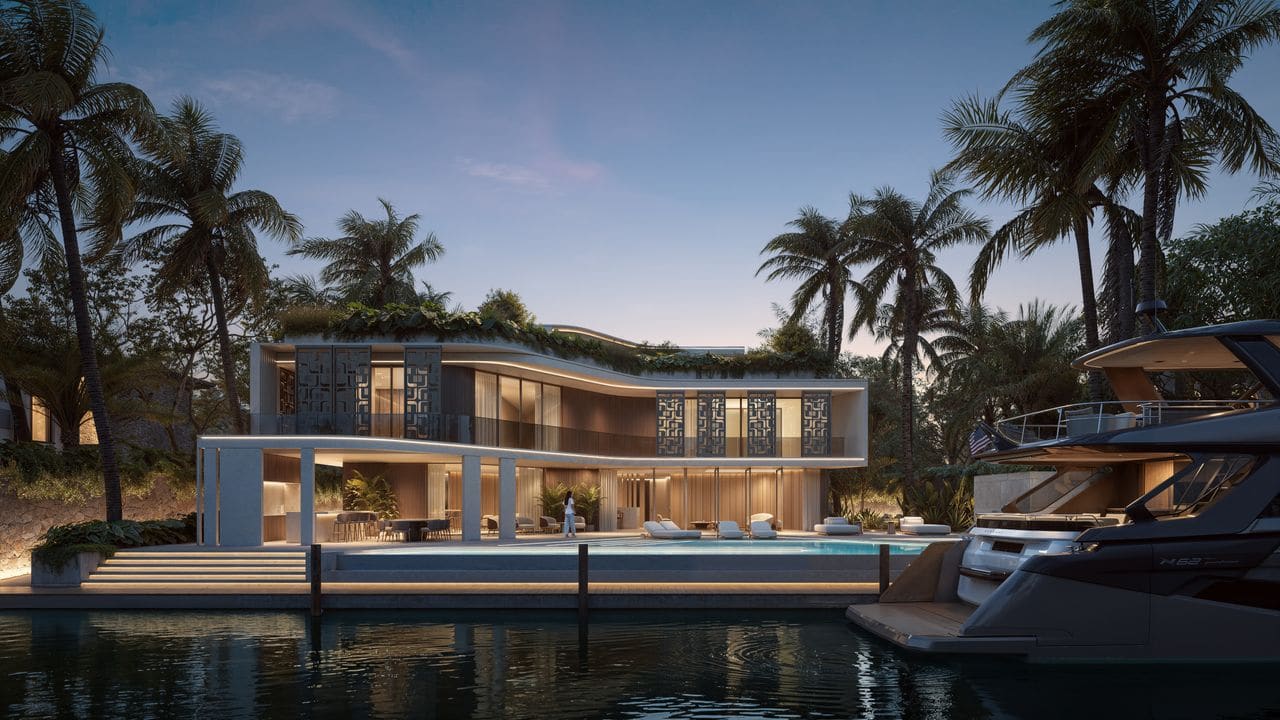
At Monterey Car Week this year, Pininfarina introduced Collection Sei Design, a portfolio of six distinct villa designs created in partnership with luxury builder Manny Angelo Varas and MV Group USA. Each residence measures approximately 8,000 square feet and is offered turnkey at $16,950,000, excluding land. The buyer's only requirement is a plot of at least 20,000 square feet. Everything else, from structural shell to lighting fixtures, is resolved by the studio.
It is Pininfarina's first dedicated single-family housing venture in the United States, though the firm has completed residential towers in the UAE and Brazil over the past few years. The move into detached homes represents a logical extension of the studio's expanding architectural practice, now overseen by chief architectural officer Samuele Sordi and guided by CEO Paolo Dellachà.
The Aesthetic Language of Mobility
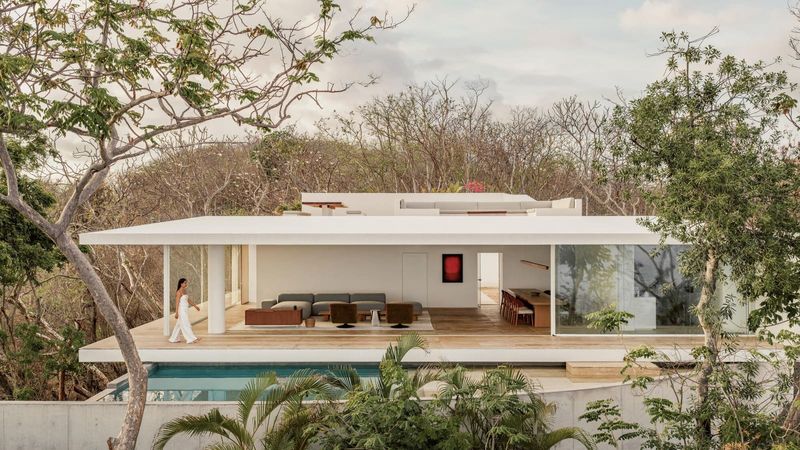
The six designs share a recognizable formal vocabulary: curved balconies that cantilever over pools, sliding perforated screens that modulate light and privacy, deep covered terraces that blur the threshold between interior and exterior. These are not radical gestures. They are polished, serene, and deliberately restrained, closer in spirit to mid-century modernist villas than to the sculptural extravagance of contemporary starchitecture.
What distinguishes the collection is not innovation in plan or section, but rather the promise of total coherence. Pininfarina is not offering architectural services; it is offering a product. The fenestration, the millwork, the furniture, the palette, all emerge from a single design sensibility. For clients accustomed to the fragmented process of commissioning architects, hiring interior designers, and negotiating with contractors, the appeal is clear: one entity, one vision, one contract.
This approach has precedent. In the early twentieth century, firms like Wiener Werkstätte and later the Bauhaus promoted the Gesamtkunstwerk, the total work of art in which every element, down to the doorknobs, was designed in concert. More recently, brands like Fendi Casa and Armani Casa have ventured into residential interiors, though typically as furnishing lines rather than as complete architectural packages. Pininfarina's model goes further, absorbing construction and site coordination into the offering.
A Collectable Residence
Sordi describes the villas as "collectable residences," a phrase that positions the houses closer to limited-edition objects than to conventional real estate. It is a framing borrowed directly from the automotive world, where Pininfarina's name carries decades of cachet. The firm has shaped some of the most admired cars of the past century, including the Ferrari 250 GT, the Maserati GranTurismo, and the Alfa Romeo Duetto, a 1966 roadster that became an icon of Italian style in the United States.
Dellachà explicitly tied the Collection Sei launch to the Duetto's 60th anniversary, positioning the villas as spiritual successors to that car's blend of elegance and restraint. The analogy is instructive. The Duetto was never the fastest or most technologically advanced sports car of its era, but it was beautiful, and it aged well. Pininfarina's houses aim for the same longevity, the same resistance to stylistic obsolescence.
Whether that strategy succeeds depends on the client base. The villas are designed for warm climates, and early renderings situate them in coastal settings, particularly around Miami, where the curved balconies and open plans make sense in a subtropical context. The aesthetic is resolutely international, with little regional inflection. These are houses that could exist in Ibiza, Phuket, or the French Riviera with minimal adjustment.
The Limits of Authorship
The turnkey model raises questions about authorship and adaptability. In traditional architectural practice, the client's needs and the site's constraints shape the design. Here, the process is inverted: the design is fixed, and the client must conform. Pininfarina offers six variations, but within each, customization appears limited. The firm is selling a vision, not a service.
This works for certain buyers. Those who have commissioned yachts from firms like Wally or Riva understand the logic: you choose a model, select finishes from a curated palette, and trust the designer's judgment. The result is a coherent object, free from the compromises and negotiations that typically attend collaborative design.
But architecture is not a yacht. A house is stationary, embedded in a specific landscape, subject to local climate and building codes. It must accommodate not just the owner's current preferences but also the unpredictable rhythms of domestic life over decades. The degree to which Pininfarina's designs can absorb those variables without losing their formal integrity remains an open question.
The Brand as Guarantee
Ultimately, what Pininfarina is selling is not just design but assurance. The firm's name, rendered in that familiar cursive script, functions as a guarantee of quality and taste. For buyers navigating the luxury real estate market, where architectural merit is often obscured by marketing hyperbole, a recognizable brand offers clarity. You may not know whether the house is good architecture, but you know it is a Pininfarina.
This is not a new phenomenon. In fashion, hospitality, and consumer goods, brand extension into architecture has become routine. Bulgari designs hotels, Missoni licenses its patterns to condominium interiors, Porsche consults on residential towers. What distinguishes Pininfarina's approach is the level of control. The firm is not licensing its name; it is designing, building, and furnishing the entire residence.
Whether that model scales remains uncertain. Six houses is a small portfolio, easily managed. A larger operation would require more standardization, more delegation, and potentially a dilution of the design vision that justifies the premium. For now, the collection remains exclusive, aimed at the narrow slice of the market that values coherence above all else and has the resources to pay for it.
Save this story. A free account keeps your reading list and the 07:00 email in one place.
CREATE FREE ACCOUNT →SIGN IN