A Studio as Portal
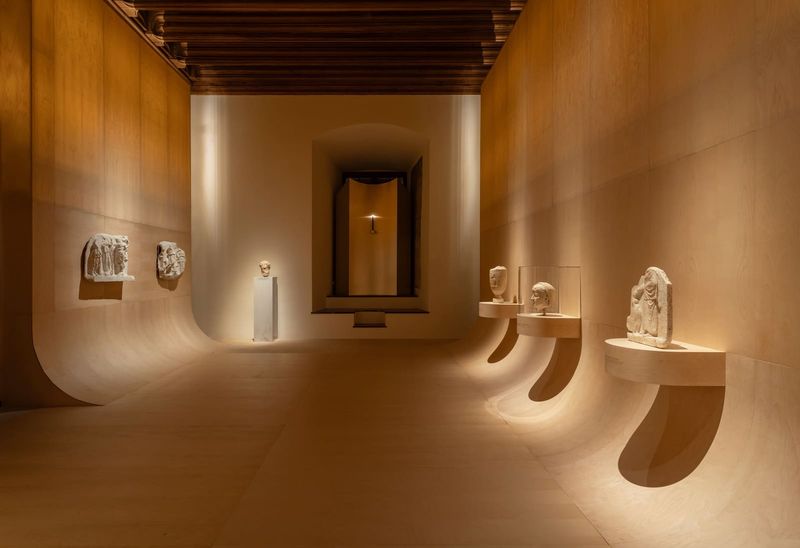
When visitors step into the ground-floor gallery space, they encounter not an exhibition in the traditional sense but a carefully choreographed spatial narrative. The first room is a meticulous reconstruction of Devlin's London workspace, populated with maquettes at various stages of completion, dog-eared reference volumes, and the accumulated tools of a scenographic practice. A video plays on loop, Devlin's voice threading through the space, establishing the intimacy that will define the hour ahead. The doors part scenographically, a term borrowed from theatre design, and the exhibition proper begins.
This threshold matters. At World Archi Design, we've long argued that the best design retrospectives function less as surveys and more as arguments about process itself. Devlin has structured her show around a pedagogical instinct: to trace, step by step, how a multidisciplinary practice accretes over time. The exhibition runs until 4 April 2027, and its architecture reveals a designer unusually willing to expose the scaffolding behind the spectacle.
240 Species in a Mirrored Room
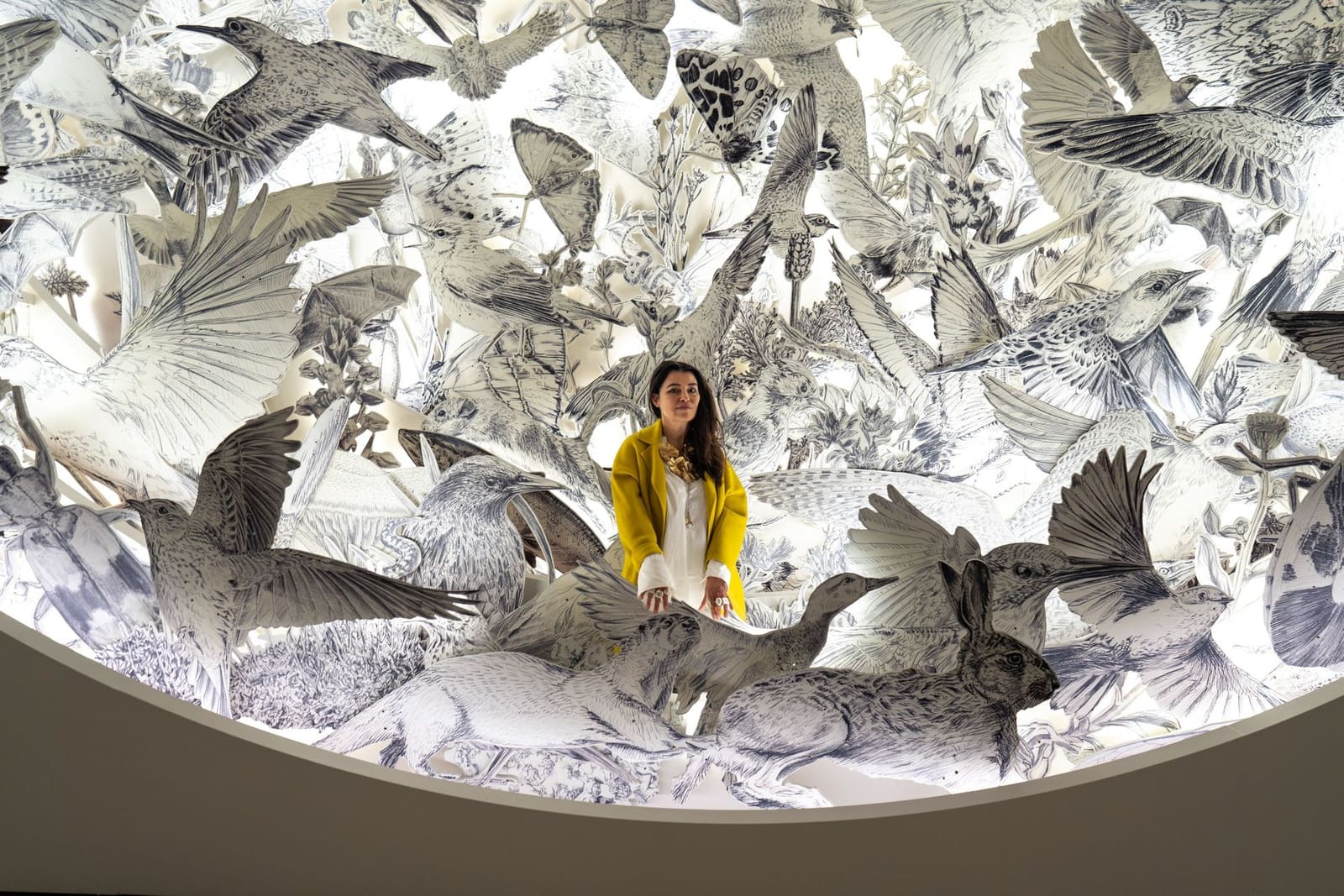
Beyond the studio threshold sits "Come Home Again", an illuminated composition that debuted at the Tate Modern in 2022. The work catalogues 240 species, mammals to insects, fish to birds, all documented within London's municipal boundaries. Devlin's drawings are rendered in her characteristic line work, precise but not clinical, and the mirrored walls multiply the menagerie into an infinite bestiary.
The piece operates on two registers simultaneously. As environmental inventory, it anchors Devlin's practice in the Anthropocene discourse that has animated so much contemporary design. As spatial intervention, it deploys mirrors not for narcissistic effect but to collapse the boundary between observer and observed. The viewer becomes implicated in the ecosystem, their reflection woven into the grid of species.
This doubling recurs throughout the exhibition. Devlin has spent her career designing for performance, opera, and large-scale public installation, contexts where the audience's presence completes the work. The retrospective format risks flattening that participatory dimension into documentation. By employing mirrors, kinetic elements, and immersive thresholds, Devlin preserves the liveness that defines her scenographic method.
The 30-Year Desk and the Archive Walls
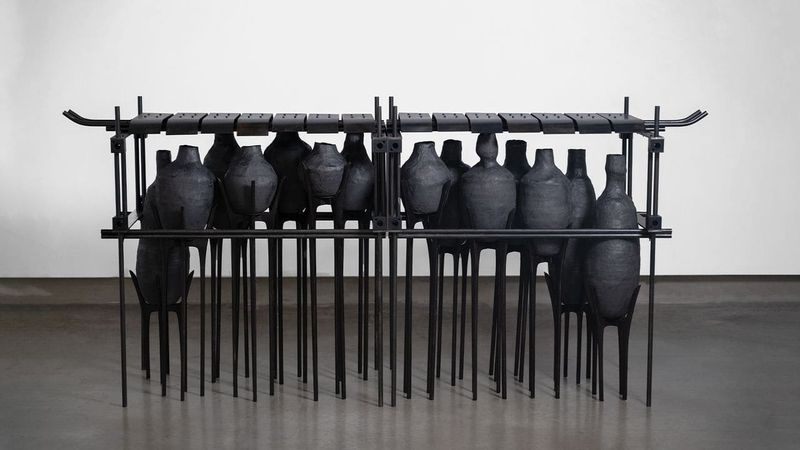
The centrepiece of the exhibition is a curved structure Devlin calls the 30-year desk. It houses 5,000 objects drawn from her personal archive: 30 revolving models, hundreds of sketches, material samples, correspondence, and ephemera. The desk is not a vitrine but a working surface, albeit one frozen at the moment of display. Visitors can orbit it, tracking the evolution of recurring motifs, the shift from hand-drawn elevation to digital rendering, the incremental refinement of a signature formal vocabulary.
Flanking the desk are two wall installations, "The 50-Year Archive" (Part I and II), which extend the timeline further back. These include sketchbooks from Devlin's formative years, drawings that predate her first commissions, and paintings that hint at parallel practices she might have pursued. The curation is generous, almost unguarded. We see false starts, abandoned concepts, the kind of developmental work that rarely survives the editorial filter of a retrospective.
The desk and archive walls together constitute a spatial argument about creative labour. Against the cult of the singular masterwork, Devlin insists on the value of accumulation, iteration, and lateral thinking. The curved form of the desk suggests a timeline but also a spiral, where past work loops back to inform present projects. This is process-driven design in its most legible form.
The Red Tunnel and the Kinetic Library
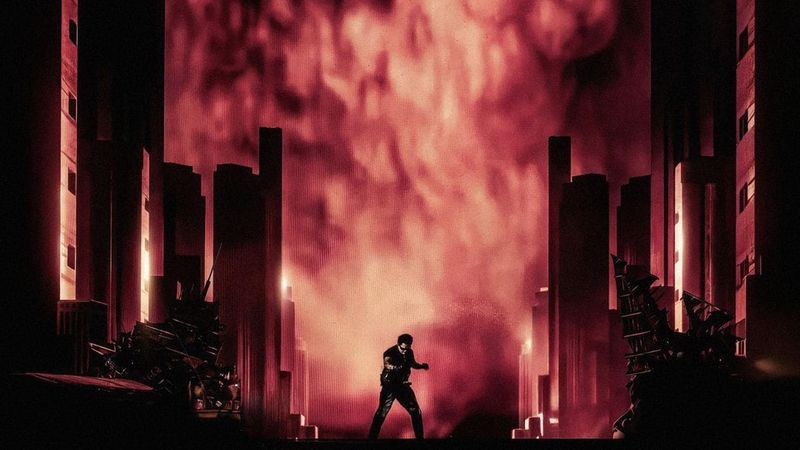
Between the archive and the final gallery, visitors pass through a tunnel bathed in near-fluorescent red. The colour is not arbitrary. It appears in Devlin's slipcase for "A Concise Atlas", in her stage designs for opera, and in several public installations. Red, in Devlin's practice, functions as both threshold and signal, a chromatic announcement that the everyday is about to shift into the heightened register of performance.
The tunnel deposits visitors onto a mirrored platform where "Infinite Library" unfolds. The installation comprises a colour-coded collection of kinetic sculptures featuring more than 2,000 books, each one cited by Devlin as formative to her worldview and practice. The books are not static; motorised mechanisms rotate them, creating a constantly shifting taxonomy. The colour coding is precise but intuitive, grouping texts by theme rather than discipline: ecology, mythology, architecture, poetry, political theory.
The library is both generous and daunting. It offers a reading list, a syllabus, a map of intellectual influences. But it also raises questions about access and canon formation. Whose books make it into the infinite library? What gets excluded in the process of distillation? Devlin's selections skew heavily toward European and Anglo-American theory, with notable absences from Global South discourse. This is not a critique unique to her practice, it reflects the inherited biases of the design education system she emerged from. But in making the library explicit, Devlin also makes it contestable.
Precedent and Lineage
Devlin's work invites comparison to earlier scenographic practitioners who moved fluidly between stage, installation, and public space. The Czech designer Josef Svoboda, active from the 1940s through the 1990s, pioneered the use of kinetic elements and projected light in theatrical contexts. His Laterna Magika productions fused live performance with multimedia, a hybrid form that anticipated Devlin's own cross-disciplinary method.
Closer to the present, the Japanese collective teamLab has explored immersive, digitally mediated environments that respond to viewer presence. Where teamLab often leans toward the algorithmic sublime, Devlin retains a more tactile, material sensibility. Her installations foreground craft, the hand-drawn sketch, the physical model, even as they incorporate digital projection and automation.
The retrospective format itself has a lineage. The Design Museum's ground-floor gallery has hosted monographic exhibitions for designers ranging from Zaha Hadid to Beazley Designs of the Year winners. Devlin's show distinguishes itself through its pedagogical framing. Rather than presenting finished works as self-evident achievements, she exposes the connective tissue: the sketchbooks, the reading lists, the studio rituals that sustain a long practice.
Pedagogy as Curatorial Strategy
Devlin has stated explicitly that the exhibition layout responds to the Design Museum's audience, which includes a high proportion of students, emerging designers, and practitioners in adjacent fields. The sequence from studio to desk to library is not chronological but methodological. It models a way of working rather than celebrating a catalogue of hits.
This pedagogical impulse aligns with a broader shift in design exhibition-making. The Victoria and Albert Museum's "Engineering the World" (2021) foregrounded process over product, displaying working drawings and prototypes alongside finished objects. The Vitra Design Museum's "Here We Are! Women in Design 1900-Today" (2021) emphasised networks and collaboration over individual genius. Devlin's retrospective participates in this turn toward transparency, demystifying the designer as solitary auteur.
Yet there is tension inherent in the format. A retrospective, by definition, looks backward. It consolidates a career into a legible narrative, smoothing over detours and dead ends. Devlin's inclusion of failed experiments and early sketches complicates this tendency, but the very act of curation imposes order. The 5,000 objects on the 30-year desk are selected from a much larger archive. What remains unseen?
Material and Technique
Devlin's practice is materially heterogeneous. The exhibition includes hand-drawn sketches in graphite and ink, digital renderings, scale models built from card and foam, and large-scale installations incorporating LED arrays, mirrors, and motorised elements. This range reflects the demands of scenographic work, which must move fluidly between the intimate scale of the sketch and the monumental scale of the stage or public square.
The maquettes on display reveal Devlin's spatial thinking. Many are constructed from simple materials, white card and balsa wood, allowing form and proportion to read clearly. Others incorporate colour and texture, testing how light will interact with surface. The models are not precious objects but thinking tools, battered from repeated handling and iteration.
The kinetic elements in "Infinite Library" employ relatively straightforward automation, motorised turntables that rotate the book stacks at variable speeds. The effect is hypnotic, the constant motion creating a sense of flux and instability. This aligns with Devlin's recurring interest in ephemerality and transformation, themes that run through her stage work and public installations alike.
The Colour Red as Leitmotif
The near-fluorescent red tunnel functions as both transition and statement. Red, in Western chromatic symbolism, carries associations with danger, passion, and transgression. In Devlin's practice, it operates more as a marker of intensity, a chromatic shift that signals heightened attention. The tunnel compresses space, funnelling visitors from the expansive archive into the concentrated experience of the library.
This use of colour as spatial punctuation has precedents in exhibition design. Carlo Scarpa's installations for the Venice Biennale employed coloured walls to delineate thematic zones. More recently, the architect David Adjaye's design for the Studio Museum in Harlem used deep, saturated hues to create immersive atmospheres. Devlin's red tunnel is less architectural envelope and more theatrical device, a passage that prepares the body for what comes next.
A Practice in Reflection
Across the exhibition, mirrors recur as both formal device and conceptual frame. They appear in "Come Home Again", in the platform supporting "Infinite Library", and in transitional spaces between galleries. Mirrors in Devlin's work rarely serve narcissistic ends. Instead, they function as tools for spatial expansion, doubling the architecture and implicating the viewer in the composition.
This strategy has roots in Renaissance perspective tricks and Baroque trompe-l'oeil, but Devlin deploys it toward contemporary ends. In an era of climate crisis and social fragmentation, the mirror becomes a device for making visible our entanglement with systems larger than ourselves. The reflection is not flattering; it is diagnostic.
The exhibition closes with no grand finale, no single masterwork that synthesises everything that came before. Instead, visitors exit through a space that returns them, obliquely, to the everyday. This refusal of climax is deliberate. Devlin's practice is ongoing, and the retrospective format risks imposing closure. By withholding a definitive conclusion, the exhibition preserves a sense of openness, the possibility that the next project might veer in an unexpected direction.
What the Archive Reveals
The decision to include 5,000 objects from Devlin's personal archive is both generous and overwhelming. No visitor will absorb every sketch, every maquette, every annotated book. The sheer volume becomes part of the argument: a practice of this duration and range cannot be distilled into a handful of iconic images. It requires sustained attention, repeated visits, a willingness to sit with the incomplete and the provisional.
This approach challenges the conventions of the design retrospective, which typically curates a greatest-hits narrative. Devlin's exhibition is messier, more generous, and ultimately more useful to the emerging practitioners she hopes to reach. It models not genius but persistence, not inspiration but method.
Save this story. A free account keeps your reading list and the 07:00 email in one place.
CREATE FREE ACCOUNT →SIGN IN