
A Question That Refuses Simple Answers
What does it mean to be a Black designer working today? The question itself contains multitudes, and that complexity forms the foundation of an ambitious exhibition arriving at London's Design Museum this November. 'The Nue Black Aesthetic' brings together more than one hundred objects by sixteen contemporary practitioners, spanning furniture, tailoring, product design, architecture, and sculpture. Guest-curated by Charlene Prempeh alongside project curator Tiya Dahyabhai, the exhibition refuses to treat Black design as a singular phenomenon. Instead, it insists on specificity: individual histories, distinct geographies, divergent methodologies.
For Prempeh, founder of creative studio A Vibe Called Tech and author of Now You See Me: An Introduction to 100 Years of Black Design, the answer to that opening question has grown more layered during the years spent developing the exhibition. The designers themselves may not have fundamentally shifted, she notes, but the context surrounding their practice has. Diversity initiatives have eroded. Division, if not outright racism, has found wider acceptance. These practitioners work within that reality, and understanding their output requires acknowledging the environment that shapes it.
The exhibition's title reaches deliberately into earlier moments. The Black Aesthetic of the 1960s and the New Black Aesthetic of the 1980s both sought to define a collective identity and artistic posture. Prempeh's "Nue" introduces something different: nuance. It signals a refusal to collapse varied experiences into a single narrative, particularly as diasporic voices have gained strength within broader Black communities over the past two decades. Different countries across Africa and the Caribbean carry distinct stories, and those particularities matter. What distinguishes this show is not that contemporary Black designers differ radically from previous generations, but that Prempeh is examining a different type of Black designer altogether, one whose practice is rooted in specificity rather than homogeneity.
Six Sections, One Unfolding Argument
The exhibition unfolds across six thematic sections, each building on the last. Towards a Nue Black Aesthetic opens with seven decades of design history, tracing the practitioners and scholarship that have shaped the present moment. Identity as Inspiration then considers how personal histories and cultural references enter individual work. Among the pieces on display is a suit designed by Bianca Saunders for Usher at the 2023 Met Gala, a garment that layers celebrity visibility with precise tailoring and diasporic reference.
Community Building explores design as a tool for creating belonging. Labrum's Arsenal 2024/25 away kit appears here, a project that merges sportswear, club identity, and broader questions about representation within mass-market design. Rethinking the System shifts focus to designers challenging established hierarchies and assumptions about value. This section interrogates the canon itself, asking who has historically held the authority to decide what enters museum collections and design literature.
The final two sections become more intimate. Black by Design, a new film directed by Samona Olanipekun, follows the featured designers through interviews and studio visits, offering insight into their processes and motivations. Finale presents a site-specific commission by Ini Archibong that closes the exhibition on a contemplative note. Titled "Mfon," meaning grace in Nigeria's Ibibio language, the work is a vast chandelier made from hand-blown Murano glass, experienced alongside an ambient soundtrack. Its scale creates space for the different experiences, identities, and localities carried through the exhibition to coexist without competition.
Individual Practices, Distinct Questions
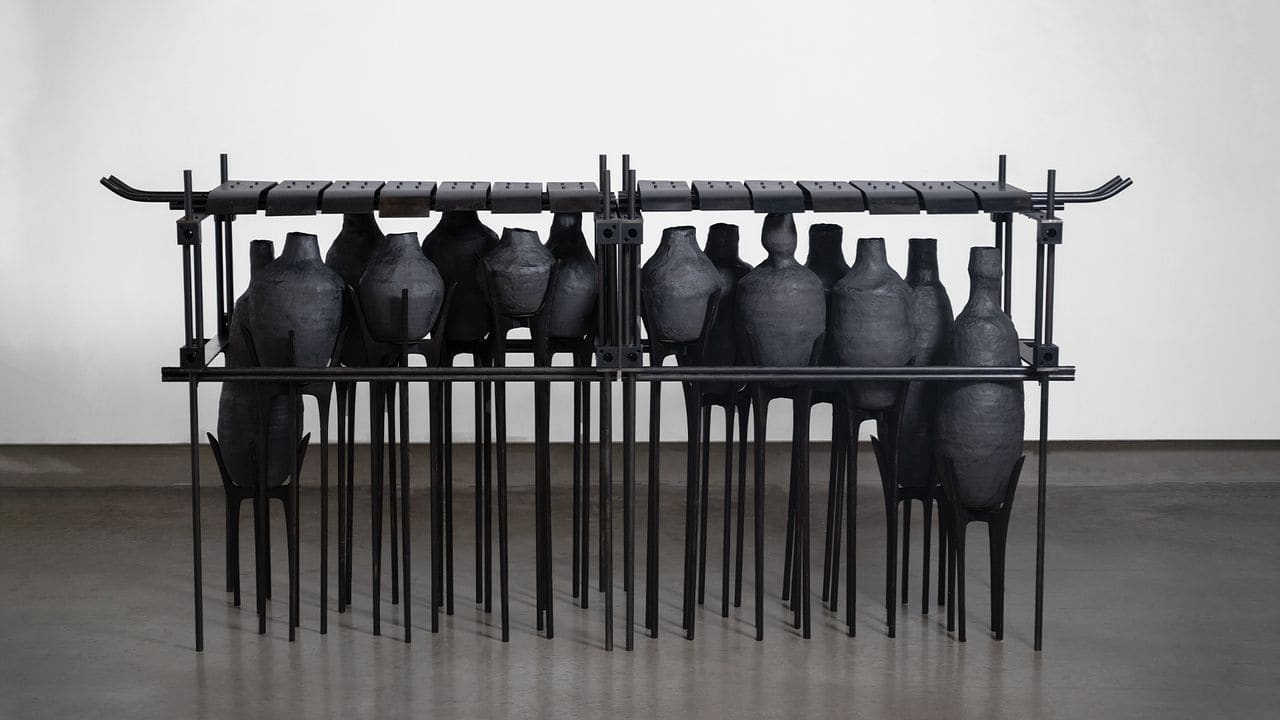
Within that broader framework, individual designers approach the exhibition's central questions from markedly different angles. Simone Brewster, whose first museum show runs concurrently at the Design Museum, will present new work that places her practice in dialogue with the other designers. Architect and artist Giles Tettey Nartey contributes "Strange Notes," a contemporary interpretation of the balafon, a gourd-resonated xylophone originating in West Africa. The piece addresses a persistent problem Nartey has observed: the tendency of the Western design canon to treat traditional West African design as artifact rather than living practice. By reinterpreting the balafon, Nartey insists on its relevance to contemporary design discourse.
Tejumola Adenuga's "Àgbalàgbà (Elderly)" chair, produced in 2022, exemplifies another approach. The work draws on formal traditions while interrogating how age, care, and material culture intersect. Mac Collins presents "Open Code" from 2023, a piece that engages with systems thinking and modularity. Samuel Ross contributes "Signal-3, Trauma Chair, Recovery Chair," work that layers industrial materials with references to healing and resilience. Andu Masebo's "Around Table" from 2025 rethinks communal furniture typologies, while Simone Brewster's "Resting Figure," created for the exhibition in 2026, explores the body's relationship to sculptural form.
The wider group includes Taiba Akhuetie, Phoebe Collings-James, Foday Dumbuya, Feben, Nifemi Marcus-Bello, Saul Nash, Tosin Oshinowo, and Rachel Scott. Work by more than twenty additional designers, including Althea McNish and Yinka Ilori, expands the exhibition's historical scope across the twentieth and twenty-first centuries.
Resisting the "Crafty" Label
One assumption Prempeh particularly wanted to challenge is the persistent framing of Black design as inherently "crafty." That characterization, she argues, often flattens the intellectual rigor and technical complexity present in these practices. The exhibition aims to foreground the systems thinking, material research, and conceptual depth that inform the work on display. Deciding who belonged within that conversation required careful consideration. The exhibition focuses primarily on UK designers or those with significant ties to the country, with shared themes helping determine its final shape.
Curation, Prempeh notes, is fundamentally an act of selecting and organizing. Dozens of other Black designers whose work she respects did not make it into the exhibition, not because their practices lack merit, but because the show required coherence around specific themes that could help tell a compelling story about Black design today. Those choices were difficult, but necessary to create a framework that serves both the designers and the audience.
Who Decides What Enters the Canon?
That framework inevitably raises questions about authority and access. Who has historically decided what enters the design canon? When discussing the canon, Prempeh points out, we are really discussing museum collections and established literature. The directors of those museums and the publishing houses behind that literature have held that power. While independent work on the fringes has value, she argues, it remains equally important to ensure that marginalized stories become part of these institutions. Otherwise, the canon remains incomplete.
Challenging those structures can happen from inside established institutions or beyond them. Some designers are gaining entry into existing spaces and reshaping what those spaces can be once they arrive. Others are moving out of them entirely, forming their own structures. Both strategies matter. That freedom also applies to the stories Black designers choose to tell about themselves. Prempeh hopes contemporary Black designers can decide when they want to discuss their Blackness, what aspects of their identity they want to foreground, and when. That freedom, she insists, is something all designers deserve, not just Black ones.
She also questions why the responsibility for understanding these practices should continually fall on the designers themselves. When asked what happens when Black designers no longer have to make themselves legible to predominantly white institutions, Prempeh reframes the question. The onus, she argues, is on the institutions to meet Black designers where they are, to research and understand the integrity and intention behind their work. When that doesn't happen, the institutions and their audiences are the ones missing out. Black design and Black designers, not just in this exhibition but globally, deserve to be seen, presented, and understood fully.
Leaving with Curiosity, Not Answers
Prempeh's own writing and curatorial practice has always centered on proposing questions rather than resolving them. She wants the exhibition's final moment, Archibong's "Mfon," to do that for visitors: to stop them, to prompt reflection, to generate new questions. If visitors leave with curiosity about Black design, she will have more than achieved her goal.
That curiosity is the point. The exhibition does not seek to define Black design or to establish a new monolith in place of the old one. Instead, it creates space for multiplicity, for designers whose practices resist easy categorization, whose work draws on different traditions, geographies, and concerns. In that refusal to simplify, 'The Nue Black Aesthetic' offers something rarer than definition: room to breathe, to diverge, to claim authority over one's own story. The canon, after all, is not a fixed entity. It is a conversation, and this exhibition insists that conversation must expand to include voices that have been excluded for too long.
'The Nue Black Aesthetic' opens at the Design Museum, London, on 6 November 2026 and runs through 8 August 2027.
Save this story. A free account keeps your reading list and the 07:00 email in one place.
CREATE FREE ACCOUNT →SIGN IN