
A Thread Between Two Cultures
There's a particular kind of intelligence embedded in vernacular textile traditions, one that often gets lost when designers attempt to translate handwork into industrial production. The challenge isn't simply replicating a stitch pattern or copying a motif; it's understanding why a technique evolved the way it did, what problems it solved, and how those solutions might remain relevant at scale. Nipa Doshi and Jonathan Levien have spent their careers navigating this terrain, and their latest collection for Hay demonstrates how much nuance that navigation requires.
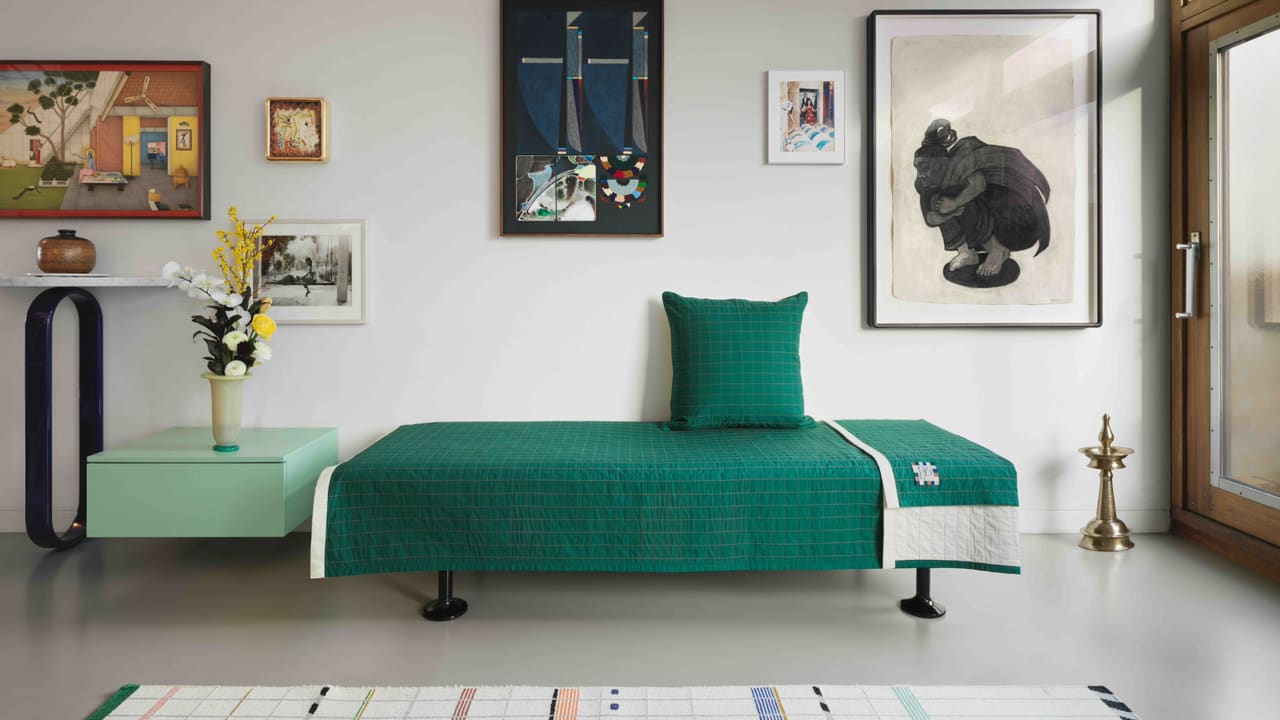
The Dori range, named after the Hindi word for thread, comprises quilted bedspreads, cushions, and organic cotton cushion covers. At first glance, the pieces read as minimal: gridded contrast stitching across reversible two-tone fields. But that simplicity is deceptive. According to Hay, the collection emerged from two years of research, beginning with a fabric sample Mette Hay noticed during a studio visit. The sample featured kantha stitching, a running embroidery technique used traditionally across Gujarat, West Bengal, and Rajasthan for quilting layers of cotton. What caught Hay's eye was the reverse side, where the stitch logic became visible in a way the front concealed.
From Ahmedabad to Industrial Looms
Doshi studied at the National Institute of Design in Ahmedabad, where her aunt ran a textile workshop employing over 60 master craftspeople. That workshop, set within the garden of a modernist house, produced work for Issey Miyake and Hermès, as well as the Charpoy daybed collection Doshi Levien designed for Moroso in 2008. It was there that Doshi developed what she describes as a deep affection for Indian textiles and techniques, alongside an appreciation for the modernist architecture of B V Doshi, Le Corbusier, and Louis Kahn that shaped Ahmedabad's built environment.
Traditional kantha embroidery is hand-stitched, often by women repurposing old saris into layered quilts. The technique is both economical and expressive, each piece carrying the accumulated time of its maker. Translating that into machine embroidery for Hay required rethinking what the stitching actually does. In the Dori collection, the grid isn't purely decorative. According to Doshi, it functions as a subtle guide, indicating how to fold, place, and compose the bed. Even within industrial production, the piece retains what she calls a sense of craftsmanship, where every detail reflects care and time.
This isn't the first instance of Doshi Levien bringing textile traditions into conversation with contemporary furniture systems. The Dori range is designed to coordinate with their Quilton sofa, a quilted landscape system that debuted for Hay in 2021, and their Rabari rug collection for Nanimarquina. Each project shares a similar logic: identifying a vernacular technique, understanding its structural and aesthetic principles, then adapting those principles to different materials, scales, or production methods.
Color as Structure
Doshi Levien maintains an in-house color lab with somewhere between 300 and 400 hues, yet the studio still mixes additional shades for specific projects. For Dori, the designers produced more than 50 color combinations before settling on three reversible two-tone palettes: midnight blue, maroon, and green. The research spanned miniature paintings from Jodhpur, glazed ceramic and lacquer samples, Picasso's 1932 La Lecture, and Malevich's 1915 Suprematism: Self Portrait in Two Dimensions.
The reversible format introduces a layer of complexity. Each piece can be flipped to alter the room's identity, and each colourway is embroidered with two contrasting, bright threads. That means four colors must work together in every iteration: a dark saturated fabric on one side, a light fabric on the reverse, and two thread colors that remain legible against both. The embroidery threads are deliberately vibrant, fine but visible whether stitched into dark or light ground. It's a tighter constraint than it appears, requiring the kind of color literacy that comes from years of material testing.
The studio's Kinari collection for Galerie Kreo was recognized as Best Colour Study in the Wallpaper Design Awards 2024, and that same rigor is evident here. The palette isn't illustrative or nostalgic; it doesn't attempt to evoke India through expected hues. Instead, the colors function structurally, organizing the pieces spatially and allowing users to shift the room's tone without acquiring new objects.
Craft Intelligence in Mass Production
One of the recurring questions in contemporary design is whether industrial production can carry the intelligence of handwork. The answer, as Dori suggests, depends on what you mean by intelligence. If it's the mark of the maker's hand, the answer is no. But if it's the accumulated logic of a technique, the spatial and functional reasoning embedded in traditional making, then the answer shifts.
Kantha stitching developed as a way to extend the life of worn textiles, layering and quilting them into something more durable. The running stitch created both structure and decoration, and the grid it formed helped organize the fabric, preventing layers from shifting. In translating that to machine embroidery, Doshi Levien retained the functional logic. The grid still organizes the fabric; it still guides how the piece is used. What's lost is the temporal trace of handwork. What's gained is accessibility, the ability to produce the pieces at a scale that makes them available beyond a narrow collector market.
The collection also includes small details that resist total abstraction. Each piece carries an embroidered signature on a label, a gesture toward the personal within the industrial. It's a modest detail, but one that acknowledges the studio's position between craft and mass production, between the specificity of Doshi's family workshop in Ahmedabad and the distribution networks of a global furniture brand.
Bedmaking as Ritual
Doshi describes the collection as a celebration of the ritual of making a beautiful bed, of enjoying the process of doing something simple well. It's a framing that positions the textiles not as passive objects but as participants in daily practice. The reversible design, the tactile grid, the carefully calibrated color relationships all encourage a more attentive relationship to domestic space.
This attention to ritual aligns with a broader shift in how studios approach home goods. Rather than designing objects that disappear into the background or announce themselves as statements, there's increasing interest in pieces that invite interaction, that reward the small acts of arranging, folding, and composing a room. The Dori collection fits within that trajectory, offering textiles that feel considered without being precious, accessible without being generic.
At World Archi Design, we've been tracking how studios negotiate the space between vernacular craft and industrial production, and the results are often uneven. Too often, the translation flattens the original technique into surface pattern, losing the structural and functional logic that made it compelling. Doshi Levien's approach is more careful. By focusing on what the stitching does rather than simply what it looks like, the studio has produced a collection that feels coherent with both its Indian textile roots and its role within Hay's catalog. The grid remains a guide; the color remains a structure; the bed remains a ritual. Whether that's enough to justify calling it craft in any meaningful sense is debatable, but it's certainly more thoughtful than most attempts to industrialize handwork.
Save this story. A free account keeps your reading list and the 07:00 email in one place.
CREATE FREE ACCOUNT →SIGN IN