
Fabric as Foundation
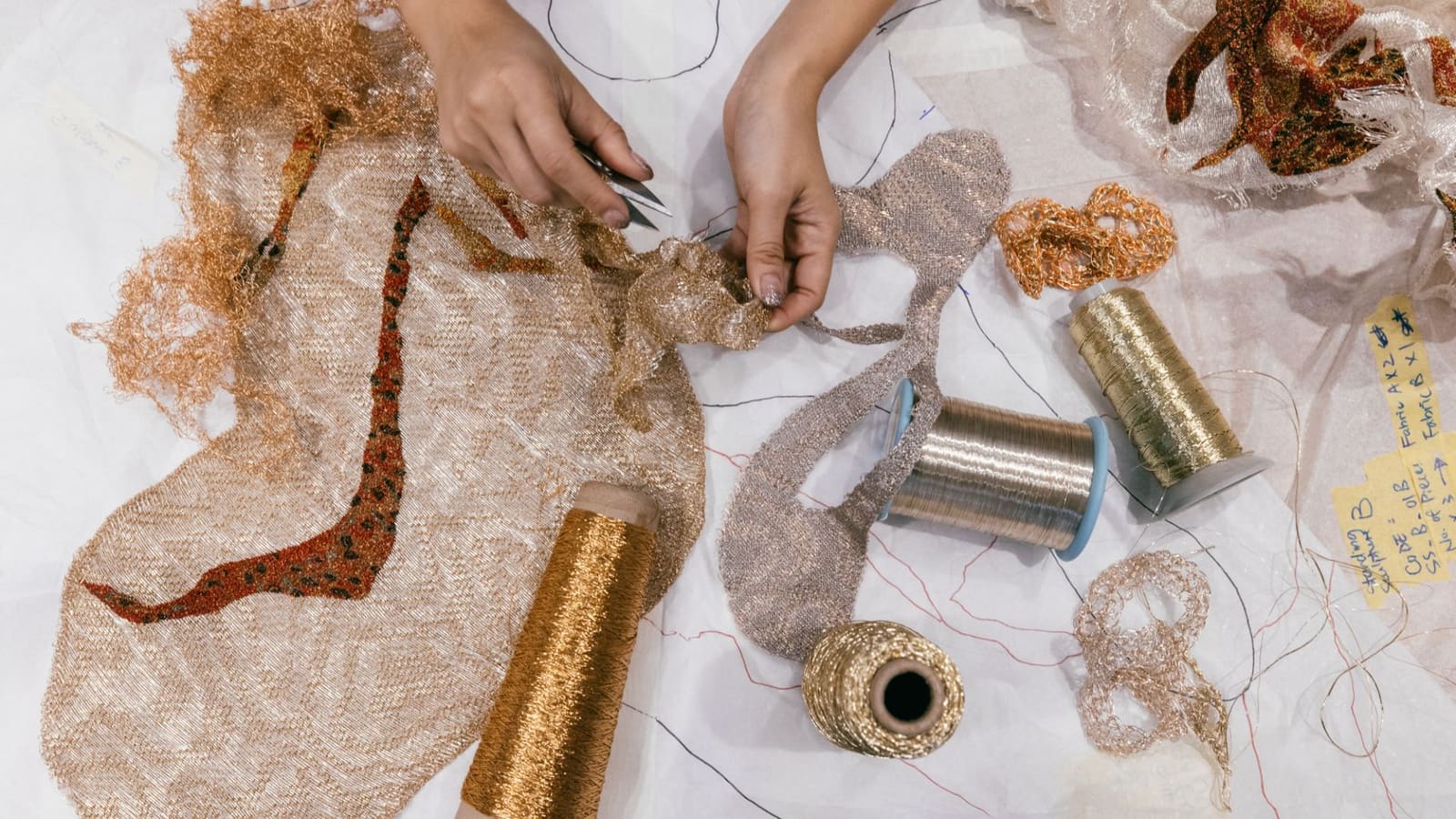
There is a factory unit in Kwai Hing where a jacquard loom shares floor space with a 3D printer. The pairing is deliberate. At The Fabrick Lab, Elaine Yan Ling Ng and her team treat textile not as upholstery or ornament but as a load-bearing system - something closer to rebar than wallpaper. The studio's name encodes the ambition: a pun on "brick," repositioning woven fiber from finish to foundation.
Ng describes the operation as "mad scientists working with needle and thread." The output supports the claim: data-driven sculptures, permanent light installations, thermochromic carpets, and kinetic surfaces that respond to motion or heat. These are not textile applications. They are textile arguments.
The Macallan Commission: Heritage Made Tangible
When The Fabrick Lab was tasked with translating the heritage of The Macallan whisky house into a spatial experience for its Hong Kong location, Ng faced a familiar problem: how to make an invisible process - decades of quiet maturation inside oak casks - visceral to visitors who expect immediacy.
The answer was Phantasmagoria, an interactive installation comprising three thousand handmade textile petals, each one unique, paired with custom LED programming and 3D-printed recyclable polycarbonate modules. The petals were constructed using non-woven and 3D-knit techniques, capturing the organic irregularity that machine precision tends to flatten. Embedded sensors detect proximity and motion - a visitor approaching the piece, or the swirl of a glass nearby - and trigger cascading shifts in light and shadow across the surface, mimicking the slow color transformation of whisky as it absorbs tannins, vanillin, and lignin from barrel wood.
The installation demonstrates Ng's material-first philosophy: technology animates the craft, but without the tactile depth of handwork, the piece would read as sterile. Conversely, without responsive programming, the narrative remains static. The two systems do not compete; they form a composite.
Material-First Process: Designing the Substance Before the Object
Most design studios begin with form. The Fabrick Lab begins with the material itself. When a brief arrives, the team conducts what Ng calls "deep research" - an analysis of the client's culture, objectives, and audience to isolate the emotional register the project must occupy. Then they assemble a bespoke team, often crossing disciplines, and design the material before they design the object.
This sequence is not common. In much of the industry, materials are selected late, pulled from catalogs or supplier lists. Ng inverts that hierarchy. The material becomes the medium through which narrative is engineered.
The studio's first major international commission, SUNDEW, created for Swarovski over a decade ago, crystallized this approach. The installation mimicked carnivorous plants - beautiful, treacherous, kinetic. To achieve the desired movement, the team embedded heat-activated shape-memory polymers into textile structures interwoven with crystal. The result was a surface that could shift form in response to temperature, a kind of choreographed predation.
SUNDEW also established another hallmark of the studio's method: if the machinery to produce a given material does not exist, they hack it. Industrial tools are repurposed, components are combined from unrelated systems, and traditional textile techniques - warps, wefts, loops - are abandoned when they constrain the concept. Fiber is treated as a structural system, not a decorative one.
AI, Craft, and the Limits of Synthesis
Ng is skeptical of AI's utility in the making phase. She acknowledges its value in comparative research - validating the originality of a concept against existing precedents - but when it comes to translating abstract ideas into physical objects, she finds it insufficient. The Fabrick Lab's work depends on human intuition, the lived experience of master craftspeople, and the kind of tacit knowledge that resists codification.
As Ng points out, AI synthesizes documented theories. It cannot yet replicate the physical nuances that emerge when a weaver adjusts tension mid-pass or when a dye reacts unpredictably with fiber. In her view, the studio's original outputs become the data AI will eventually need to learn from, not the other way around. For now, in the realm of physical creation, AI needs craftsmen more than craftsmen need AI.
Textile's Structural Renaissance
For most of the twentieth century, textiles occupied a secondary role in industrial design. Plastic injection molding dominated high-volume manufacturing; fabric was relegated to upholstery, fashion, and soft goods. Even a decade ago, when Ng began working as a Color, Material, and Finish designer in Asia, the role was rare, and materials were often selected as an afterthought.
That is changing. Resource scarcity and sustainability pressures have forced industries to reconsider. Textiles offer advantages that rigid materials cannot: they are lightweight, compactly shipped, and constructed with flexibility that reduces waste. Advanced 3D knitting is now used in medical devices, wearable technical straps, and footwear. The structural potential of fiber - long understood in aerospace and military applications - is finally migrating to consumer and architectural contexts.
Ng predicts that over the next decade, textiles will shift from complementary components to primary structural systems across automotive, aerospace, and medical engineering. The discipline is entering what she calls a "technical craft renaissance," where sustainability and extreme production efficiency converge. Consumers are growing more deliberate; demand for generic, mass-produced items is shrinking. Textiles, with their inherent adaptability and reduced manufacturing volume, are positioned to fill that gap.
Hybrid Methods at Architectural Scale
The Fabrick Lab has already embedded metal and optical fibers into textile structures. Ng's next ambition is to scale the studio's hybrid digital-making methods to architectural dimensions, revisiting earlier research with shape-memory alloys and documenting the methodology in a book. The goal is to prove that the intersection of ancient heritage and progressive technology can fundamentally alter how things are made.
Robotics and advanced hardware are integrating into daily life at an accelerating pace. Textiles, Ng argues, will play a critical role in making these mechanical systems more durable, agile, and human-centric. The irony is that the future of these advanced structures will be rooted in biomimicry and ancient craft - the same techniques that predate industrialization.
Redefining the Supply Chain
At World Archi Design, we have tracked the slow migration of textile innovation from fashion and interiors into architecture and infrastructure. Studios like The Fabrick Lab are not simply applying new materials; they are redefining the supply chain itself. By treating fiber as a structural medium rather than a surface treatment, they challenge the assumption that textiles are inherently soft, passive, or decorative.
Ng's work suggests a different taxonomy: one where fabric can be engineered to carry load, transmit data, respond to environmental stimuli, and communicate narrative. In that framework, the distinction between textile and structure begins to collapse. The loom and the printer share the floor not as opposites, but as tools in the same system - one that builds with thread the way others build with steel.
Save this story. A free account keeps your reading list and the 07:00 email in one place.
CREATE FREE ACCOUNT →SIGN IN