
A Craft Born From Necessity
The story begins not with fashion, but with survival. In Alabama's Black Belt region, a remote bend in the Alabama River became home to a quilting tradition that has endured for more than a century. Women stitched together whatever materials they could find: worn work clothes, leftover fabric scraps, even flour sacks. The goal was warmth in homes that lacked heating. What emerged, however, was something far more profound than functional textiles.
These quilts became repositories of memory, history, and kinship. Dinah Miller, captured in West Africa as a teenager and brought to Alabama in 1860, is often credited as the matriarch of this movement. Her descendants and the broader community continued the practice through generations, each quilt carrying forward not just technique but lived experience. The bold, improvisational patterns that define Gee's Bend quilts resist easy categorization. They are neither purely folk art nor academic abstraction, but something entirely their own.
The land itself carries weight. Named after Joseph Gee, a plantation owner who acquired 6,000 acres in 1816, the area was later purchased by the federal government in 1937. Low-interest loans allowed residents to reclaim ownership of the land their ancestors had worked under enslavement. Martin Luther King visited in 1965, after local authorities severed ferry services to suppress voter turnout. The Freedom Quilting Bee, established the following year, created a cooperative structure that enabled quilters to sell their work to major retailers, including Bloomingdale's.
From Archive to Atelier
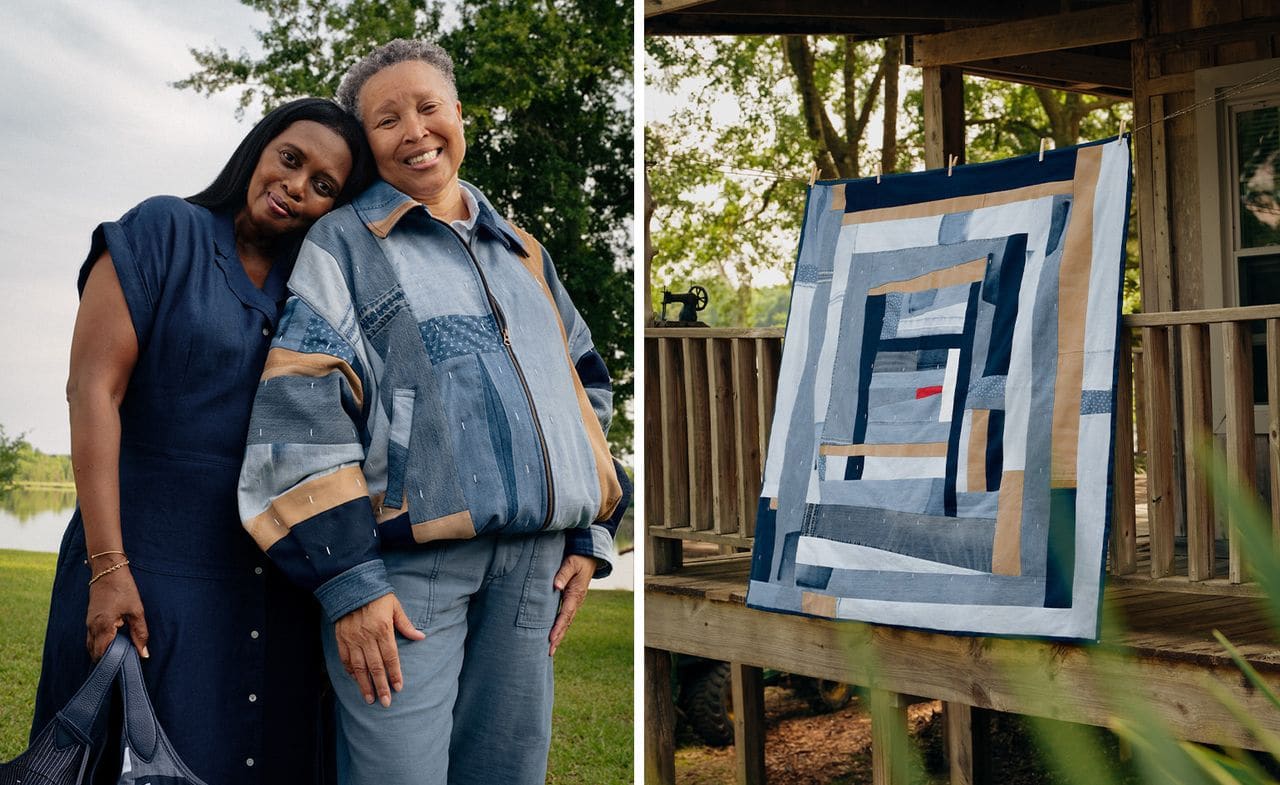
Ralph Lauren has introduced a new collaboration that brings two Gee's Bend quilters, Loretta Pettway Bennett and Claudia Pettway Charley, into its Artist in Residence programme. The project centers on two original quilts created by the textile artists, which have been reimagined across a collection of apparel and home accessories. The range includes a jacket, a reinterpreted Polo Play Bag, decorative pillows, and hand-painted ceramics.
The designs retain the visual language of the original quilts: bold geometric forms, improvisational compositions, and symbolic motifs that carry personal meaning. Pettway Bennett's recurring red triangles, for instance, represent her sons. The aesthetic is unmistakably Gee's Bend, rooted in a vernacular that has evolved over generations through communal practice rather than formal instruction.
Fabrication choices echo the material pragmatism of traditional quilting. Much of the apparel is constructed from denim, a workwear staple that mirrors the repurposed textiles used in historic Gee's Bend quilts. Ralph Lauren has incorporated upcycled fabrics from its own archive, a nod to the resourcefulness that originally shaped the quilting tradition. It is a gesture that aligns material strategy with cultural context, though the commercial scale of production necessarily differs from the intimate, hand-stitched process of the quilters themselves.
The Language of Improvisation
Gee's Bend quilts resist the grid. While many quilting traditions emphasize precision and symmetry, the work emerging from this Alabama community embraces asymmetry, irregular shapes, and unexpected color juxtapositions. This improvisational approach has drawn comparisons to modern art movements, particularly abstract expressionism, though such parallels risk flattening the distinct cultural and historical roots of the practice.
Loretta Pettway Bennett has described the quilting process as deeply intuitive. The quilts absorb the maker's thoughts, concerns, and daily experiences, often without conscious intention. For Bennett, the practice is hereditary, embedded in what she calls her DNA. She has already begun teaching her four-year-old granddaughter to thread needles, ensuring the tradition continues into another generation.
This intuitive, improvisational quality presents both an opportunity and a challenge when translating quilts into fashion and home goods. The original works are singular, hand-made objects that resist mechanical reproduction. Scaling them for commercial production requires a delicate balance: preserving the visual energy and symbolic resonance while adapting to industrial manufacturing processes. The Ralph Lauren collaboration attempts this through pattern translation and material selection, though the inherent tension between craft and commerce remains.
Design With Intent
The partnership is part of Ralph Lauren's broader Design With Intent initiative, which aims to move beyond aesthetic borrowing toward direct collaboration with communities that have historically influenced American design. Previous projects have spotlighted indigenous artists, including Naiomi Glasses, Zefren-M (both Diné/Navajo), and Jocy and Trae Little Sky (Oceti Sakowin) of TÓPA. The initiative represents a shift in how heritage and influence are acknowledged within the fashion industry.
Historically, design inspiration has often flowed in one direction: designers extract motifs, techniques, or aesthetics from cultural traditions without meaningful engagement or compensation. The Artist in Residence model proposes a different structure, positioning the originating artists as collaborators rather than sources. Five per cent of the purchase price from the Gee's Bend collection will be directed to the Equal Justice Initiative, a Montgomery-based organization focused on social justice.
The collaboration raises questions about authorship and attribution in contemporary design. When a quilt created by Pettway Bennett is adapted into a jacket or a bag, who is the author of the resulting object? The pattern language belongs to the quilter, but the garment construction, branding, and distribution infrastructure belong to Ralph Lauren. The partnership acknowledges this complexity, though the mechanics of collaboration, creative control, and financial arrangement remain largely opaque to outside observers.
Material Memory and Market Forces
At World Archi Design, we have been tracking the growing interest in vernacular craft traditions within high-end fashion and interiors. Brands increasingly recognize that heritage techniques carry both aesthetic value and cultural capital. The challenge lies in structuring these partnerships in ways that honor the source communities rather than simply extracting design content.
The Gee's Bend quilters have navigated this tension for decades. The Freedom Quilting Bee provided a cooperative framework that allowed quilters to maintain control over production and pricing. Contemporary collaborations operate within a different economic model, where scale, distribution, and brand equity shift the balance of power. The Artist in Residence programme attempts to address this through direct collaboration and financial contribution, though the long-term impact on the Gee's Bend community remains to be seen.
The collection launches globally through Ralph Lauren's website and select retail locations. The pieces will circulate far beyond Alabama, carrying the visual vocabulary of Gee's Bend into living rooms and wardrobes around the world. Whether this visibility translates into sustained support for the quilting tradition itself, or merely introduces its aesthetic into a broader design lexicon, will depend on structures that extend beyond a single product launch.
Continuity and Change
Quilting in Gee's Bend has always been adaptive. The practice began with necessity, evolved through cooperative enterprise, and now enters the realm of fashion collaboration. Each phase has required negotiation between tradition and circumstance, between preserving technique and responding to new economic realities.
The Ralph Lauren partnership is one iteration of this ongoing negotiation. It offers visibility, financial support, and a platform for quilters whose work has historically been undervalued. It also raises familiar questions about cultural exchange, authorship, and the terms under which heritage becomes design content. The success of the collaboration will ultimately be measured not just in sales or media coverage, but in whether it creates pathways for future generations of Gee's Bend quilters to sustain their practice on their own terms.
Save this story. A free account keeps your reading list and the 07:00 email in one place.
CREATE FREE ACCOUNT →SIGN IN