
The Carpenter's Year
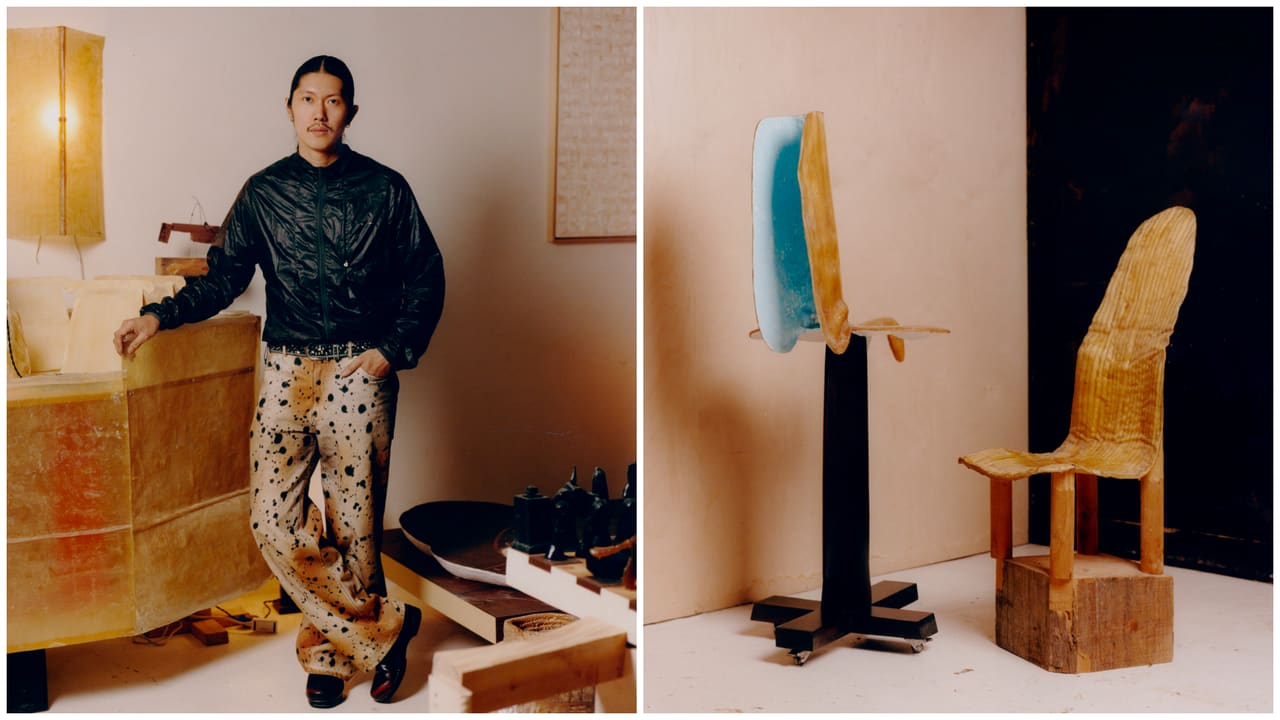
A furniture designer hands over drawings. A craftsman spends twelve months building and lacquering ten chairs. The technique is centuries old, state-protected, rarely seen outside museum collections. For Minjae Kim, showing those chairs in Seoul last year marked the first time he had committed fully to a method his own country formalizes as heritage. He had been designing furniture for half a decade by then, and much of that stretch was spent wrestling with a single question: what does it mean to reference a place you left?
At World Archi Design, we have tracked dozens of designers navigating diasporic identity, but few articulate the discomfort as plainly as Kim does. Born in Seoul, educated in painting and architecture, he completed mandatory military service before relocating to Seattle in 2008 to continue his studies. A master's degree at Columbia University followed, then three years at Studio Giancarlo Valle, then a pandemic-era launch from a basement apartment in New York. The trajectory is familiar. The friction it generates is not.
Remaking What You Do Not Recognize
Kim's first solo exhibition, mounted at LA design gallery Marta in 2021, catalogued Western furniture archetypes. One chair drew directly from the study of Sigmund Freud. These were objects rooted in a cultural vocabulary Kim had absorbed through education, not upbringing. His method was to claim them by transformation: he treated fibreglass like fabric, quilting it before coating it in resin, a process that collapsed the boundary between soft and structural.
The following year, Kim collaborated with his mother, painter Myoungae Lee, for a show at Matter Projects in New York. Four pieces responded to her Coexistence paintings, including a chair that translated her compositional logic into three dimensions. The project was intimate, familial, and the press coverage that followed fixated on heritage. Kim's response was blunt: if someone else had made the same objects, he said, no one would call them Korean.
If You're Korean You Know
The next exhibition, staged with Nina Johnson Gallery in Miami, carried the title IYKYK: If You're Korean You Know. Here Kim made the references explicit. He fabricated moon jars from fibreglass rope, a material choice that felt almost confrontational in its departure from ceramic tradition. He designed lighting inspired by ceremonial robes. The work was legible to anyone familiar with Korean visual culture, and Kim has described his mindset at the time as nearly punk in its defiance. The subtext was clear: if you want to see Korean tradition, I will show you exactly how it is done.
The gesture was sharp, but it was also incomplete. Three years ago, the non-profit cultural foundation Arumjigi invited Kim to bring the IYKYK approach to a South Korean audience. The commission softened what had been a combative stance. It required Kim to address viewers who would recognize the references without needing them explained, and that shift in context changed the work itself. The lacquered chairs that emerged from that process represented a maturation: tradition deployed not as provocation but as material, handled with the same rigor Kim applied to fibreglass or resin.
The Cougar and the City
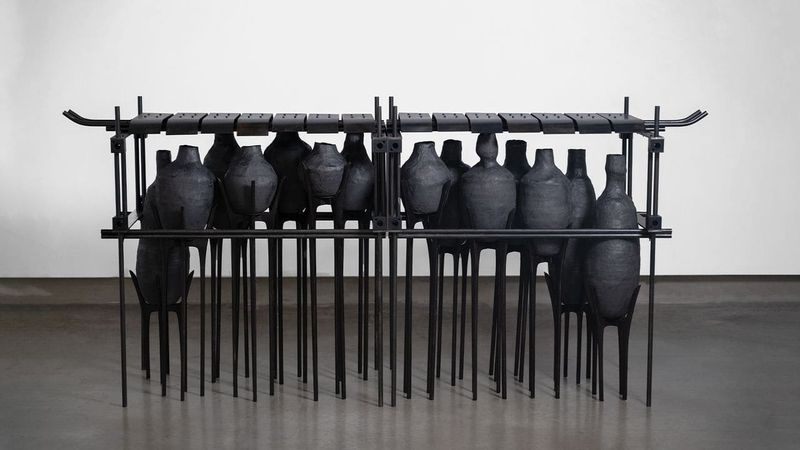
Last year, Kim returned to Marta with Phantom-22, an exhibition that pivoted away from Seoul entirely and fixed on Los Angeles. The centerpiece was a sculpture named after P-22, a mountain lion who crossed multiple freeways to reach Griffith Park, lived there for years, and eventually died. The animal became a local icon, a symbol of urban wilderness and the strange coexistence of nature and infrastructure. Kim's sculpture took the cougar's name and embedded it in a broader meditation on what he called the spectres of the city: creatures, ideas, topographies that define a place but remain half-visible.
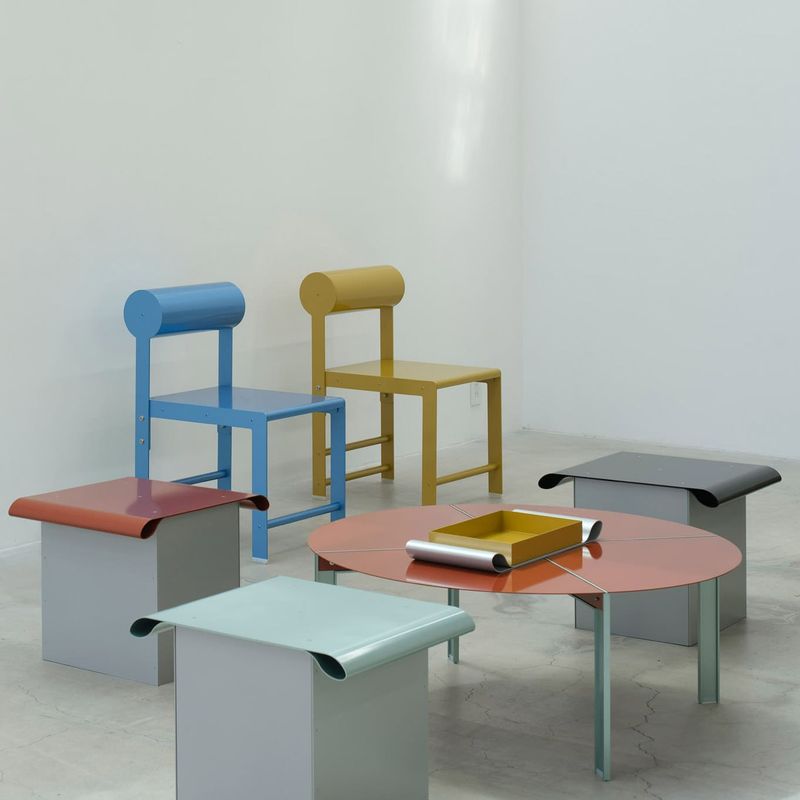
The production furniture in the show was fabricated in California, with cast-resin handles that carried Kim's signature tactile sensibility. The work demonstrated range, an ability to shift geographic and conceptual registers without losing coherence. It also underscored a recurring theme in Kim's practice: the negotiation between place and distance, between making work about a location and making work within it.
The Gap Narrows, the Crisis Melts
Kim has spoken openly about the isolation of working in New York with references that few around him share. He describes it as a lonely fight, one waged in a context where the cultural coordinates of his upbringing remain foreign to most viewers and clients. But he has also noted a shift. As South Korean culture has gained global visibility in recent years, the need to explain himself has diminished. The gap has narrowed, though it has not closed.
Returning to Seoul remains complicated. He stands out. He tries to blend in. The identity crisis, he says, has been melting away, but the phrasing suggests a slow thaw rather than a resolution. In September, Kim will exhibit with Marta at Frieze Seoul, a homecoming of sorts, though one filtered through the apparatus of an international art fair.
Precedent and Parallel
Kim's trajectory invites comparison with other designers who have worked across similar fault lines. Ini Archibong, for instance, has spoken about synthesizing Nigerian heritage with Swiss training and a Southern California upbringing, producing work that refuses to be read through a single lens. Tiffany Loy, based in Singapore, has explored the tension between colonial-era typologies and contemporary Asian identity, often through material experimentation that echoes Kim's approach to fibreglass and resin.
What distinguishes Kim is his willingness to stage the discomfort publicly. The IYKYK exhibition was not a celebration of heritage; it was a response to being read as heritage. The lacquered chairs were not a return to tradition; they were an engagement with it on terms Kim had spent years defining. The work is less about resolution than about making the negotiation visible.
What Remains
Furniture is a slow medium. A chair takes time to build, longer to lacquer, years to understand. Kim's practice has unfolded at that pace, and the work he produces now carries the weight of a decade spent figuring out what it means to design from a position of distance. The lacquered chairs, the fibreglass moon jars, the sculpture named after a dead cougar: these are objects made by someone who has learned to hold multiple geographies at once, without collapsing them into simplicity.
The question Kim started with, what to make of his birthplace, has not been answered so much as reframed. The work suggests that heritage is not a fixed resource to draw from but a set of conditions to work within, against, and through. That approach, rigorous and self-aware, is what gives the furniture its charge. It is also what makes Kim's trajectory worth watching as he continues to build a practice that refuses easy categorization.
Save this story. A free account keeps your reading list and the 07:00 email in one place.
CREATE FREE ACCOUNT →SIGN IN