
From Plywood to Metal
There's a particular kind of design confidence required to take techniques honed in one material and translate them wholesale into another. Shinichiro Okuda, principal of Los Angeles studio Waka Waka, built his practice around Baltic birch plywood, treating the laminated sheets as a signature medium. When Japanese manufacturer Benex approached him to contribute to Eetal, its ongoing sheet-metal furniture initiative, the challenge wasn't simply to design in steel and aluminium but to carry forward a vocabulary developed in wood.
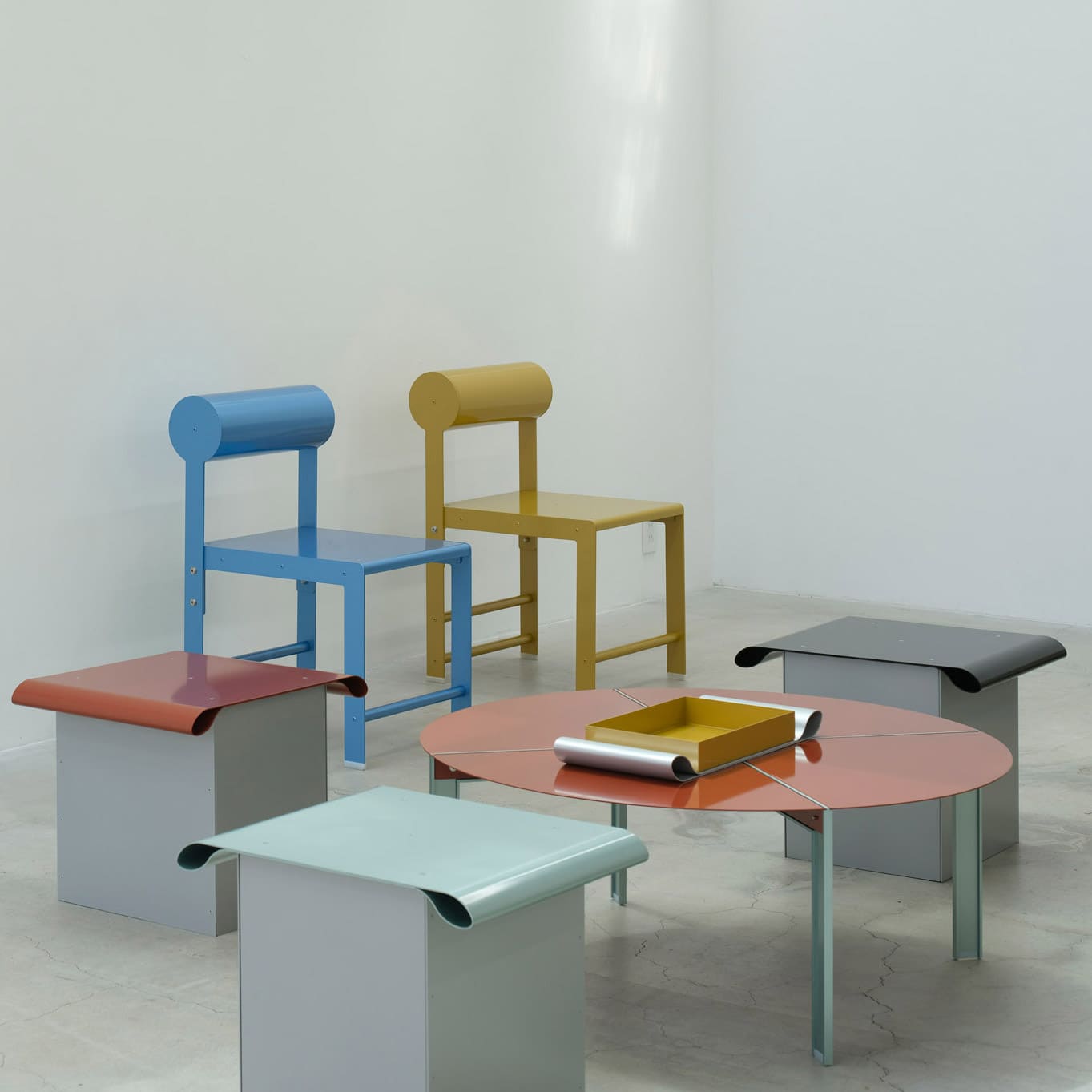
The Ribbon collection, unveiled at 3 Days of Design in Copenhagen earlier this year, is Okuda's answer. Rather than mimic plywood's warmth or grain, the pieces acknowledge metal's inherent character: coolness, structural precision, and an industrial lineage. Yet the collection refuses to let those qualities dominate. Through considered geometries and saturated color, Waka Waka coaxes something unexpectedly fluid from the rigid sheets.
Geometry as Vocabulary
At World Archi Design, we've long observed that the most compelling furniture often emerges from constraint. Waka Waka's approach to the Ribbon line is no exception. Each piece in the collection begins with elemental shapes: circles, squares, arches. These forms are then bent, folded, and curled into three-dimensional configurations that reveal the ductility of thin-gauge metal.
The collection comprises a chair, table, and stool, alongside smaller accessories including a tray, garment hanger, and two clothing racks. What unifies them is a treatment of edges. Where sheet metal typically terminates in a sharp fold or hemmed seam, Okuda introduces ribbon-like curves. The metal doesn't simply turn; it rolls, creating a continuous, glossy border that softens the visual weight of each object.
This formal strategy has precedent in mid-century Scandinavian metalwork, particularly the folded-steel furniture of Bruno Mathsson and Poul Kjærholm, but Waka Waka's iteration feels less austere. The curves are tighter, more gestural, suggesting a handcraft sensibility even when executed through industrial fabrication.
Industrial Blue and Edo Saturation
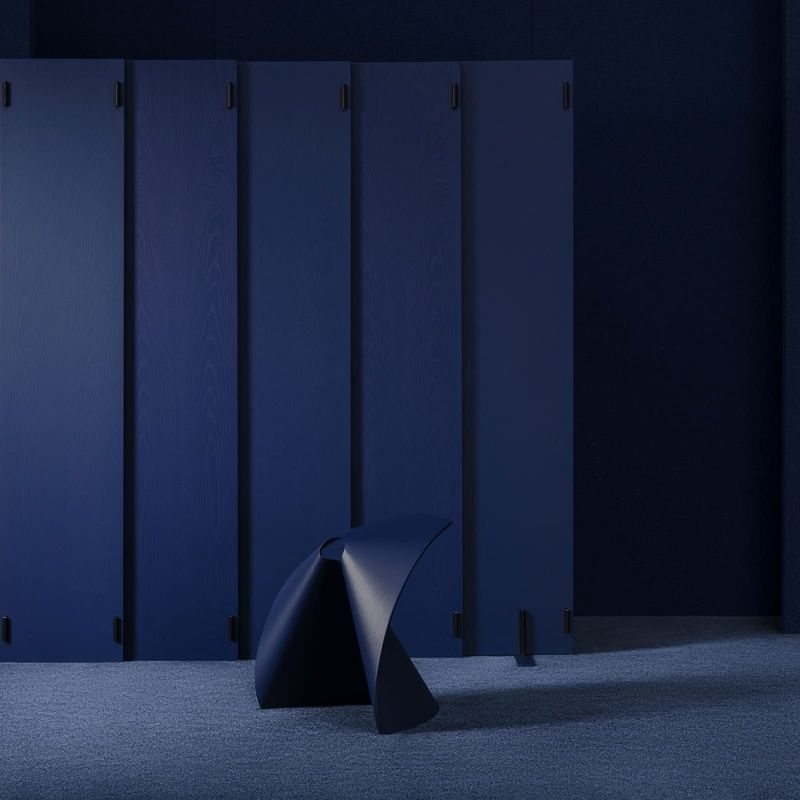
Color in furniture design often functions as decoration, applied after form is resolved. For the Ribbon collection, it operates as a structural decision. Okuda selected the palette during a visit to a Benex production facility, where he noticed a particular blue used across the company's standard industrial products. That hue became the collection's anchor.
The blue in question isn't a contemporary designer color. It's a factory standard, specific to Japanese manufacturing, and it carries associations with utility and mass production. By elevating it to a primary finish, Waka Waka recontextualizes the industrial vernacular, treating factory logic as a legitimate aesthetic source.
To complement the blue, Okuda turned to the Edo period, Japan's early modern era spanning roughly 1603 to 1868. The palette of that time is characterized by saturated, high-chroma hues: vibrant yellows, deep pinks, rich blacks. These colors were achieved through natural dyes and mineral pigments, and they appear throughout ukiyo-e woodblock prints and textile design. Okuda's decision to pair Edo-era saturation with contemporary powder coating creates a temporal layering, where historical color theory meets present-day fabrication.
The result is a collection that feels both recognizable and slightly unfamiliar. The colors are bold without tipping into novelty, grounded by the materiality of the metal itself.
Materiality and Warmth
One of the recurring tensions in metal furniture design is how to address the material's perceived coldness. Steel and aluminium conduct heat rapidly, and their surfaces reflect light in ways that can read as clinical. Designers have historically responded by introducing wood accents, upholstery, or textured finishes, essentially masking the metal.
Waka Waka takes a different approach. Rather than soften the material through hybrid construction, the studio doubles down on metal's properties while introducing warmth through form and color. The ribbon edges create a sense of movement, a fluid line quality that counteracts the rigidity of the underlying structure. The saturated colors, meanwhile, provide visual warmth without compromising the industrial character.
This strategy aligns with a broader shift we've tracked across contemporary furniture design, where designers embrace rather than apologize for their materials. The Ribbon collection doesn't pretend to be something other than sheet metal. The hardware, connection points, and fabrication methods remain visible, even celebrated. It's an approach that recalls the tectonic honesty of Prouvé's folded-steel furniture, though with a lighter, more chromatic sensibility.
Fabrication and Detail
Benex's Eetal project functions as both commission and technical collaboration. The manufacturer produces aluminium and steel sheets for industrial applications, and Eetal challenges designers to explore those materials in domestic contexts. For Waka Waka, this meant adapting plywood joinery concepts to metal fabrication.
Where plywood relies on mechanical fasteners or laminated construction, sheet metal offers bending, welding, and folding. The Ribbon pieces exploit the latter, using the material's flexibility to create self-supporting forms. The chair, for instance, achieves structural stability through a continuous loop of folded metal, eliminating the need for separate legs or bracing. The table similarly uses geometry to distribute load, with arched supports that echo the collection's ribbon motif.
The powder-coated finishes are applied after forming, a sequence that allows the color to wrap seamlessly around curves and folds. This continuity is critical to the collection's visual coherence. Unlike painted metal, which can chip or wear at stress points, powder coating bonds to the surface through an electrostatic process, offering durability that suits both the material and the intended use.
Exhibition and Context
The Ribbon collection has appeared in exhibitions across Japan, including shows in Tokyo and Osaka, with upcoming presentations scheduled for Los Angeles, Fukuoka, and Nagasaki. This circuit matters. Japanese audiences will likely read the Edo-period color references as culturally specific, while Western viewers may respond more to the formal qualities and industrial aesthetic. The collection's adaptability across contexts speaks to its balance of specificity and universality.
In Los Angeles, where Waka Waka is based, the collection will be shown at Small Office in September. The city's design scene has historically favored wood, particularly mid-century teak and walnut, so the introduction of a metal-forward collection represents a counterpoint. It will be interesting to see how local audiences, accustomed to the warmth of timber, respond to Okuda's chromatic approach to cold materials.
Precedent and Position
Folded-metal furniture has a long lineage, from Gerrit Rietveld's angular steel chairs to Ron Arad's sculptural experiments in the 1980s. Waka Waka's contribution lies in its synthesis of industrial process and decorative color. Where Rietveld emphasized structure and Arad pursued sculptural form, the Ribbon collection foregrounds surface and edge condition.
The collection also enters a moment when designers are revisiting sheet goods, both plywood and metal, as sustainable alternatives to solid timber. Metal, in particular, offers recyclability and durability, qualities that align with circular economy principles. By demonstrating that sheet metal can yield expressive, inhabitable forms, Waka Waka contributes to an expanding vocabulary for material efficiency.
Whether the Ribbon collection will influence broader trends in metal furniture remains to be seen. Its success, however, suggests that there's room within industrial materials for warmth, color, and cultural specificity. The challenge for other designers will be to find their own synthesis, one that respects the material while pushing beyond utilitarian convention.
Save this story. A free account keeps your reading list and the 07:00 email in one place.
CREATE FREE ACCOUNT →SIGN IN