
From Surface Decoration to Structural Logic
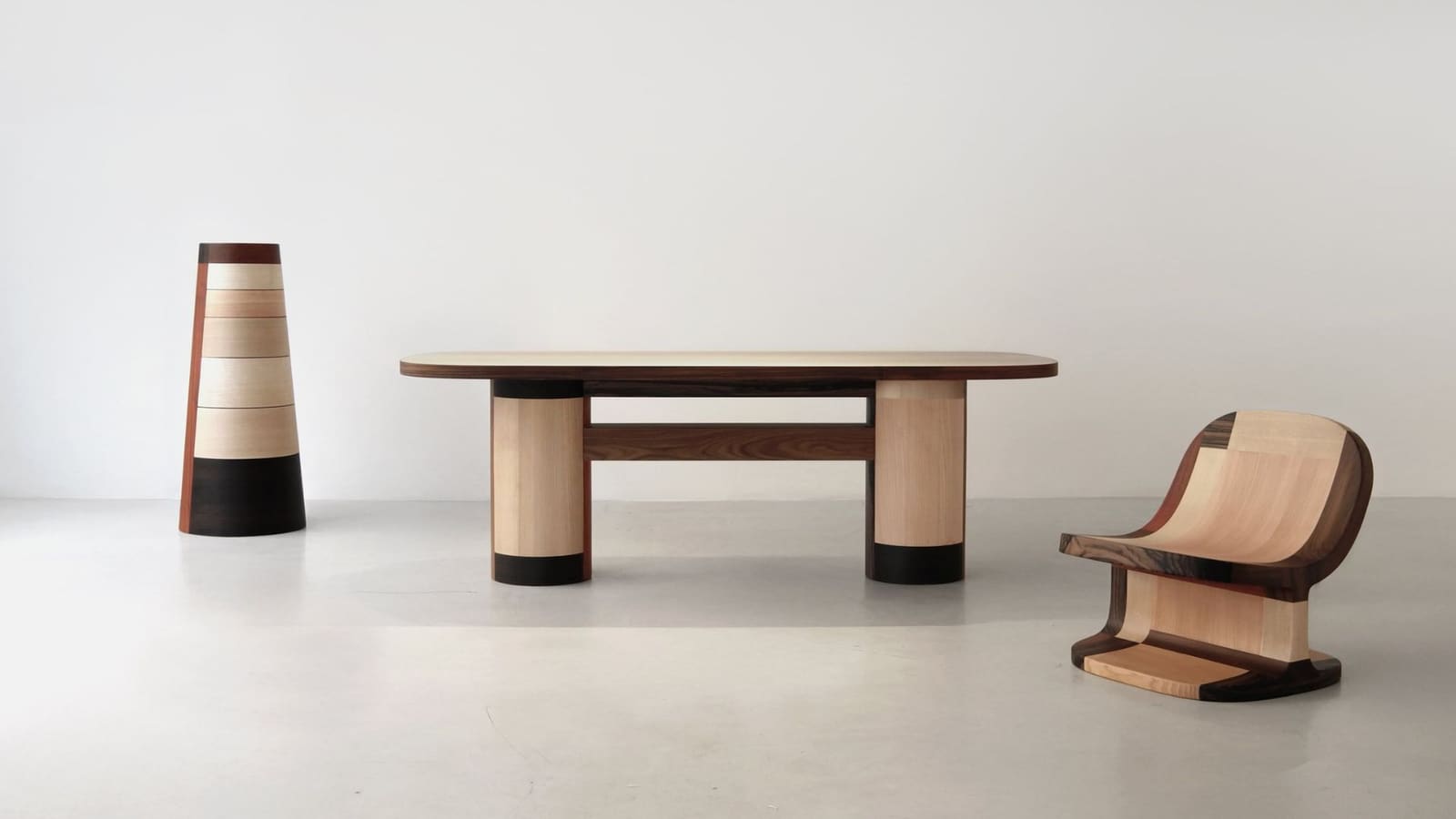
Every furniture workshop produces scraps. The odd-angled pieces left after cutting a board, the narrow strips too small for conventional use, the offcuts that accumulate in bins and eventually find their way to firewood or landfill. Studio Booboon, a Copenhagen-based practice led by Richard Bone and Jisu Yun, has inverted that hierarchy. Their Fragments Becoming collection, shown at Other Circle 2026 during 3daysofdesign, treats those discarded pieces as primary building material, assembling them into cabinets, dining tables, and lounge chairs where every fragment reads as intentional rather than salvaged.
The studio frames the work as 3D marquetry, a term that signals both continuity with historical craft and a departure from it. Traditional marquetry is a surface technique. Thin veneers of contrasting woods are cut, fitted together like puzzle pieces, and glued onto a substrate to create decorative patterns. The method has roots stretching back to Mesopotamian caskets from around 2600 BC and reached ornate heights in Renaissance Italy and Baroque France, where craftsmen produced intricate floral and geometric compositions on furniture facades.
Studio Booboon's approach takes marquetry's visual language but relocates it from surface to structure. Instead of applying a pattern onto a solid core, each timber fragment becomes a load-bearing component. The pattern does not sit atop the object; it constitutes the object. A cabinet door is not a panel with inlay applied to its face. The door itself is the assembled fragments, so the visual composition and the physical construction are identical.
Material Honesty and Compositional Constraints
All three pieces in the collection are finished without stain or added pigment. Every tonal variation, every shift in grain pattern, every contrast visible in the completed furniture comes directly from the inherent characteristics of the timber fragments used. This decision removes the option of correcting or disguising a poorly matched piece with color, which places significant compositional demands on the designer. The assembly must work on the material's own terms, with no post-production adjustment to harmonize mismatches.
This constraint echoes certain precedents in material-forward design. Carlo Scarpa's use of contrasting stone and wood in his Venetian interiors often relied on the inherent qualities of each material to generate visual rhythm, with minimal finishing to obscure their nature. More recently, Max Lamb's Marmoreal tables, cast from reconstituted marble chips, similarly foreground the aggregate as both structure and ornament. Studio Booboon's work sits within this lineage but pushes the logic into furniture typologies that carry different structural demands.
Varied Typologies, Consistent Method
The collection includes a cabinet, a dining table, and a lounge chair, each requiring different approaches to joinery, load distribution, and user interaction. A cabinet door operates on hinges and must remain planar under repeated opening and closing. A dining table surface must span a distance without deflection while supporting distributed weight. A lounge chair must accommodate the dynamic loads of a seated body, with structural members that resist both compression and bending.
Applying the same fragment-based construction method across these typologies is not simply a matter of scaling the technique up or down. Each piece requires its own structural solution, and the fragments must be selected and oriented to meet those demands while maintaining the visual coherence of the assembly. The chair, for instance, likely requires longer, more linear fragments for its legs and backrest, while the cabinet can accommodate more irregular pieces within its panel construction.
The studio does not publish detailed joinery drawings or structural analysis, but the finished pieces suggest a hybrid approach. Some fragments appear to be edge-joined with glue and possibly dowels or biscuits, while others may rely on mortise-and-tenon connections concealed within the assembly. The absence of visible metal fasteners maintains the continuity of the wood surface, reinforcing the read of the object as a monolithic assembly rather than a collection of discrete parts held together by external hardware.
Workshop Waste as Design Constraint
At World Archi Design, we have been tracking the shift from sustainability as a marketing claim to sustainability as a design constraint, a distinction that matters. When waste material becomes the primary input, the designer no longer has the freedom to specify dimensions, grain direction, or color palette in advance. Instead, the design emerges from what is available, and the compositional decisions are made in response to the material at hand rather than imposed upon it.
This is not a new idea. The Japanese tradition of yosegi-zaiku, a form of parquetry developed in the Hakone region during the Edo period, similarly works with small wood pieces to create geometric patterns, though typically at a smaller scale and with a focus on decorative boxes rather than furniture. The Shakers, too, built furniture from locally sourced and often irregular timber, allowing the material's characteristics to inform the final form. Studio Booboon's work extends these precedents into contemporary practice, using offcuts as a constraint that generates rather than limits design possibilities.
The environmental argument is secondary to the formal one. Yes, using workshop waste reduces material consumption and diverts timber from landfill, but the more compelling aspect of the work is how it reframes the relationship between fragment and whole. In conventional furniture making, the whole is primary and the parts are cut to serve it. Here, the parts precede the whole, and the design process becomes one of assembly and composition rather than reduction and shaping.
Craft Research as Ongoing Practice
Fragments Becoming follows Studio Booboon's Playful Reappropriation collection, which launched at Milan Design Week in 2024. That earlier body of work included Jodak, a series of lighting sculptures constructed from fabric offcuts, and the Silhouette furniture series, built from discarded beech slices. Both projects shared the same methodological core: taking fragmentary or discarded material and reassembling it through craft techniques so that the method itself becomes the design language.
Richard Bone, trained at the Royal College of Art, and Jisu Yun, both formerly of Nendo, bring different disciplinary perspectives to the practice. Nendo's influence is visible in the studio's interest in typology and serial production, but Studio Booboon's work is less concerned with industrial scalability and more focused on material research and craft process. The studio operates at a scale that allows for hands-on fabrication and iterative experimentation, which is essential when working with non-standardized material inputs.
The progression from Playful Reappropriation to Fragments Becoming suggests a trajectory toward increasingly structural applications. The earlier work explored waste material primarily in decorative or non-load-bearing contexts, lighting and surface treatments, while the current collection addresses the more demanding requirements of furniture that must support weight and withstand daily use. This shift indicates a maturation of the studio's technical capabilities and a deepening engagement with the structural possibilities of fragment-based construction.
Implications for Material Practice
If marquetry can be extended from surface to volume, other surface-based craft techniques may be similarly reinterpreted. Intarsia, the Italian technique of inlaying contrasting materials into a solid substrate, could theoretically be adapted into a three-dimensional assembly method. Japanese kumiko, the intricate lattice work traditionally used in shoji screens, already operates in three dimensions but has rarely been applied to load-bearing furniture. The conceptual leap Studio Booboon makes is not inventing a new joinery technique but recognizing that a decorative method can be repurposed as a structural one.
The broader implication is that waste material, when treated as a primary input rather than a secondary byproduct, can drive formal innovation. Designers working under material abundance have the luxury of specifying ideal dimensions and properties. Designers working under material scarcity or with waste streams must develop different compositional strategies, ones that respond to irregularity, variation, and constraint. Studio Booboon's work demonstrates that these constraints do not limit design but redirect it, producing forms and methods that would not emerge under conditions of material abundance.
Open Questions
Several questions remain unanswered in the studio's presentation of the work. How are the fragments sourced? Are they exclusively from Studio Booboon's own workshop, or does the studio collect offcuts from other furniture makers? What species of timber are used, and does the collection include both hardwoods and softwoods? How are the fragments prepared before assembly? Are they planed to uniform thickness, or does the assembly accommodate variation in dimension?
These are not trivial details. If the method is to be adopted more widely, understanding the parameters within which it operates becomes essential. A furniture maker working primarily with hardwoods will generate different offcuts than one working with softwoods or plywoods, and the joinery methods that work for one may not translate to another. Similarly, the tools and skills required for this type of construction are not standard in most contemporary furniture workshops, which are typically organized around cutting, shaping, and finishing whole boards rather than assembling fragments.
Marquetry's Next Chapter
Studio Booboon's Fragments Becoming collection does not resolve all the technical and practical challenges of building furniture from offcuts, but it establishes a compelling proof of concept. By extending marquetry from surface decoration to volumetric construction, the studio opens a line of inquiry that other designers and makers can pursue. The work is not a finished system but a starting point, a demonstration that a centuries-old craft technique can be reimagined for contemporary material and environmental contexts.
Whether this approach scales beyond studio production remains to be seen. The labor intensity of selecting, preparing, and assembling individual fragments may make it impractical for mass manufacturing, but that does not diminish its value as a research direction. Some of the most influential design work of the past century has operated at the scale of the prototype or limited edition, establishing formal and technical precedents that later inform industrial production. Studio Booboon's contribution is not a product line but a method, and methods can be adapted, refined, and reinterpreted across different contexts and scales.
Save this story. A free account keeps your reading list and the 07:00 email in one place.
CREATE FREE ACCOUNT →SIGN IN