
Building a World to Witness Its Own End
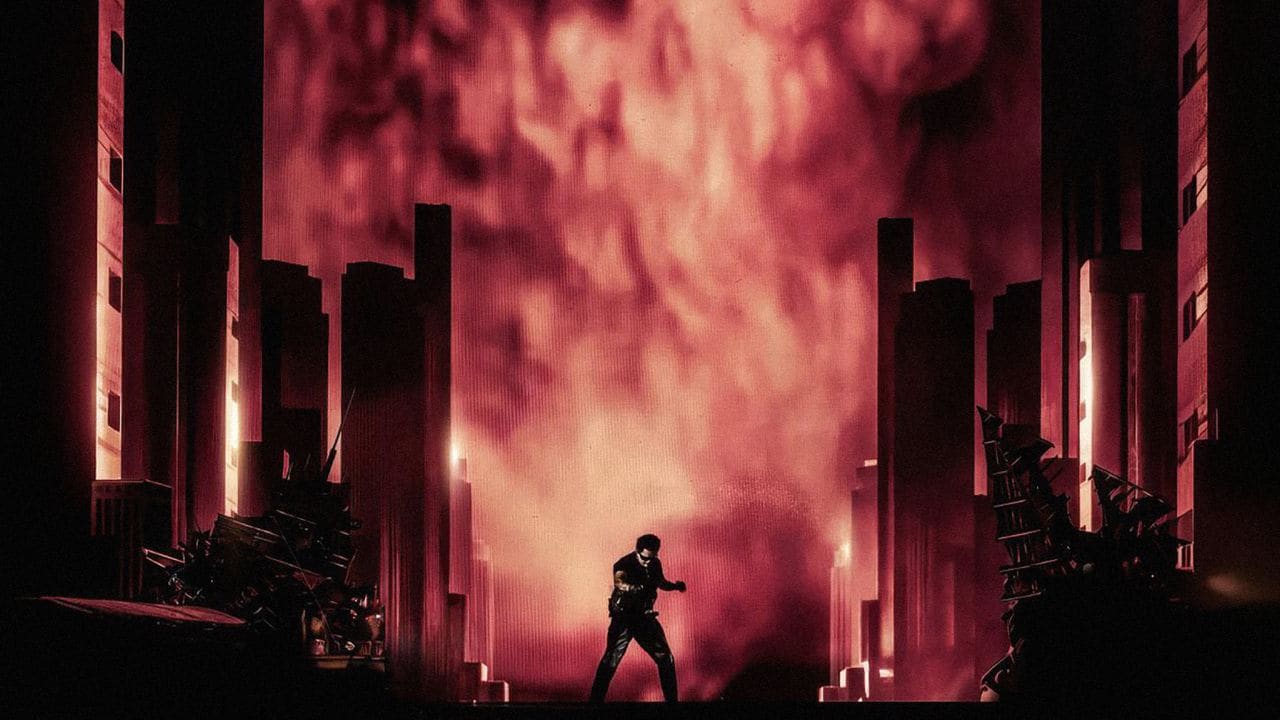
When a city is designed to collapse, it must first convince you it was worth building. That principle governs Alexander Wessely's scenography for The Weeknd's After Hours Til Dawn tour, a four-act descent through post-apocalyptic urbanism now arriving at Wembley Stadium for five nights beginning 14 August. The Swedish-Greek artist has crafted a stadium-scale environment where physical set, LED surface, light, and smoke converge into architecture that ages before the audience, fracturing in synchrony with the performer's narrative arc. This is not spectacle for its own sake; it is spatial storytelling in which the built environment carries as much emotional weight as the music itself.
Wessely's route into scenography passed through photography, and that origin remains legible in his approach to illumination. Light, in his hands, is not decorative but structural. It grants physical consequence to objects that might otherwise dissolve against the scale of projection. Every beam is shaped, every shadow intentional, so that steel, fabric, and engineered form maintain their presence alongside digital imagery. The screen builds pictures; light builds mass. In an era when LED walls dominate live performance design, Wessely's insistence on treating light as a tectonic element rather than an atmospheric flourish distinguishes his work from the prevailing flatness of much contemporary stage design.
The Image That Unlocked the Ruin
The conceptual breakthrough for this iteration of the tour was not a skyline or a screen treatment but a single figure rising from ash in darkness, caught in slow strobes. From that image, Wessely began thinking in fragments: classical ruins, archaeological remains, broken things with greater presence than complete ones. The stadium becomes an excavated future, a space that reads as both sacred and abandoned. He describes it as closer to a cathedral than a stage, and that framing is instructive. Cathedrals are designed to humble the body, to make the individual feel the weight of something larger. Wessely applies that logic to a pop performance, using scale and ruin to position the performer not as hero but as remnant.
The set evolves across the trilogy in tandem with the emotional trajectory of Abel Tesfaye's narrative. It begins whole, monumental, bathed in gold. By the tour's later chapters, the architecture splinters, temperature drops, colour drains, and the world outlives the man at its centre. This is not aging as metaphor; it is aging as material fact. The fracture is structural, not cosmetic. Wessely and show director La Mar Taylor, who co-founded XO with Tesfaye and has shaped the visual identity of The Weeknd from the outset, worked to ensure that the physical environment bore the same damage as the performer. The result is a rare alignment of narrative, spatial design, and musical pacing in which the audience moves through collapse rather than observing it from a distance.
Blurring the Seam Between Steel and Screen
One of the most technically ambitious aspects of the production is the deliberate dissolution of the boundary between physical set and LED wall. Wessely extends the built architecture digitally so that the screen becomes the continuation of the city, not a backdrop to it. Set extensions push the horizon past what the eye can verify, and at a certain point the stadium itself begins to feel like part of the ruin. This blurring of the real and the projected is a preoccupation Wessely has pursued in other contexts, including his work at Sphere Las Vegas, where the immersive LED envelope challenges conventional distinctions between surface and space.
The strategic advantage of this approach is twofold. First, it allows the scale of the world to shift instantaneously. The screen can transform Tesfaye into a giant, then reduce him to dust, before the audience registers the transition. Second, it anchors the digital imagery in physical truth. The steel, the light, the smoke, these elements provide weight and consequence that prevent the spectacle from collapsing into pure virtuality. Wessely argues that both are necessary: the physical gives you truth, the screen gives you transformation. Without the former, the latter becomes weightless; without the latter, the former becomes static.
The Body Against the Architecture
Tesfaye's physical relationship to the set shifts across the performance in a way that maps directly onto the narrative arc. He begins vast, monumental, a figure at the peak of his own worship. The world is built to frame him as untouchable, gold-lit, elevated. As the show progresses, the architecture turns on him. He glitches, fragments, loses control of his own image. By the final act, he is returned to human scale, one to one with the audience, and then he disappears. The world outlives him. This progression from worship to dissolution is not subtext; it is the organizing logic of the entire spatial system.
Wessely's decision to make the performer smaller as the set grows more fractured inverts the typical logic of stadium spectacle, in which scale is deployed to amplify the star. Here, scale is deployed to diminish the individual, to position him as subject to forces larger than himself. The architecture does not serve the performer; it survives him. That reversal is what gives the production its conceptual coherence and prevents it from devolving into empty grandeur.
Sorayama's Chrome Relic and the Question of Worship
At the centre of the set sits a sculpture by Hajime Sorayama, the Japanese artist known for his hyper-realistic depictions of chrome-bodied figures. The work is futuristic, weathered, erotic, and archaeological all at once. It reads as both idol and ruin, a relic from a civilisation that mistook the machine for a god. Wessely met Sorayama in Tokyo, and the alignment was immediate. Both artists circle the same question: what does the human worship when it no longer knows what it believes?
The chrome body functions as a visual anchor for the production's thematic concerns. It is patinated, suggesting age and exposure, yet it remains reflective, catching light and throwing it back into the space. It is a machine rendered sacred, or a sacred object rendered mechanical. The ambiguity is intentional. In a performance about a man losing himself, the sculpture becomes a mirror for the audience's own uncertainty about what deserves reverence. It is not incidental that the figure is humanoid but not human, that it suggests the body without being one. That tension between the organic and the synthetic, between presence and absence, runs through the entire production.
Light as Vernacular
Wessely's background in photography continues to inform his spatial practice. He treats light not as an effect but as a primary material, one that shapes volume, defines edges, and gives objects their physical presence. In the context of a stadium tour, where LED walls can easily overwhelm physical elements, this approach is essential. The real objects on stage, the steel beams, the platforms, the sculptural forms, must hold their own against the scale of the screen. Light is what allows them to do so. It is what makes them feel like something you could touch rather than something projected.
This insistence on the materiality of light aligns Wessely's work with a longer tradition of spatial design in which illumination is understood as architecture. Louis Kahn spoke of light as the maker of material; James Turrell uses it to construct perceptual environments; Olafur Eliasson deploys it to reveal the mechanisms of seeing. Wessely operates in that lineage, applying it to the ephemeral, high-velocity context of live performance. The result is a scenography that feels less like decoration and more like construction, less like atmosphere and more like structure.
Designing for Descent
The tour is structured in chapters, each with its own state of collapse and its own temperature. The peak is gold, monumental, slow, worship at its highest. The middle fractures, colder, faster, the image breaking apart. The end strips everything back to a single figure in near silence. Colour and pace carry the descent, so the audience feels the fall in the light before they could articulate it. This is spatial dramaturgy: the environment as protagonist, the architecture as narrator.
Wessely's challenge was to make the collapse legible without making it literal. The city does not explode; it erodes. The fracture is gradual, atmospheric, felt before it is seen. This requires a different kind of precision than traditional set design, one that attends to incremental shifts in tone, texture, and intensity. The audience must be able to sense the change without being able to pinpoint the moment it occurred. That is the hallmark of effective environmental storytelling: the world changes you before you notice it has changed.
What the Screen Cannot Do
For all the power of digital projection, Wessely remains committed to the primacy of the physical. The screen can shift scale, multiply imagery, and create worlds that defy material constraint. But it cannot, on its own, provide the weight and consequence that physical objects carry. Steel, smoke, light, these elements have mass. They occupy space. They can be felt as much as seen. That tactile dimension is what prevents the production from dissolving into pure image, what anchors the spectacle in something approximating reality.
This is not a nostalgic preference for the analog. It is a recognition that live performance operates in physical space, with bodies present in real time. The screen extends that space, expands its possibilities, but it cannot replace it. The most effective moments in the tour are those in which the physical and the digital become indistinguishable, in which the seam disappears and the audience loses the horizon. That dissolution is the goal, and it requires both vocabularies working in concert.
The Cathedral and the Ruin
At Wembley, London audiences will encounter a version of the tour that has been mutating since 2022. The city has aged. The architecture has fractured. The performer has been reduced, elevated, and erased. What remains is a space that feels both ancient and speculative, a ruin from a future that has already passed. Wessely has built a world that outlives its inhabitant, a stadium-scale environment in which collapse is not an event but a condition. It is scenography as archaeology, architecture as narrative, light as mass. And it is, in the end, closer to a cathedral than a stage.
Save this story. A free account keeps your reading list and the 07:00 email in one place.
CREATE FREE ACCOUNT →SIGN IN