
The Architecture of Interrupted Futures
What happens when a building designed for production becomes a monument to possibility itself? Ibrahim Mahama's current exhibition at the Fondation Cartier poses this question not as theoretical speculation but as literal fact. The Ghanaian artist has purchased, dismantled, and transported portions of the Aboso Glass Factory - a bottle plant inaugurated by President Kwame Nkrumah in 1966, weeks before his government collapsed - and reconstructed it within Jean Nouvel's luminous Parisian galleries. The original signage, metal framework, 1,000 wooden crates, and more than 25,000 green glass bottles now occupy the museum's ground floor, an act of architectural salvage that doubles as historiography.
Born in Tamale in 1987, Mahama gained international recognition after enveloping Venice's Arsenale in burlap sacks during the 2015 Biennale. Those jute remnants - originally produced in South Asia, then used to transport Ghanaian cocoa to European markets - have become his signature material. Yet the current show, titled "The Harvest Season" and curated by Aby Gaye-Duparc, reveals an expanded practice that treats entire built environments as sculptural elements. The factory installation, titled Things Fall Apart, required two years of negotiation and logistical choreography. A second iteration is being assembled simultaneously at Mahama's Red Clay studio in Tamale, creating a trans-continental dialogue between the work's sites of origin and display.
The choice of the Aboso facility is deliberate. Nkrumah's government opened the plant as part of Ghana's post-independence industrialisation programme, an attempt to build manufacturing capacity and reduce reliance on former colonial powers. The coup d'état that toppled Nkrumah arrived mere weeks later, severing that trajectory. By acquiring the factory's physical fabric before it could be scrapped, Mahama has arrested a different kind of erasure - the disappearance of material evidence for a future that never arrived.
Spatial Syntax and Symbolic Loads
Nouvel's 2024 expansion of the Fondation Cartier offers 4,000 square metres of exhibition space, much of it organised around 19th-century stone arches salvaged from the site's previous incarnation. Mahama has suspended lengths of burlap between these columns, creating a porous threshold between street and gallery. The juxtaposition is instructive: European masonry paired with South Asian jute that carried West African commodities. Each material system embeds a history of labour and circulation; together, they form a stratigraphic reading of global exchange.
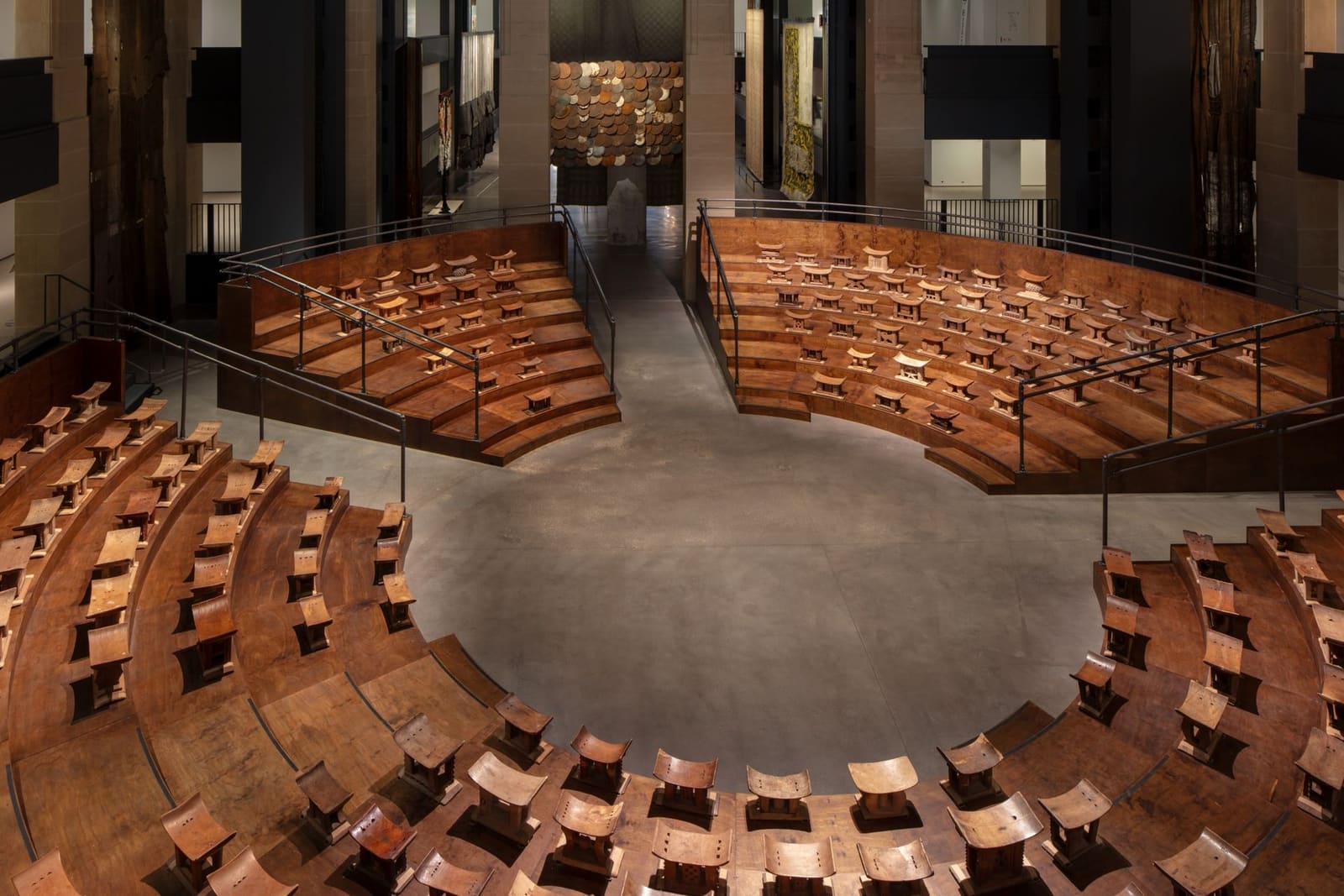
Elsewhere in the exhibition, Parliament of Ghosts presents rows of empty wooden stools sourced from the Asante Empire, which British forces annexed in 1902. Arranged in parliamentary formation, the installation references both pre-colonial governance structures and the democratic institutions that followed independence. Mahama reconfigures this work for each presentation; the Asante stools replace chairs used in earlier iterations, deepening the piece's engagement with contested political genealogies. The absence of bodies amplifies the question: who was meant to occupy these seats, and what conversations were foreclosed?
The artist's collage series layers archival factory documents with charcoal renderings of labourers carrying steel rails. The drawings reference the construction of colonial-era railways, infrastructure built to extract resources rather than serve local populations. By superimposing these figures onto industrial paperwork, Mahama collapses temporal distance, suggesting continuities between 19th-century forced labour and 20th-century economic dependency. The technique recalls Robert Rauschenberg's combines, but where Rauschenberg trafficked in American consumer detritus, Mahama's materials encode asymmetries of power.
Collective Practice and Institutional Critique
Mahama has invited nine artists and collectives to participate, a curatorial gesture that reflects his broader commitment to collaborative infrastructure. Proceeds from his own sales have funded three art centres in Tamale, including Red Clay, which houses disused trains once operated around Ghana's manganese and bauxite mines. These locomotives, now static, function as archives - material witnesses to extractive industries that enriched foreign shareholders while leaving minimal local benefit.
Among the invited contributors is Dorothy Akpene Amenuke, Mahama's former professor at Kwame Nkrumah University of Science and Technology, whose textile installation Gli (meaning "wall") consists of deep red woven panels that visitors can walk among. The piece operates at the scale of architecture, transforming fabric into spatial partition. Amenuke's presence in the exhibition underscores Mahama's pedagogical lineage; he credits her with introducing him to burlap as a medium capable of bearing both aesthetic and political weight.
James Barnor, now 97, appears with photographs documenting Ghana's independence era, when he worked as the country's first photojournalist. Two years prior, Mahama reconstructed Barnor's 1950s Accra portrait studio, Ever Young, at Red Clay, installing a large-format Polaroid camera to shoot contemporary residents. The resulting portraits hang alongside Barnor's earlier work, creating a temporal fold that measures the distance between liberation's promise and its partial realisation.
The CATPC - Congolese Plantation Workers Art League - contributes sculptures cast in a composite of cacao, sugar, salt, and palm oil. One depicts an art collector astride a bull, a sardonic commentary on Western institutions that acquired African objects through colonial channels. The collective uses art sales to repurchase land confiscated in 1911 by the founders of Unilever, who employed forced labour to harvest palm oil. Their inclusion in a French museum carries deliberate irony; as collective member Ced'art Tamasala notes, they are "coming to take back a bit of the strength, to bring it back to the plantation where everything came from."
Material Permanence and Adaptive Strategies
Mahama's decision to acquire and relocate the Aboso factory extends a lineage of architectural preservation that includes Gordon Matta-Clark's building cuts and Rachel Whiteread's casts. Yet where Matta-Clark fragmented structures to reveal hidden spaces and Whiteread inverted them into solid form, Mahama treats the factory as a readymade - an industrial artefact elevated to art status through recontextualisation. The gesture recalls Marcel Duchamp's fountain, but operates at architectural scale and with explicitly post-colonial intent.
The logistical complexity of the project cannot be overstated. Dismantling a factory, transporting its components across continents, and reassembling them within a climate-controlled gallery required permissions from Ghanaian authorities, coordination with French customs, and structural engineering to ensure the installation could bear its own weight. Mahama describes the process as "insanely difficult," yet necessary to "introduce a new audience to a very different position in terms of what art from the continent has to offer."
That position involves treating material culture not as static heritage but as live resource. By splitting the factory between Paris and Tamale, Mahama ensures the work functions in both contexts - as exhibition piece and as public space for reflection on industrial history. This dual siting challenges the conventional flow of African art toward Western institutions, proposing instead a model of simultaneous presence that refuses to privilege one location over another.
Beyond the Burlap: Expanding Vocabularies
While Mahama's jute works remain present - hanging between the Fondation's arches, absorbing and diffusing light - the exhibition demonstrates a deliberate expansion of formal strategies. Paintings by Gideon Appah, Mahama's contemporary from art school, hang alongside loans from the Musée d'Orsay, a curatorial choice that positions Appah's figurative canvases within art historical lineages while maintaining their grounding in Accra's visual culture. Appah's subjects - surfers, cinema facades, men in tailored suits - reference the 1970s as a moment of urban sophistication, a counterpoint to ethnographic readings that collapse African cities into undifferentiated tradition.
Zohra Opoku, a German-Ghanaian artist, presents screenprinted textiles visible through the museum's street-facing windows. Her work examines heritage and identity; she met her father, a village chief, for the first time at age 27, shortly before his death. The textiles negotiate the distance between diasporic experience and ancestral claim, using pattern and repetition to explore belonging as constructed rather than inherited.
The inclusion of artists from Slovenia, Afghanistan, and the Democratic Republic of Congo further complicates any singular reading of the exhibition as "African art." Mahama's selection criteria prioritise connection - personal, political, or conceptual - over geography. This approach reflects a post-national curatorial logic that recognises how colonialism, migration, and global capital have already scrambled neat regional categories.
The Question of Harvest
The exhibition's title, "The Harvest Season," operates as both metaphor and methodology. Mahama describes his practice as harvesting "the potentials that were in the past, but somehow stayed there and never travelled to the future." This temporal model differs from nostalgia; it treats history not as lost golden age but as reservoir of unrealised possibility. The factory, the trains, the burlap sacks - each object contains latent futures that were interrupted or redirected. By relocating and recontextualising them, Mahama proposes that those futures might yet be accessed, not as resurrection but as raw material for new configurations.
The metaphor extends to his institutional practice. The three art centres he has established in Tamale function as sites of harvest in a different register, cultivating creative capacity through open access rather than credentialing gatekeepers. Students, plantation workers, and established artists share the same spaces, a model that refuses hierarchies of training in favour of collective experimentation. This approach aligns with the pedagogical experiments of Black Mountain College or the Bauhaus, but emerges from specifically Ghanaian conditions and priorities.
Curator Gaye-Duparc frames the exhibition around a central question: what remains of the utopias conceived during African independence in the late 1950s and early 1960s? Which legacies endured, which failed, and how might contemporary practice build from those foundations? Mahama's answer involves neither celebration nor lament. Instead, he treats independence-era ambitions as ongoing projects, their incompleteness not as failure but as invitation.
Precedent and Divergence
Mahama's work invites comparison with other artists who have engaged post-colonial material culture. El Anatsui's bottle-cap tapestries similarly transform commodity packaging into monumental textiles, yet Anatsui's surfaces tend toward abstraction, their origins legible but not foregrounded. Mahama retains the indexical quality of his materials; the burlap sacks remain visibly burlap sacks, their stitching and stains intact. This refusal of aesthetic transformation echoes Arte Povera's embrace of humble substances, though Mahama's materials carry geopolitical freight that Jannis Kounellis's coal or Michelangelo Pistoletto's rags do not.
Closer parallels might be drawn with Theaster Gates, whose Dorchester Projects in Chicago rehabilitate abandoned buildings as cultural infrastructure. Both artists leverage art-world capital to fund community resources; both treat architecture as sculptural medium. Yet where Gates works within a single city, reimagining urban decline through targeted intervention, Mahama operates across continents, tracing the material flows that connect Tamale, Accra, and Paris through histories of extraction and exchange.
The factory installation also recalls Thomas Hirschhorn's monument projects, temporary structures that occupy public space to honour overlooked figures. Hirschhorn's Gramsci Monument (2013) in the Bronx created a summer-long gathering place; Mahama's factory functions similarly as social sculpture, though its status as museum exhibition rather than neighbourhood intervention alters its public. The Fondation Cartier's location in central Paris ensures high foot traffic, yet the audience remains predominantly art-world affiliated, a limitation Mahama acknowledges through the simultaneous Tamale installation.
Institutional Choreography
The Fondation Cartier's decision to dedicate its second major exhibition in the new Nouvel building to Mahama signals institutional confidence in work that does not conform to conventional display formats. The factory installation required structural reinforcement; the burlap hangings demanded careful tensioning to prevent sagging; the green glass bottles, stacked in precarious towers, necessitated seismic bracing. These technical demands reflect a broader curatorial willingness to accommodate practices that challenge white-cube neutrality.
That willingness has limits. The exhibition remains a temporary occupation; after February 2027, the factory will be dismantled again, its components returned to Tamale or dispersed. This impermanence is intrinsic to Mahama's practice - he reconfigures works for each presentation - yet it also reflects museums' structural resistance to permanent alteration. The building will return to its prior state, the intervention absorbed and erased.
Mahama appears sanguine about these constraints. When asked about timing the exhibition amid social upheaval, he responds that "the world has been in crisis for far too long," and that artists who accumulate institutional power have a responsibility to wield it. This pragmatism distinguishes his approach from more antagonistic modes of institutional critique. Rather than refusing the museum, he uses it as platform and resource, redirecting its capital toward projects that exceed its walls.
Towards a Scalar Practice
What emerges across "The Harvest Season" is an artist working simultaneously at multiple scales: the intimate (photographs of tattooed arms used for identification), the bodily (textile panels that visitors navigate), the architectural (the factory), and the infrastructural (the Tamale art centres). This scalar flexibility allows Mahama to move between registers - personal narrative, formal experimentation, historical analysis, community building - without privileging any single mode.
The exhibition does not resolve into a singular thesis. Instead, it presents a constellation of practices united by attention to material history and commitment to collective process. The burlap, the factory, the stools, the glass bottles - each object functions as evidence and as provocation, asking what it means to preserve, to relocate, to repurpose. Mahama treats these questions as ongoing rather than answerable, his practice less about producing definitive statements than maintaining space for inquiry.
In this, he joins a generation of artists rethinking monumentality not as permanence but as sustained engagement. The factory will be dismantled, the exhibition will close, but the questions it raises about post-colonial futures, material memory, and artistic responsibility persist. Mahama's harvest is not a single season but a recurring cycle, each iteration yielding new configurations from the same fundamental materials.
Save this story. A free account keeps your reading list and the 07:00 email in one place.
CREATE FREE ACCOUNT →SIGN IN