
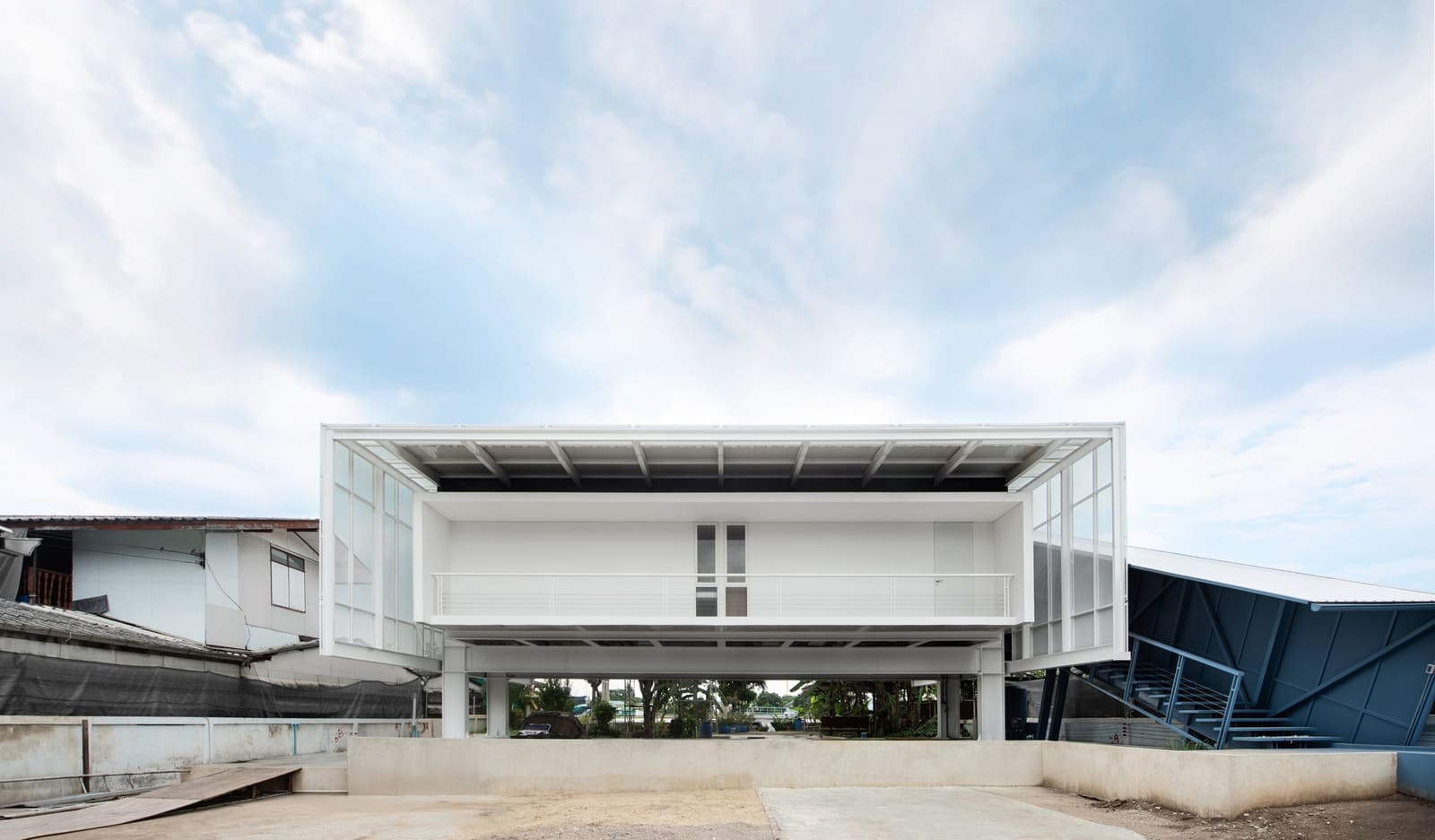
A Site That Remembers
The question of what to do with a site's past is rarely straightforward. When land changes hands, when industry gives way to domesticity, the temptation is often to start fresh, to scrub clean the traces of what came before. Mahachai Residence, a compact villa completed in 2025 by Patara Architects, takes a different path. Occupying a riverside plot in Samut Sakhon, Thailand, where a boat-repair warehouse once stood, the 180-square-metre structure operates less as erasure and more as translation, carrying forward the memory of labour and water into its architectural language.
This is not a full-time home but a day-use villa, a place conceived for pause rather than permanence. The owner, who once operated the warehouse on this very ground, sought a retreat where rest and observation could unfold against the backdrop of the Tha Chin River, a waterway that has long served as both artery and workspace for the communities along its banks.
Riverside Typology and the Parti of Pause
At World Archi Design, we have tracked a growing interest in adaptive reuse and site-specific memory, particularly in Southeast Asian contexts where rapid development often bulldozes industrial heritage. Mahachai Residence offers a quieter approach, one that does not literally preserve the warehouse but instead absorbs its essence into the new building's logic.
The programme is deliberately modest. This is not a residence designed for sleeping or extended domestic routines. Instead, it functions as a place to rest during daylight hours, to watch the river, to witness the particular quality of light as the sun sinks and the water turns molten. The parti, then, is one of observation and repose, a building that frames the river rather than turning inward.
Patara Architects structured the villa to privilege the view, orienting primary living spaces towards the Tha Chin River. The massing is restrained, avoiding the vertical exuberance that might dominate the low-lying riverside context. Instead, the building sits close to the water, its horizontal emphasis echoing the flatness of the delta landscape and the long, low profiles of the working boats that still ply this stretch of river.
Material Continuity and Tectonic Honesty
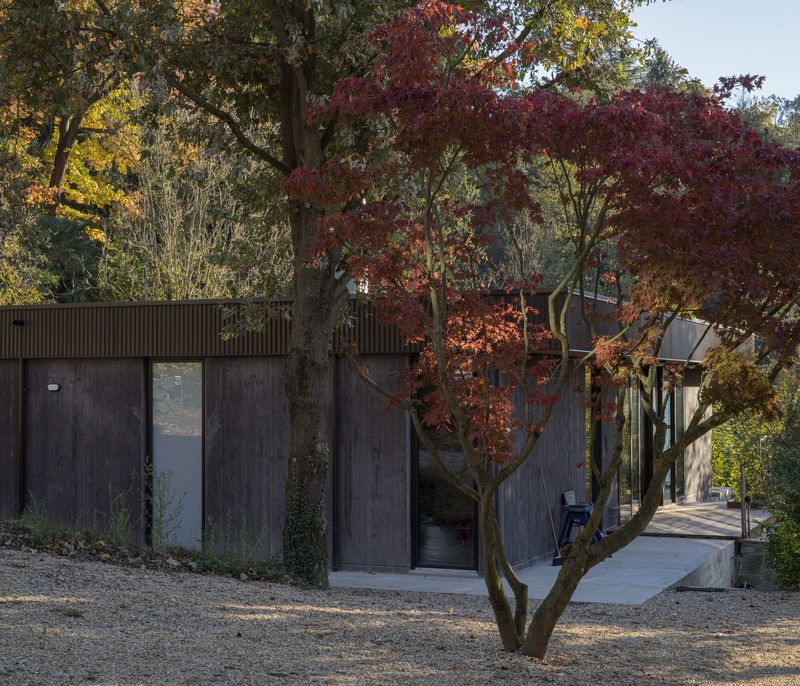
One of the most compelling aspects of Mahachai Residence is its material strategy. Rather than cladding the villa in polished finishes that signal a break from the site's industrial past, the architects selected materials that speak to durability, weathering, and the aesthetic of repair and maintenance. This is architecture that acknowledges the warehouse without mimicking it, that understands the vocabulary of labour without resorting to pastiche.
The choice of materials also responds to the riverside microclimate. Proximity to water brings humidity, salt, and the constant presence of wind. Materials must withstand not only weather but also the particular conditions of a site where the boundary between land and water is porous. The tectonic expression is honest, surfaces are allowed to age, to patina, to show the passage of time in a way that connects the villa to the working boats and structures that share the riverbank.
This approach contrasts sharply with the trend towards pristine, maintenance-intensive finishes that dominate much contemporary residential work. Mahachai Residence instead embraces a kind of material humility, a willingness to let the building participate in the same cycles of wear and repair that characterised the warehouse it replaced.
Fenestration and the Choreography of Light
The villa's fenestration is calibrated to capture specific moments in the river's daily cycle. Large openings face the water, framing views that change with the tide, the weather, and the movement of vessels. The most celebrated moment, according to the brief, is sunset, when the Tha Chin River transforms, its surface catching the low-angle light and turning a deep, burnished gold.
This is not merely picturesque. The choreography of light and water is central to the experience of the building, shaping how time is perceived within its walls. The villa becomes a kind of instrument for observing natural phenomena, a device that slows the owner down and attunes them to the rhythms of the river.
The interior, designed by Patara Architects with collaboration from Studio Mueja for furnishings, maintains a restraint that allows the exterior landscape to dominate. Spaces are uncluttered, with a palette that defers to the view rather than competing with it. This is architecture that understands when to step back, when to let the site do the work.
Precedents and Context
Mahachai Residence invites comparison with other riverside projects that engage with industrial heritage, though few operate at this intimate scale. One thinks of the adaptive reuse work of Herzog & de Meuron, particularly their transformations of former industrial structures into cultural and residential spaces, though their projects typically involve preserving the original shell. Here, the approach is more abstract, the memory carried through material sensibility and programme rather than literal preservation.
Closer to home, the project resonates with the work of other Thai practices that have grappled with the tension between vernacular building traditions and contemporary needs. The villa's emphasis on natural ventilation, its horizontal massing, and its integration with the landscape recall principles seen in projects by firms such as IDIN Architects and Sher Maker, though Patara Architects brings a particular attention to the narrative dimension of the site.
The decision to create a day-use villa rather than a full-time residence is also notable. It suggests a programme more akin to a pavilion or a retreat, a building type with deep roots in Thai architectural culture. The sala, a traditional open pavilion used for rest and social gathering, offers a historical precedent, though Mahachai Residence is enclosed and climate-controlled. Still, the spirit of pause, of temporary withdrawal, connects the two.
The Ethics of Displacement
There is, of course, a broader question lurking beneath the surface of this project. When industry gives way to leisure, when a working site becomes a place of contemplation, who benefits and who is displaced? The owner in this case is the same person who operated the warehouse, which complicates the usual narrative of gentrification. Yet the transformation from production to repose, from labour to observation, still marks a shift in the social and economic character of the site.
Mahachai Residence does not resolve this tension so much as acknowledge it. By refusing to erase the memory of the warehouse, by allowing the building to carry forward something of the site's working past, the architecture at least gestures towards continuity. Whether this is sufficient, whether memory can stand in for presence, is a question each observer must answer for themselves.
Looking Forward
As we consider the trajectory of riverfront development across Southeast Asia, projects like Mahachai Residence offer an alternative to the high-rise condominium towers and luxury resorts that have come to dominate urban waterfronts. This is architecture that respects scale, that honours context, that understands the river not as a backdrop but as a living presence.
The villa's success lies in its restraint, in its willingness to do less rather than more. In an era when residential architecture often equates luxury with excess, Mahachai Residence proposes a different calculus, one in which richness comes from observation, from the careful framing of light and water, from the quiet persistence of memory in material and form.
Whether this model can scale, whether it can inform larger developments, remains uncertain. But as a provocation, as a demonstration of what becomes possible when architects listen to a site's history rather than overwriting it, Mahachai Residence stands as a small, significant achievement.
Save this story. A free account keeps your reading list and the 07:00 email in one place.
CREATE FREE ACCOUNT →SIGN IN