
A Wooded Campus Before Silicon Valley Existed
When the Thomas J Watson Research Center first rose from Westchester County's hills in 1961, the geography of technology looked nothing like today's map. Silicon Valley had yet to coalesce into the industry's gravitational center. Computing companies scattered themselves across North America, typically anchoring near established manufacturing hubs. IBM chose a different path, commissioning Eero Saarinen to carve a research campus from rural woodland thirty-five miles north of Manhattan.
The decision reflected something broader than real estate strategy. IBM had assembled a constellation of design minds during this period, Saarinen among them, alongside Eliot Noyes, Paul Rand, and Ray and Charles Eames. Together, they forged an identity that fused technology with visual and spatial intelligence. Mark Podlaseck, creative director at IBM Research, points to this lineage when he describes the company's design consciousness. The Yorktown Heights site became physical evidence of that ethos, a place where modernist principles met the nascent computer age with humanist intention.
Form as Connection
Saarinen's parti was fundamentally about encounter. The building unfolds in a semi-circular plan, stretching across hundreds of acres with a fully glazed facade that dissolves boundaries between interior research and exterior landscape. Repeating corridors link laboratories and offices, engineered not just for circulation but for collision. The architect understood that technical work, however specialized, benefits from unplanned meetings and cross-pollination. Researchers moving through those glazed passages encountered both colleagues and the wooded terrain outside, a deliberate choreography of connection.
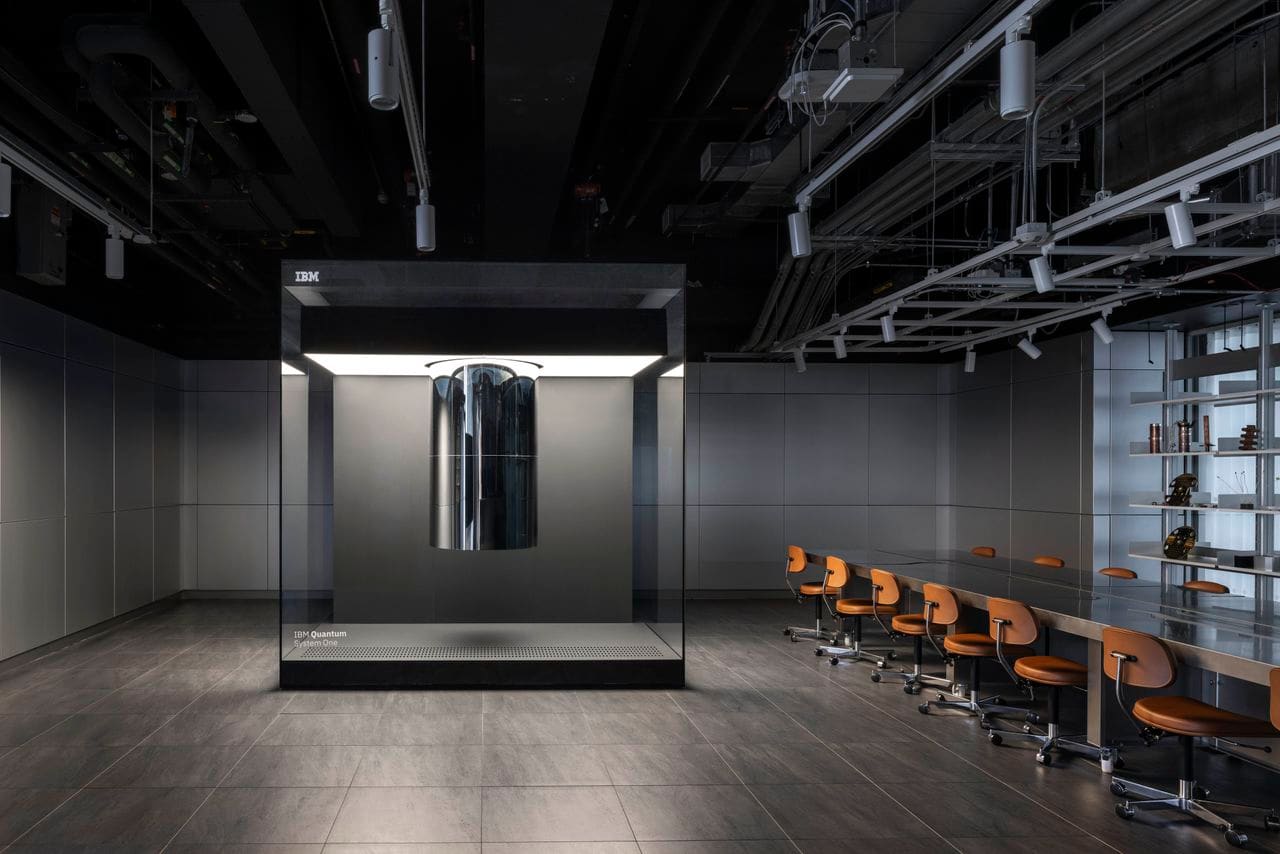
That spatial logic persists in the campus's newest layer. The Think Lab, designed by Universal Design Studio and Map Project Office in close collaboration with IBM Research, extends Saarinen's original diagram into the age of quantum-centric supercomputing. At its most literal level, the project houses advanced computational infrastructure that marries quantum and classical systems. But the design refuses to treat this equipment as mere machinery to be cordoned off behind glass or tucked into back-of-house zones.
Integration Over Exhibition
Satoshi Isono of Universal Design Studio describes the studio's resistance to what he calls the "showroom" model. Rather than staging technology as spectacle, the Think Lab weaves quantum computing systems into a unified environment where research, equipment, and human presence occupy shared territory. Everything exists within one continuous space, a decision that echoes Saarinen's original insistence on connectedness.
This approach required deep engagement with the 1961 building. Isono and Podlaseck made multiple trips to Yale University, where Saarinen's archive resides, studying material specifications, construction samples, period photography, hand drawings, and blueprints. The goal was not restoration but resonance. The team retained proven materials from the original scheme while introducing new elements that acknowledge both the building's past and the character of contemporary computational hardware.
Materiality became a key thread. Saarinen's campus incorporated stone quarried directly from the site, embedding the building within its topography. The Think Lab honors that gesture through material choices that reference the existing stone and concrete while also nodding to the metals and composites of quantum machines. The palette registers as both familiar and forward-looking, a tectonic conversation across six decades.
Sensory Engagement with Abstract Technology
Think Lab operates as a private facility, accessible only by invitation. Yet within that controlled context, the design prioritizes openness and immediacy. Isono emphasizes that visitors can get close to the technology, engaging it directly rather than observing from a distance. Podlaseck frames this as creating a complete experience, one that invites tactile and emotional response rather than passive viewing.
The space orchestrates multiple sensory layers. Visual transparency allows sightlines through the quantum systems. Acoustic design balances the ambient hum of infrastructure with the operational sounds of the machines themselves, calibrated so neither overwhelms. Music drifts through the air from an analog turntable, an unexpectedly analog gesture in a quantum computing facility. These decisions recognize that quantum technologies remain abstract and difficult to grasp for many visitors. The design translates complexity into something felt as well as understood.
This sensory strategy has precedent in Saarinen's work. His TWA Terminal at JFK, completed the same year as the IBM campus, demonstrated how architecture could communicate the experience of flight through form and spatial sequence. At Yorktown Heights, he sought to manifest the spirit of discovery and innovation. The Think Lab continues that project, asking how architecture might make quantum computing legible not just intellectually but experientially.
Precedent and Evolution
The Think Lab belongs to a lineage of research environments designed to foster interdisciplinary exchange. Bell Labs' campus in Holmdel, New Jersey, also designed by Saarinen and completed in 1962, shared the Yorktown Heights emphasis on long corridors and chance encounters. More recently, projects like Foster + Partners' Apple Park and NBBJ's Amazon Spheres have revisited these themes, embedding workspaces within landscape and prioritizing circulation as social infrastructure.
What distinguishes IBM's approach is continuity. Rather than building anew on a greenfield site, the Think Lab operates within an existing modernist framework, extending rather than replacing. This poses both constraints and opportunities. The designers inherit Saarinen's spatial logic but must adapt it to technologies he could not have imagined. Quantum computing demands environmental controls, vibration isolation, and cryogenic infrastructure. Integrating these requirements without fragmenting the space required careful choreography.
The result suggests that adaptive reuse need not be limited to historicist preservation. The Think Lab demonstrates how a modernist building can absorb contemporary technical demands while maintaining its original spatial character. The intervention respects Saarinen's vision not through mimicry but through shared principles: transparency, material honesty, and the belief that architecture shapes how people encounter both technology and each other.
Architecture as Interface
At World Archi Design, we've been tracking how research facilities navigate the tension between technical requirements and human experience. Too often, laboratories prioritize sterile efficiency, segregating equipment from the people who operate it. The Think Lab offers an alternative model, one where architecture functions as interface rather than enclosure.
This matters particularly for emerging technologies like quantum computing, which remain opaque to broad audiences. If these systems are to move beyond specialist circles, they require translation. Architecture can serve that role, creating environments where abstract computational power becomes tangible. The Think Lab does this not through didactic explanation but through spatial and sensory experience. Visitors encounter the machines within a context that emphasizes connection, materiality, and the continuity between past and future innovation.
Saarinen's original campus emerged at a moment when computing itself was being defined. The Think Lab arrives at a similar inflection point, as quantum systems begin to reshape what computation can achieve. Both projects share a conviction that the spaces housing this work should reflect humanist values, that technology advances most effectively when embedded within environments designed for discovery, collaboration, and even beauty. In extending Saarinen's vision, IBM Research and its design collaborators affirm that modernism's core principles remain relevant, adaptable, and generative.
Photo: Dean Kaufman
Save this story. A free account keeps your reading list and the 07:00 email in one place.
CREATE FREE ACCOUNT →SIGN IN