
Project Info
Company: Trace Architecture Office
Project Name: Nujiang Grand Canyon Bookstore of Librairie Avant-Garde
Location: Yangpo Village, Lushui, Nujiang Lisu Autonomous Prefecture, Yunnan, China
Designer/ Architect: Trace Architecture Office
Client/Owner: Librairie Avant-Garde & Lushui Culture and Tourism Bureau
Tracing Culture Through Architecture
Founded in Beijing in 2009 by architect Hua Li, Trace Architecture Office (TAO) has become one of China’s most distinctive practices, renowned for designs that move fluidly between landscape, culture, and contemporary form. The studio often works in remote or culturally sensitive contexts, crafting architecture that resonates with local traditions while speaking in a modern voice. This ethos finds striking expression in the Nujiang Grand Canyon Bookstore, where TAO transforms the architectural act into a cultural bridge, merging the heritage of the Lisu people with a bold contemporary landmark overlooking one of China’s most dramatic natural landscapes.
A Monument Rising from the Landscape
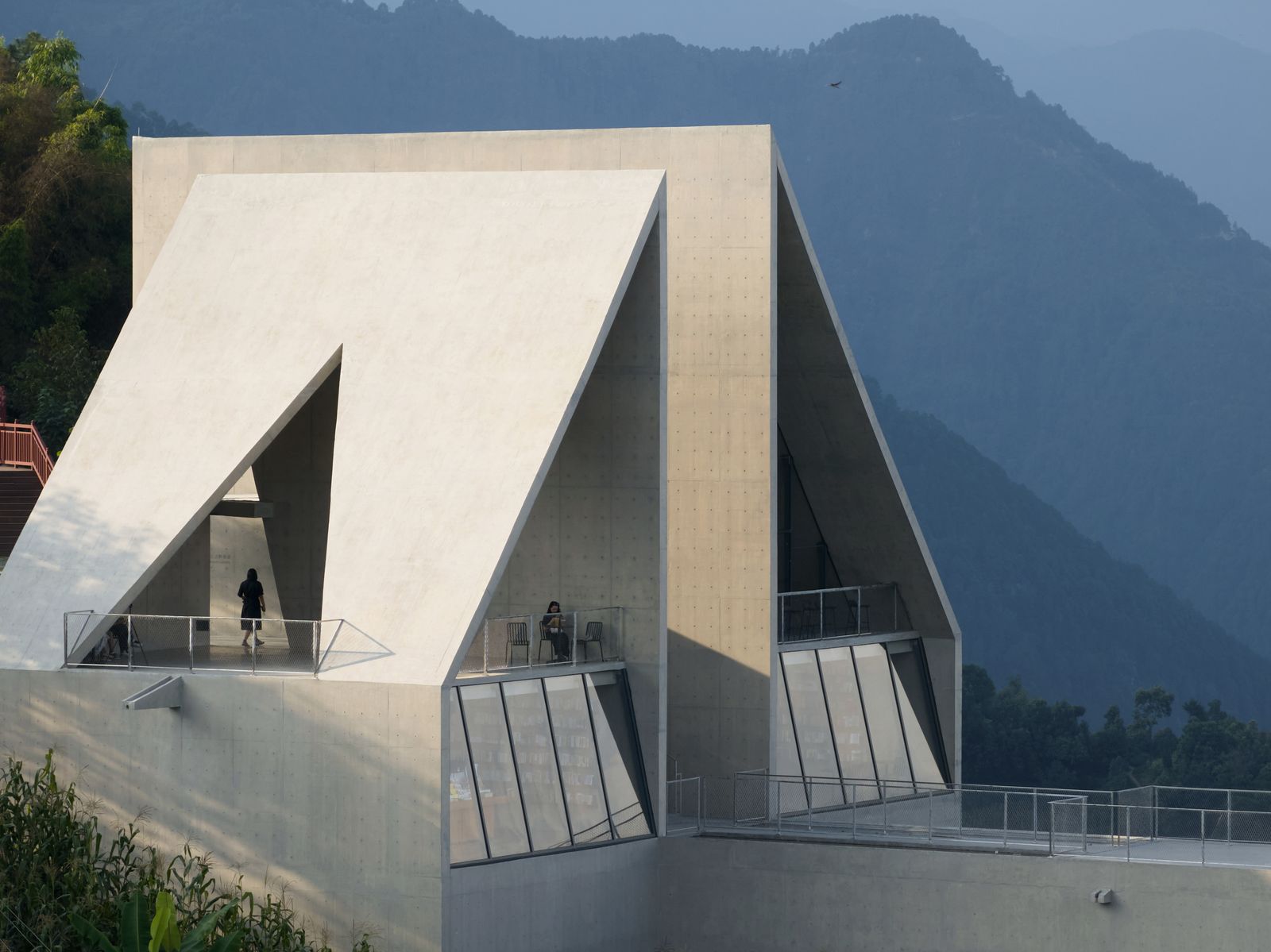
Trace Architecture Office situates the bookstore atop a sloping ridge at Yangpo Village, creating a structure that projects outward like an arrow held in tension. The form draws inspiration from the crossbow, a cultural totem of the Lisu people, and becomes both symbol and mediator. It anchors the cultural memory of the community while simultaneously confronting the vast scale of the Nujiang Canyon, offering a gesture of dialogue between human tradition and natural power.
Perched on a mountain ridge, the bookstore integrates with Yangpo Village’s dramatic topography
Contours at Play: Form and Function in Dialogue
The angular geometry of the building is shaped by both vernacular and abstraction. Its pitched forms recall the roofs of Lisu dwellings, while its dynamic silhouette echoes the ridgeline beyond. The result is not mimicry but transformation: a contemporary architecture that finds roots in local morphology while expressing the ambition of the present.
Inspired by the Lisu crossbow, the angular concrete form bridges tradition with contemporary identity
Reading Among the Clouds
The building unfolds across three distinct levels, each conceived as a unique spatial mood. A skyward café opens onto panoramic horizons, a sheltered bookstore provides intimacy and calm, and a lower-level theater, illuminated by skylights beneath a shimmering ceiling, creates a communal chamber for gathering. Movement between these tiers mirrors the experience of ascending or descending a mountain path, shifting between openness, enclosure, and illumination.
Expansive glazing merges intimate reading with panoramic landscapes, uniting culture and wilderness
Framing Nature as Immersive Context
Concrete apertures punctuate the façade, framing views of sacred mountains and the torrent of the Nujiang River. These controlled perspectives transform the building into a lens, through which the landscape becomes narrative. Circulation paths guide visitors from compressed entry spaces to expansive outlooks, turning the architectural journey into an unfolding encounter with nature itself.
A concrete corridor frames canyon views, choreographing light, perspective, and spatial movement
A Beacon and Community Hub
Positioned at the cultural threshold of Yangpo Village, the bookstore asserts its presence while remaining integrated with local rhythms. More than a repository of books, it becomes a gateway for exchange, inviting both villagers and travelers to gather in shared observation and reflection. Its presence affirms identity while opening the community to the wider world.
Seen from above, the bookstore extends outward like a bow along mountain ridges
Contextual Resonances
The project reinterprets Lisu heritage with sensitivity. Its bow-like gesture elevates cultural symbolism without falling into literal reproduction, presenting a modern expression of continuity. As one of three bookstores commissioned by Librairie Avant-Garde in Nujiang Prefecture, it expands the mission of independent bookstores into remote terrain, transforming reading spaces into cultural instruments of revitalization. The architecture demonstrates how a carefully situated building can function simultaneously as sanctuary and stage, rooted in its context yet reaching toward aspiration.
Sloping concrete walls and full-height glazing create a soaring café overlooking Nujiang Canyon
Save this story. A free account keeps your reading list and the 07:00 email in one place.
CREATE FREE ACCOUNT →SIGN IN