
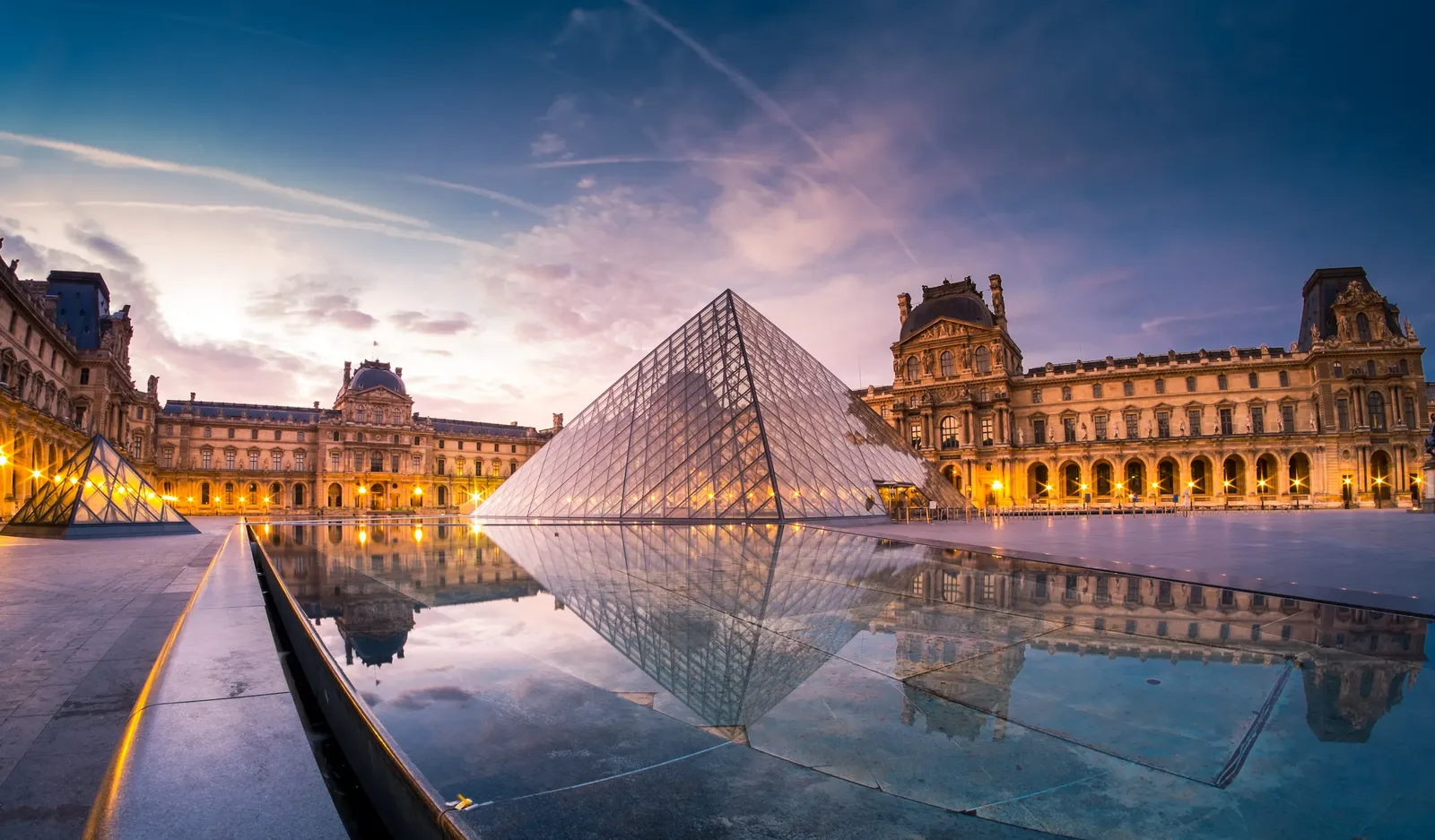
When standing before the Louvre Pyramid, I’m reminded that architecture at its best doesn’t shout - it converses. Here, in the heart of Paris, amid centuries of French grandeur, a structure of glass and steel rises not in defiance, but in dialogue with history. Designed by I.M. Pei and unveiled in 1989, the Louvre Pyramid was more than an entrance, it was a statement that redefined what it means to modernize heritage.
At the time, Pei’s design was controversial to say the least. How could a geometric glass prism possibly belong in the courtyard of a royal palace steeped in classical ornamentation? Critics decried it as a foreign intrusion, an act of architectural audacity in the most sacred of French cultural sites. Yet, more than three decades later, the pyramid has become inseparable from the Louvre’s identity, its transparency now a lens through which we experience the past anew.

A Lesson in Light and Logic
Pei’s concept began not with a form, but with a problem: accessibility. By the 1980s, the Louvre had outgrown its infrastructure. Visitors navigated multiple, disconnected wings, each with separate entrances. Pei’s solution was radical in its simplicity: bring everyone through a single, central point.
The pyramid’s geometry was the result of logic as much as poetry. Its base aligns precisely with the Napoleonic courtyard, its glass facets reflecting the façades around it. By descending through this transparent form, visitors move from light into the museum’s heart - a spatial metaphor for diving beneath the surface of history.

What I find most instructive is how Pei used modern materials to express timeless values. The pyramid’s steel structure is unapologetically contemporary, yet it never competes with its surroundings. Instead, its transparency allows the Louvre’s stone façades to remain the visual protagonist. It’s a reminder that innovation, when handled with restraint, can amplify tradition rather than erase it.
The Architecture of Reconciliation
What makes the Louvre Pyramid enduring is its sense of equilibrium. Pei understood that modernization is not about imposing the new over the old, it’s about reconciling them. His design achieved this through contrast: solid and void, opacity and transparency, past and present.
This balance is not purely aesthetic; it’s philosophical. The pyramid’s openness symbolizes access - both literal and cultural. It democratized entry into the world’s largest museum, inviting visitors of every background to step into the same light-filled space before descending into art’s historical depths.
In this sense, Pei’s intervention wasn’t an act of disruption but of mediation. The pyramid bridges centuries of design thinking, from the Renaissance ideals of proportion to the Modernist pursuit of clarity. Its glass skin may belong to the 20th century, but its precision and harmony are as old as architecture itself.

Enduring Relevance
More than thirty years on, the Louvre Pyramid still offers a lesson architects return to: that contextual sensitivity need not mean stylistic imitation. Pei didn’t mimic the palace, he respected its rhythm and geometry, then spoke in his own language. The result is a work that feels inevitable in retrospect, as if it had always belonged there.
In an era when “iconic” architecture often aims for shock value, Pei’s pyramid reminds us of the quieter power of coherence. It shows that innovation grounded in understanding can outlast trends and transcend controversy. The project’s success lies not in its glass and steel, but in its humility - a willingness to listen to its surroundings.

A Transparent Legacy
Each time I stand at the Louvre’s entrance, I’m struck by how effortlessly Pei’s design continues to frame the museum’s evolving story. It is both a threshold and a mirror - a contemporary form that reflects the timelessness around it.
The Louvre Pyramid endures because it embodies what all great architecture aspires to: balance. Between old and new, between clarity and complexity, between vision and respect. In a world still negotiating how to honor the past while embracing the future, Pei’s work remains a luminous example of what it means to build with both transparency and tradition in mind.
Save this story. A free account keeps your reading list and the 07:00 email in one place.
CREATE FREE ACCOUNT →SIGN IN