
A Maturing Regional Platform
The architectural competition landscape across Southeast Asia has, over the past decade, shifted from largely national affairs to increasingly sophisticated regional platforms. Among these, the Steel Architectural Awards ASEAN now enters its second iteration with a clearer mandate: to examine how a single material family - coated steel - can articulate diverse climatic, programmatic and cultural responses across vastly different building types. This year's twelve finalists, drawn from Indonesia, Malaysia, Thailand and Vietnam, offer a useful cross-section of that ambition.
BlueScope's programme, operating under the theme "Shaping Resilient Futures: Timeless Design with Coated Steel," has selected projects that range from a premium outlet mall in Jakarta to a university stadium in Chiang Mai, from a crafting facility for Pandora in Binh Duong to a rehabilitation centre in Perak. What binds them is not stylistic homogeneity but a shared engagement with coated steel as structural envelope, cladding system or climate modifier - roles that demand both technical precision and aesthetic judgement.
Four Categories, Four Countries
The finalists are distributed across four categories: Commercial, Industrial, Residential, and Institutional/Public/Others. Each category received entries from the four participating nations, though not every country is represented in every category - a reflection, perhaps, of differing construction priorities and steel fabrication capabilities across the region.
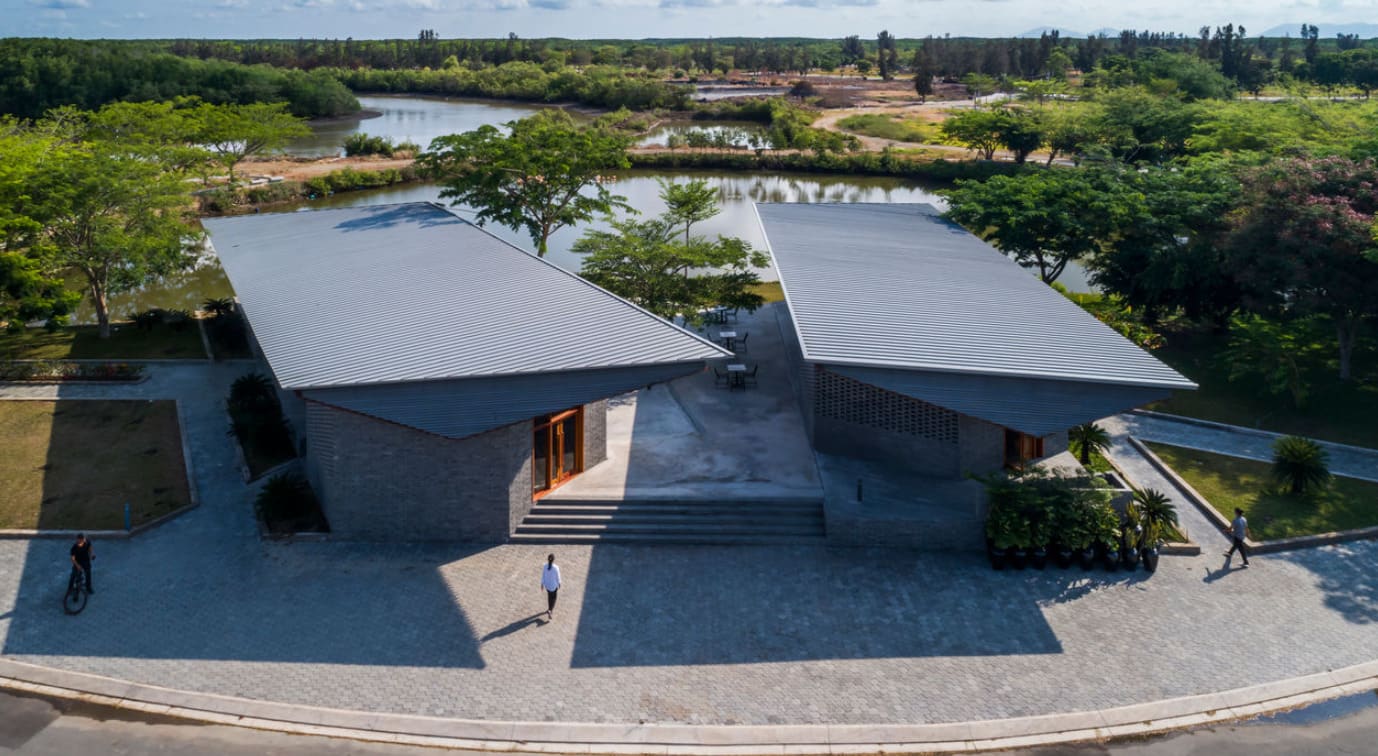
In the Commercial category, Jakarta Premium Outlet by Pandega Desain Weharima advances alongside TUAH 1895 by GDP Architects in Malaysia, KiN by DesireSynthesis in Thailand, and Can Gio Pavilions by DE-SO Asia in Vietnam. The latter, a series of pavilions in a coastal setting, exemplifies the kind of lightweight, modular intervention that coated steel enables in flood-prone or saline environments. The material's corrosion resistance becomes not merely a technical specification but a design generator.
The Industrial category presents three finalists: Euroasiatic Head Quarter by Pandega Desain Weharima in Indonesia, Nova Organic Office and Warehouse by Atelier of Architects in Thailand, and Pandora Crafting Facility by Archetype Vietnam. Industrial architecture in Southeast Asia has historically leaned towards pragmatic shed typologies; these finalists suggest a growing willingness among clients and architects alike to invest in envelope performance and spatial quality even within logistics and manufacturing programmes.
In the Residential category, only two finalists emerge: IC House by ANGKASA ARCHITECTS in Indonesia and Baan Maiyalap by Physicalist in Thailand. The relative scarcity here may reflect the dominance of masonry and concrete in Southeast Asian residential construction, where coated steel remains a less familiar choice for clients and contractors. Both projects, however, demonstrate how metal cladding systems can modulate solar gain and ventilation in hot, humid climates - a lesson worth broader adoption.
The Institutional, Public and Others category is the most diverse, encompassing Desa Binaan Tampelas by Pandega Desain Weharima in Indonesia, Pusat Rehabilitasi Perkeso Sultan Nazrin Shah by RSP Architects in Malaysia, and Chiang Mai University Main Stadium by A49CH in Thailand. The stadium, in particular, represents a scale and technical complexity that tests the limits of coated steel's spanning capacity and weather resistance. Long-span roof structures in tropical climates must contend with intense solar radiation, heavy rainfall and cyclonic wind loads; the choice of material becomes inseparable from structural strategy.
Judging Criteria and the Question of Durability
The evaluation framework centres on three criteria: Design Excellence, Innovation and Sustainability. Within these, particular emphasis is placed on how coated steel contributes to architectural quality, durability, climate responsiveness, technical performance and long-term relevance. This is a more nuanced rubric than simple aesthetic assessment; it asks whether the material choice is justified not only by appearance but by lifecycle performance.
Durability, in this context, extends beyond corrosion resistance to encompass maintenance cycles, thermal performance, recyclability and adaptability. Coated steel systems - whether pre-painted or metallic-coated - offer known service lives, predictable degradation curves and established repair protocols. In regions where building maintenance is often deferred or under-resourced, these characteristics acquire added significance. A cladding system that retains its integrity and appearance over decades without repainting represents not merely a cost saving but a form of material honesty.
The judging panel comprises five architects and academics from across the region: Geoffrey Croker of fjcstudio in Australia, Firman Setia Herwanto, vice president of Ikatan Arsitek Indonesia, Serina Hijjas of Hijjas Kasturi Associates in Malaysia, Kulthida Songkittipakdee of HAS Design and Research and vice president of the Association of Siamese Architects, and Truong Nguyen Hoang Long, head of environment and sustainable design at the University of Architecture Ho Chi Minh City. The composition balances practice and academia, national and regional perspectives - a deliberate effort to avoid insularity.
October Presentations and the Value of Direct Engagement
Finalists will present their work in person to the panel in October, a format that privileges dialogue over static submission. This mode of evaluation, increasingly rare in an era of digital portfolios and remote judging, allows for interrogation of design intent, material detailing and post-occupancy performance. It also creates space for architects to articulate choices that may not be legible in photographs or drawings - decisions about fabrication sequences, contractor coordination, budget constraints or client negotiation.
The presentation format also serves a pedagogical function. By requiring architects to defend their work before a critical audience, the programme encourages a level of reflexivity that extends beyond the individual project. What worked? What would you change? How did the material perform in ways you did not anticipate? These are questions that rarely surface in conventional award submissions.
COLORBOND at Sixty and the Long View
The ceremony in Bangkok on 20 November will include a special recognition programme celebrating the sixtieth anniversary of COLORBOND steel, BlueScope's proprietary coated steel product. Sixty years is a substantial span in the history of building materials - long enough to observe genuine lifecycle performance, to track colour stability, to document corrosion behaviour across diverse climates, and to assess whether early claims about durability were warranted.
At World Archi Design, we have covered numerous projects over the years that employ first-generation COLORBOND cladding, and the material's performance record is instructive. In tropical and coastal environments, where chloride exposure and high humidity accelerate metal degradation, the difference between coated and uncoated steel is stark. Projects that specified appropriate coating systems in the 1970s and 1980s often show minimal surface degradation today; those that economised on coating thickness or substrate preparation frequently required replacement within two decades.
This empirical record matters because it grounds material choice in evidence rather than marketing. Architects considering coated steel for a project in 2026 can examine buildings from 1966, assess their condition, and make informed decisions. Few contemporary materials offer that depth of field.
A Learning Journey to Australia
Winners in each of the four ASEAN categories will be invited to participate in a one-week learning trip to Australia, engaging directly with architects, projects and industry specialists. This exchange component distinguishes the programme from purely honorific awards. The value lies not in the trophy but in the opportunity to observe different fabrication practices, detailing conventions and climatic responses.
Australia's architectural relationship with coated steel is both longer and more varied than Southeast Asia's, encompassing everything from rural shearing sheds to urban high-rises. The country's extreme solar radiation, coastal exposure and bushfire risk have driven innovations in coating chemistry, fixing systems and thermal performance that have direct relevance to ASEAN climates. A well-structured site visit programme can compress years of trial-and-error learning into a few days of focused observation.
Beyond the Competition Model
The organisers position the Steel Architectural Awards ASEAN as "more than a competition" - a phrase that risks sounding like boilerplate but, in this case, reflects a genuine structural difference. By embedding the awards within a broader framework of knowledge exchange, professional networking and post-occupancy evaluation, the programme aspires to shift the regional conversation around material specification.
Whether it succeeds depends less on the awards themselves than on what happens after the ceremony. Do the finalists' projects become case studies in architecture schools? Do fabricators adopt detailing strategies pioneered by winning projects? Do clients become more receptive to coated steel on the strength of documented performance? These are the metrics by which a competition's influence should be measured, though they are rarely tracked.
For now, the twelve finalists represent a snapshot of contemporary practice across four nations - varied in scale, programme and ambition, but united by a willingness to engage seriously with a material that remains, in much of Southeast Asia, underexploited. The October presentations will reveal which projects have not only specified coated steel but genuinely understood its possibilities.
Save this story. A free account keeps your reading list and the 07:00 email in one place.
CREATE FREE ACCOUNT →SIGN IN