
A Spatial Homecoming
Vincent Darré's relationship with the South of France began not by choice but by rupture. When his parents separated in the 1970s, the young Parisian followed his father, a sociologist, to the Luberon; his mother soon relocated to Montpellier, unwilling to remain distant from her son. The result was a childhood oscillating between capital and coast, a duality that would later encode itself in his design vocabulary. "This allowed me to be Parisian, but also one who knew other places," Darré reflects. That particular light, the quality of water, the tempo of ease, all became foundational references, templates to which he would return.
Decades later, invited to preside over Design Parade in 2017, the annual summer festival held across Toulon and Hyères, Darré experienced an immediate, almost involuntary recognition. The Mediterranean port city felt less like a discovery than a rediscovery. "Once I got to the airport, I immediately felt I was home. Chez moi! I had never experienced that feeling before." The sensation was precise enough to prompt a search. After several false starts, he located an apartment overlooking Toulon's old port, a vantage point that satisfied both his biographical pull southward and his need for a retreat outside Paris.
Layering Time and Ornament
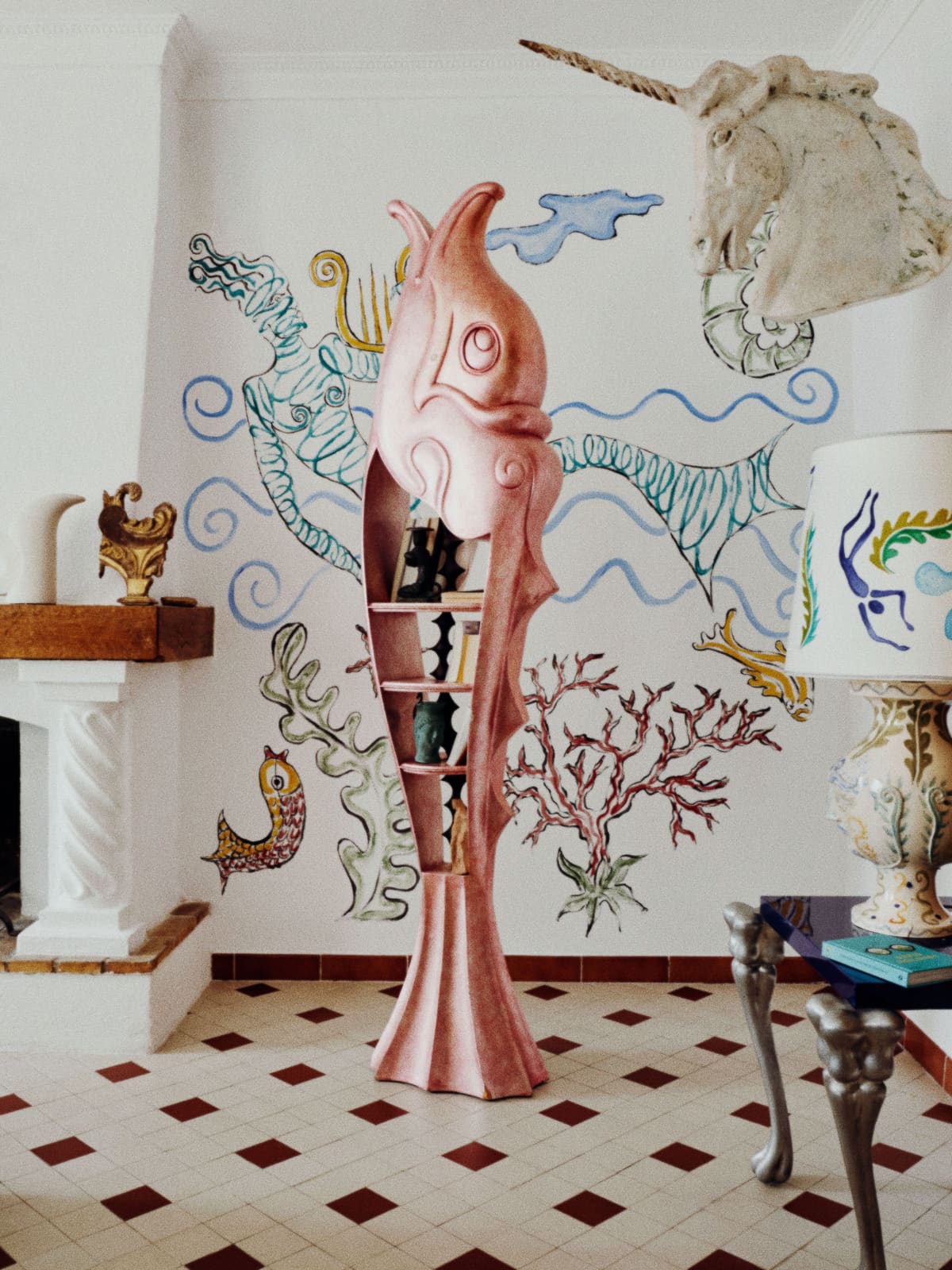
The apartment operates as a laboratory for Darré's method: dense ornament, deliberate eclecticism, and a refusal to privilege any single historical moment. In the guest bedroom, an 18th-century gilded wood bench, upholstered in velvet by Métaphores, anchors a composition that spans three centuries and multiple geographies. The Italian headboard, also 18th-century, wears Tony Duquette's Xanadu fabric for Jim Thompson, a mid-20th-century American designer's maximalist pattern produced by a Thai silk house. Darré's own painted mural frames the headboard, while the bedcover and cushions derive from his collection for Monoprix, the French mass-market retailer.
The strategy is neither pastiche nor simple accumulation. Each element retains its material and temporal identity; the juxtaposition generates a kind of spatial dialogue rather than a unified aesthetic. The gilded bench reads as a fragment of ancien régime craft, the Duquette fabric as mid-century Hollywood exoticism, the mural as contemporary intervention. What binds them is not style but a shared commitment to decoration as content, to surface as a carrier of narrative.
Drawing as Contract
Darré's training began in fashion, but his practice has always been grounded in drawing. "Sometimes people are surprised that a finished work of mine is almost always exactly like I had drawn it," he notes. The comment reveals a particular understanding of the design process: not iterative refinement, but a form of fidelity to an initial vision. The drawing functions less as a sketch than as a contract, a document to which the built work must answer.
This approach implies a confidence in the first gesture, a trust that the line laid down in ink or pencil already contains the spatial and material information necessary for realisation. It also suggests a design intelligence that operates pictorially rather than through maquettes or iterative prototyping. The mural in the guest bedroom, for instance, was likely conceived as a two-dimensional composition first, then translated directly onto the wall without significant deviation. The result is an interior that retains the clarity and decisiveness of a drawing, each element occupying its assigned role within a larger compositional scheme.
Port City as Precedent
Toulon itself offers a useful counterpoint to the more familiar narratives of French coastal living. Unlike the manicured resort towns of the Côte d'Azur, Toulon remains a working port, its identity shaped by naval infrastructure and maritime commerce rather than leisure. The old port, visible from Darré's apartment, retains a density and texture often smoothed away in more gentrified coastal zones. This grittier context may explain the apartment's particular character: it is unapologetically ornamental, even fantastical, but never precious. The layering of gilded wood, patterned fabric, and hand-painted mural reads less as escapism than as a deliberate counterpoint to the port's industrial plainness.
The Mediterranean light, so often invoked as a design influence, operates here not as a wash of brightness but as a specific condition: the way it articulates surface, intensifies colour, and sharpens the boundary between ornament and ground. Darré's interiors, with their high-contrast combinations and unabashed pattern density, seem calibrated for this quality of illumination. What might register as excessive under northern light becomes legible, even necessary, under the southern sun.
Biography as Spatial Programme
The Toulon apartment ultimately functions as a spatial autobiography, encoding the designer's split formation between Paris and the South. The objects and materials are cosmopolitan, sourced from Italian workshops, American fabric houses, and French mass retailers. Yet the sensibility, the willingness to layer and juxtapose without irony, reflects a specifically southern ease, a permission to indulge in colour and ornament that Paris, for all its sophistication, often withholds.
Darré's comment about arriving at Toulon's airport and immediately feeling at home suggests that place can operate as a kind of mnemonic trigger, collapsing decades into a single recognition. The apartment he has created there does not attempt to reproduce a childhood memory or reconstruct a lost past. Instead, it constructs a parallel reality, one that synthesises the various strands of his formation into a coherent, if densely patterned, whole. The guest bedroom, with its improbable assembly of centuries and continents, becomes a portrait of the designer himself: Parisian by birth, southern by formation, and resolutely committed to the proposition that more is, in fact, more.
Save this story. A free account keeps your reading list and the 07:00 email in one place.
CREATE FREE ACCOUNT →SIGN IN