
The Zen Paradox
Fashion designers, as a rule, spend their waking hours immersed in color theory, fabric swatches, and seasonal palettes. You might expect their private spaces to offer refuge from that chromatic intensity - neutral sanctuaries where the eye can rest. Christian Siriano once thought the same way. His previous homes leaned toward calm, edited schemes. But when he and his partner, menswear designer Kyle Smith, finally purchased a pied-à-terre in Paris's eighth arrondissement, the designer discovered a different truth: in a city already steeped in elegance, restraint felt redundant.
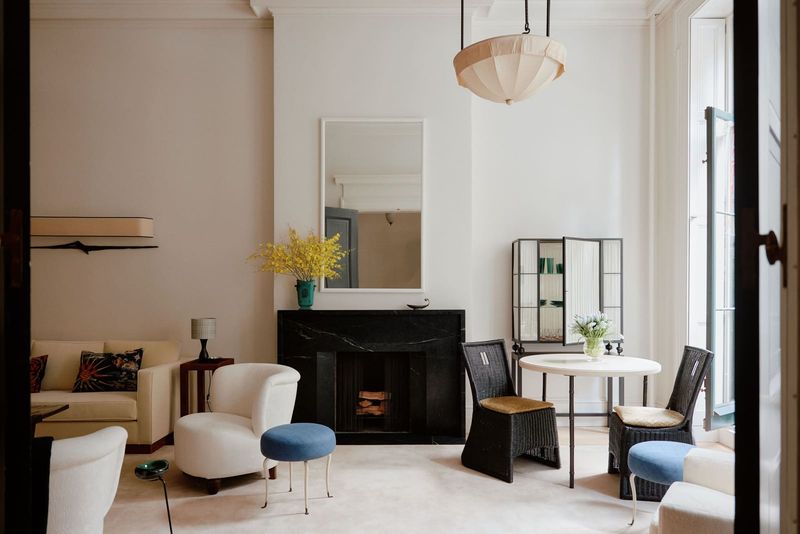
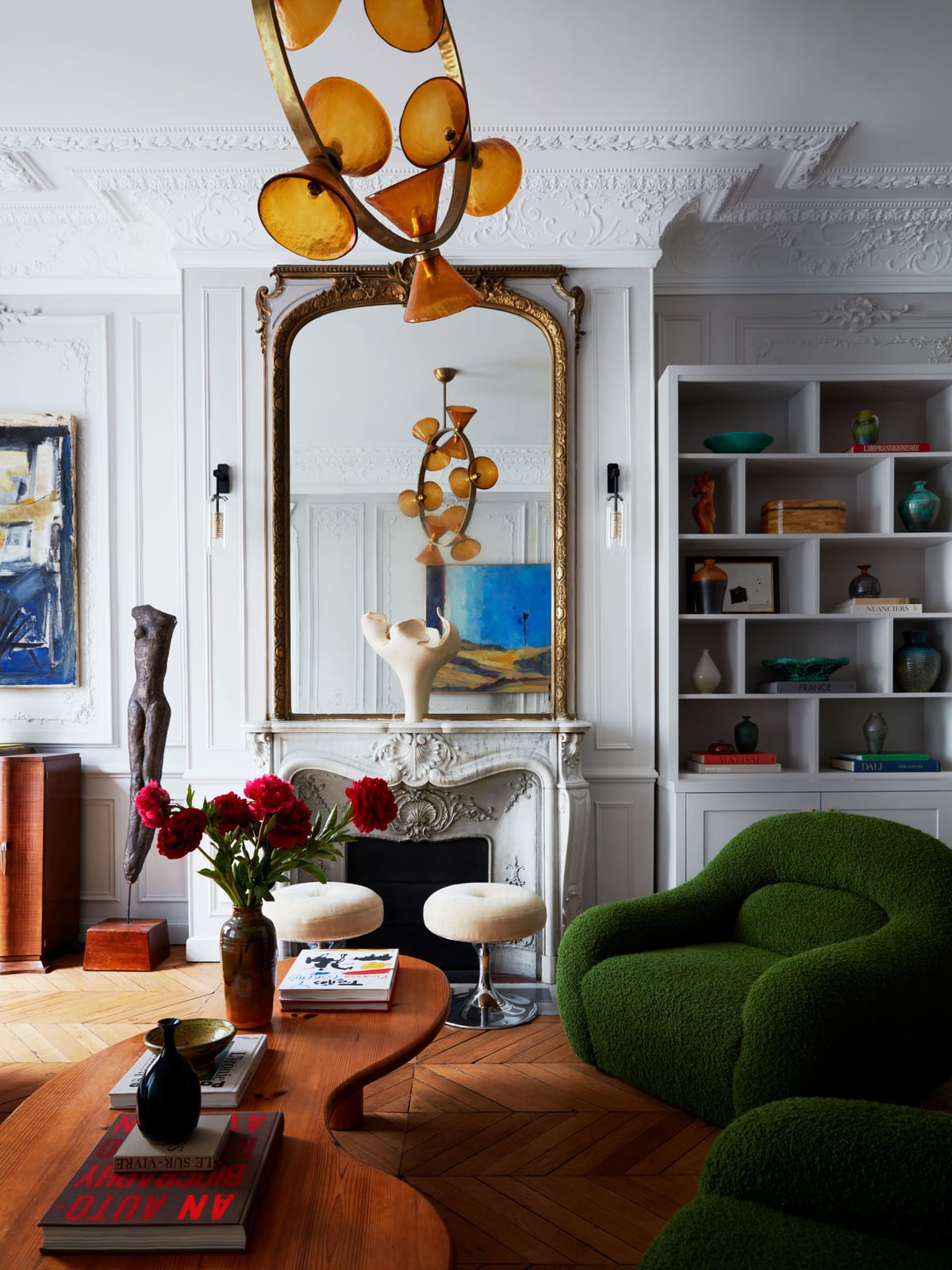
The apartment occupies a historic Right Bank building, its bones practically older than the United States itself. Original parquet de Versailles floors sweep through the rooms, interrupted only by fireplaces and overmantel mirrors that survived centuries of ownership changes. Siriano's intervention was not to strip away that history but to animate it with saturated hues and a trove of vintage furnishings. A lilac entry hall flows into a mint-green dining room. The living room wears Benjamin Moore's Gray Owl, its trim picked out in Chantilly Lace. Nearly every wall carries an abstract painting. The effect is less Haussmannian restraint, more joyful collision of eras.
"Paris already is zen," Siriano reasons. "You are already relaxed. That's why almost every room and every fixture here is in color." It's a philosophy born from extended visits to the city since 2009, when he began mounting presentations for his eponymous clothing line. Over the years, the romance deepened. The wish list for a permanent base was straightforward: central location, classic proportions, four bedrooms, grand windows, Juliet balconies. After touring roughly fifteen properties, he settled on this one, a space that demanded not renovation but curation.
A Textile Inheritance
Siriano's approach to interiors is inseparable from his relationship with fabric. He grew up watching his mother sew curtains, reupholster furniture, and construct her own wardrobe. That tactile education informs every room in the Paris apartment, where velvet, linen, and aged leather coexist in deliberate tension. The living room alone layers a 1930s Art Deco cabinet, a Pierre Chapo table, and modern art under a vintage chandelier whose curving arms echo gestures repeated throughout the space.
The commitment to vintage is nearly absolute. Siriano estimates that almost every piece in the apartment is secondhand, sourced from the Marais or the city's famous puces. French and Italian treasures from the 1930s through the 1960s dominate - a period whose craft and materiality align with his own design ethos. In the dining room, 1970s Italian chairs circle a vintage French table, while a 1950s Italian credenza anchors one wall. The room's Benjamin Moore Woodland Green provides a saturated backdrop, a choice inspired by a vintage light fixture that sparked the entire color scheme.
This is not the work of a decorator bound by stylistic dogma. Siriano buys what he likes, follows instinct, and resists the impulse to impose coherence for its own sake. "I can do a modern home, but I love things that are old," he explains. "I'm not so closed-minded. My ideas are all over the place." That openness yields a domestic landscape where Art Deco geometry shares space with mid-century organicism, where abstract expressionism hangs above neoclassical molding without irony.
The Architecture of Daily Ritual
The apartment's location shapes its use. Siriano walks most mornings to the neighborhood's open-air market, returning with flowers and produce. Afternoons might be spent at the Picasso museum or gazing at the mosaics of Sacré-Cœur. The Château de Versailles, though further afield, remains a reliable source of inspiration - Siriano and Smith favor the restaurant at the base of the palace's cascading gardens. France's decorative arts legacy is not merely backdrop but active influence, informing fabric choices, spatial arrangements, and the apartment's overall sense of proportion.
Yet proximity to cultural landmarks matters less than the threshold effect. Once inside, the apartment becomes a refuge from the city's relentless beauty. On quiet evenings, the couple lights candles and leans into the space's aristocratic ambience. On louder nights, the rooms accommodate cocktail parties, the windows thrown open to reveal streets lit in amber. The apartment also functions as a crash pad for friends - model Coco Rocha among them - and as a viewing suite for Siriano's new collections, a professional utility that underscores the space's hybrid identity.
Precedent and Permission
Siriano's Paris apartment invites comparison with other designer-occupied spaces where professional discipline loosens in favor of personal indulgence. One thinks of Carlo Mollino's Casa Mollino in Turin, where the architect's private quarters embraced a theatricality his commercial projects often suppressed. Or Renzo Mongiardino's Milanese interiors, layered with antiques and trompe-l'œil, spaces that prioritized atmosphere over architectural purity. Siriano's apartment operates in a similar register: it is not a manifesto but a permission slip, proof that even those fluent in contemporary design language can choose historical immersion.
The decision to preserve the apartment's existing layout and original details reflects a broader shift in how designers approach heritage properties. Rather than impose a signature aesthetic, Siriano allowed the building's architecture to dictate terms. The parquet de Versailles, the fireplaces, the molding - these elements are not styling props but structural facts, and the interiors respond accordingly. Color and furniture animate the space without overwhelming it, a balance that requires both confidence and restraint.
The Fantasy of France
Siriano's apartment is, at its core, an exercise in sustained fantasy. Not fantasy in the sense of escapism, but in the deliberate construction of a life shaped by aesthetic conviction. The choice to fill the space exclusively with vintage pieces, to paint every room in saturated color, to open windows onto lit streets and linger in the resulting tableau - these are acts of world-building, small decisions that accumulate into a coherent domestic reality.
That reality is also deeply practical. The apartment accommodates work and leisure, solitude and socializing, the rhythms of a fashion calendar and the slower cadence of Parisian daily life. It is both stage set and home, a duality that many designer residences struggle to reconcile. Siriano's success lies in refusing to choose: the apartment is as functional as it is photogenic, as comfortable as it is composed.
At World Archi Design, we have long observed that the most compelling interiors often emerge when designers work for themselves, freed from client constraints and market pressures. Siriano's Paris pied-à-terre confirms that pattern. It is a space unencumbered by trend forecasting or resale anxiety, designed instead to satisfy a single question: what does it mean to live beautifully in a city already synonymous with beauty? The answer, rendered in vintage furniture and Woodland Green paint, is both personal and instructive - a reminder that interiors, at their best, are less about rules than about knowing when to break them.
The apartment's true achievement may be its refusal to apologize. There is no minimalist counterpoint, no nod to contemporary sobriety. It is all in, a full-throated embrace of color, history, and the accumulated objects that make a house feel inhabited. In a design culture often anxious about excess, that confidence is worth studying. Siriano has created not just a home but a case study in domestic joy, proof that sometimes the most radical design move is simply to trust your own pleasure.
Save this story. A free account keeps your reading list and the 07:00 email in one place.
CREATE FREE ACCOUNT →SIGN IN