
The Outdoor Furniture Paradox
We've long accepted a curious trade-off in residential design: the moment furniture crosses the threshold to the patio, it sheds personality. Resin wicker in beige. Teak rectangles. Powder-coated aluminum pretending to be elegant. The implicit bargain is that weather resistance demands aesthetic compromise - that UV stability and visual interest are fundamentally incompatible goals.
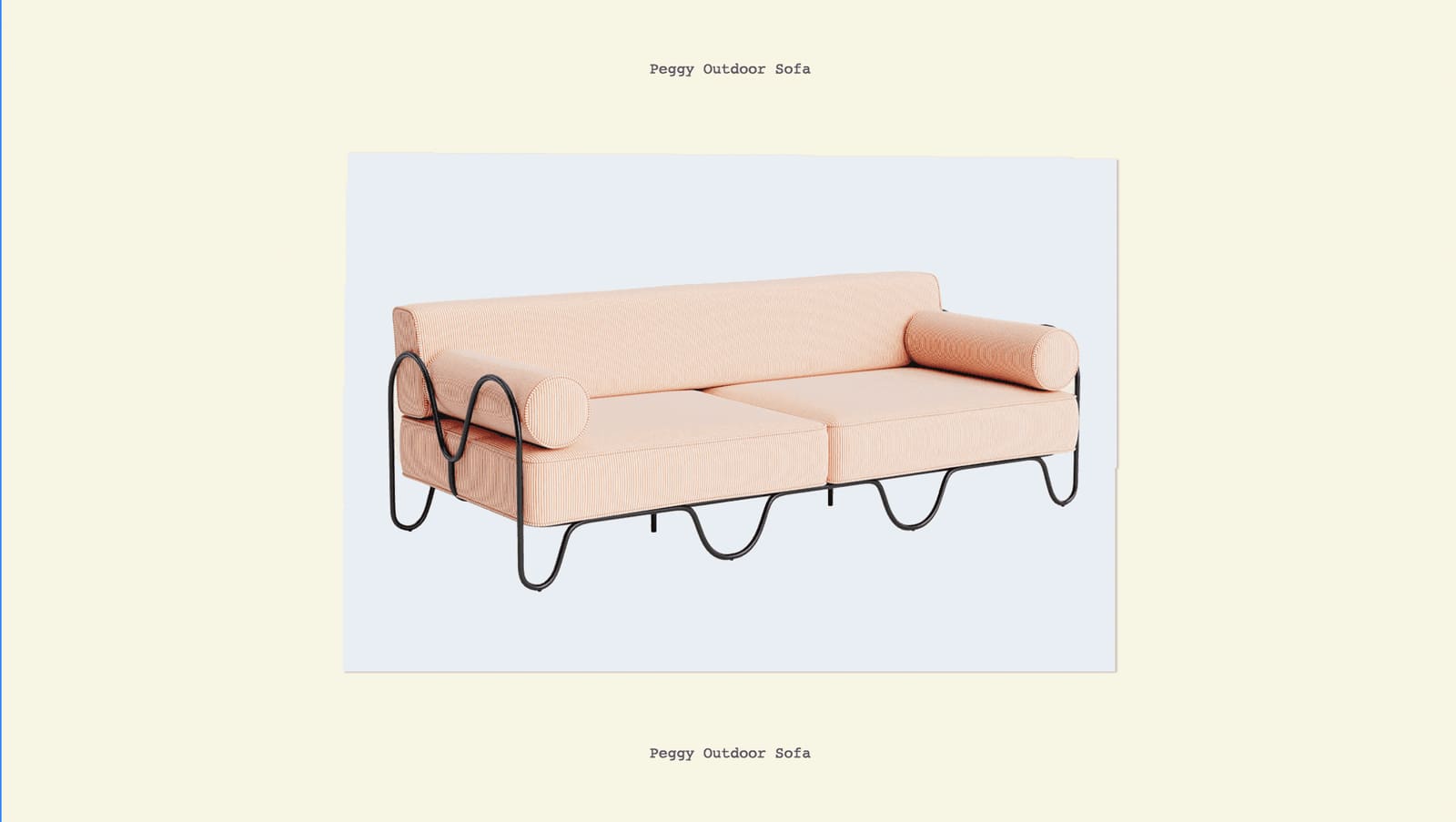
The Peggy outdoor sofa, developed through a collaboration between Lulu and Georgia and designer Sarah Sherman Samuel, suggests that bargain was never necessary. Its defining gesture is a continuous wave that ripples through the iron frame, creating a datum line that reads as both structural member and decorative motif. The profile recalls Alvar Aalto's bent plywood experiments or the sinuous metalwork of early California modernism, yet the execution is unapologetically contemporary. This is not pastiche; it's a deliberate argument that outdoor furniture can carry the same formal ambition we routinely expect indoors.
At World Archi Design, we've been tracking a quiet evolution in the outdoor category: a move away from the utilitarian logic that dominated patio furniture for decades. What makes the Peggy sofa notable is not just its silhouette but the material palette it employs to achieve that silhouette. Iron frames are uncommon in outdoor collections, where aluminum and synthetic weaves dominate for their corrosion resistance and light weight. Iron, by contrast, requires powder coating and ongoing care, but it offers something those materials cannot: structural honesty and the capacity to be formed into genuinely sculptural shapes without the visual bulk of welded tube steel.
Upholstery as a Variable
The frame ships with multiple upholstery options, all drawn from the Sunbrella and Perennials catalogs - solution-dyed acrylic fabrics engineered for colorfastness and water repellency. The tested configuration featured a creamsicle-toned stripe from the Perennials Jake line, a pattern that accentuates the sofa's playful geometry. Solid camel, olive, and neutral options are available for those seeking a more restrained expression, and several configurations include contrast piping that traces the cushion edges - a tailoring detail more commonly associated with interior upholstery than patio seating.
The cushions themselves are generous: 84 inches wide, 36.25 inches deep, yielding a seat depth that approaches daybed proportions. The fill is structured enough to provide lumbar support yet soft enough to invite extended lounging. Covers are removable via concealed zippers, a practical consideration given the inevitable exposure to pollen, rain, and the occasional spilled drink. The three-year no-fade guarantee on the upholstery is not merely a warranty; it's a signal of confidence in the material science underpinning these textiles.
Logistics and the White-Glove Question
Delivery occurs in two phases. The frame ships first, arriving approximately one week after order placement. Cushions follow anywhere from one to six weeks later, depending on the selected upholstery. Both components are delivered via white-glove service - a mandatory add-on priced above $350. The frame arrives fully assembled; handlers position it on-site, eliminating the need for Allen wrenches or instruction diagrams. Cushions arrive curbside in three oversized cartons, wrapped in protective plastic. Unpacking is mildly cumbersome due to the elongated cushion dimensions, but installation is effectively instantaneous.
The white-glove fee is steep, particularly for a product already priced at $3,398. Yet the alternative - flat-pack shipping with DIY assembly - would likely compromise the frame's structural integrity and the finish quality that makes the design work. This is the calculus of mid-tier design furniture: the cost of professional logistics is baked into the value proposition.
Performance in Situ
Real-world testing occurred in the Northeast, a climate zone characterized by humid summers, freeze-thaw cycles, and occasional severe thunderstorms. The sofa remained outdoors under a separately purchased cover when not in use, with cushions left in place rather than removed after each session. Over multiple months, including several heavy rain events, both frame and upholstery showed no visible degradation. The powder-coated iron exhibited no rust bloom. The striped fabric retained its chromatic intensity, with no evidence of UV-induced fading or water staining.
The cover protocol is worth detailing: the cushions are first wrapped in the original plastic sheeting from the shipping cartons, then enclosed in an aftermarket fitted cover. The two-layer system adds approximately two minutes to the end-of-use routine but appears to provide effective protection against moisture infiltration and particulate accumulation.
Seat comfort is a function of both cushion depth and the slight recline engineered into the frame geometry. The 30-inch overall height positions the seat at a conventional sofa datum, but the depth invites a more recumbent posture. Two adults can sit upright; three can fit if one is willing to tuck into a corner. Alternatively, a single user can sprawl diagonally - a flexibility that blurs the line between sofa and chaise.
Precedent and Context
The Peggy sofa exists within a lineage of designers who have sought to elevate outdoor furniture beyond mere function. Richard Schultz's 1966 collection for Knoll demonstrated that outdoor pieces could be as rigorous and beautiful as their interior counterparts. Patricia Urquiola's work for Kettal in the 2000s introduced textile complexity and chromatic boldness to the patio. More recently, studios like Tait and Caste have explored powder-coated steel frames with upholstered cushions, challenging the dominance of all-weather wicker.
What distinguishes the Peggy from these precedents is its accessibility. At under $3,500, it occupies a price band below custom fabrication but above big-box retail - a zone where design intent and manufacturing quality can coexist without requiring five-figure budgets. This is the democratization thesis that brands like Lulu and Georgia advance: that good design should be attainable without being disposable.
The sofa's wavy frame also invites comparison to the organic modernism of Jean Royère, whose Ours Polaire sofa featured similarly undulating arms, or to the bent-tube furniture of Warren McArthur, who explored metal forming techniques in the 1930s. These are lofty references, but the formal echoes are genuine. The Peggy sofa translates those historical gestures into a contemporary idiom suited to outdoor use, proving that typological evolution need not abandon its roots.
Styling and Adjacencies
The iron frame's neutral metallic finish allows the sofa to coordinate with a range of adjacent furnishings. In the tested environment, it paired with an existing metal table and chair set, creating a material consistency that unified the patio without requiring a complete furniture overhaul. The stripe upholstery introduced a note of levity, but the design would be equally legible in a monochrome scheme or alongside natural wood pieces.
Stylistically, the sofa navigates multiple territories. The wavy frame reads as playful, almost whimsical, aligning with the relaxed aesthetic of California modernism. Yet the proportions are restrained enough to function in more formal outdoor rooms. This versatility is a function of good design: the piece is specific enough to have a point of view but not so idiosyncratic that it demands a particular decorative context.
For families, the low profile and rounded edges eliminate the sharp corners and elevated perches that make some outdoor furniture hazardous for young children. The cushion depth is forgiving, and the removable covers simplify the inevitable cleanup that accompanies outdoor family use.
The Broader Shift
The success of the Peggy sofa - both as a design object and as a market proposition - suggests that consumer expectations for outdoor furniture are shifting. No longer is it sufficient for a patio sofa to merely withstand the elements. It must also contribute to the spatial and aesthetic narrative of the home, functioning as an extension of interior design rather than a separate, utilitarian category.
This shift has implications for how we conceive outdoor spaces. If the furniture can be as considered as what sits inside, then the patio becomes not a secondary zone but an integral room - one that happens to lack a roof. Landscape architecture has long argued for this parity; the furniture industry is finally catching up.
The Peggy sofa is not without limitations. The iron frame requires seasonal care in harsh climates, and the cushions demand storage during winter months in regions with freeze-thaw cycles. The white-glove delivery fee is a significant surcharge. And the price point, while accessible relative to custom work, remains out of reach for many households.
Yet these constraints do not diminish the sofa's accomplishment. It demonstrates that outdoor furniture can be formally inventive, materially honest, and built to last - that we need not choose between design quality and weather resistance. In doing so, it quietly redefines what the outdoor category can be.
Save this story. A free account keeps your reading list and the 07:00 email in one place.
CREATE FREE ACCOUNT →SIGN IN