
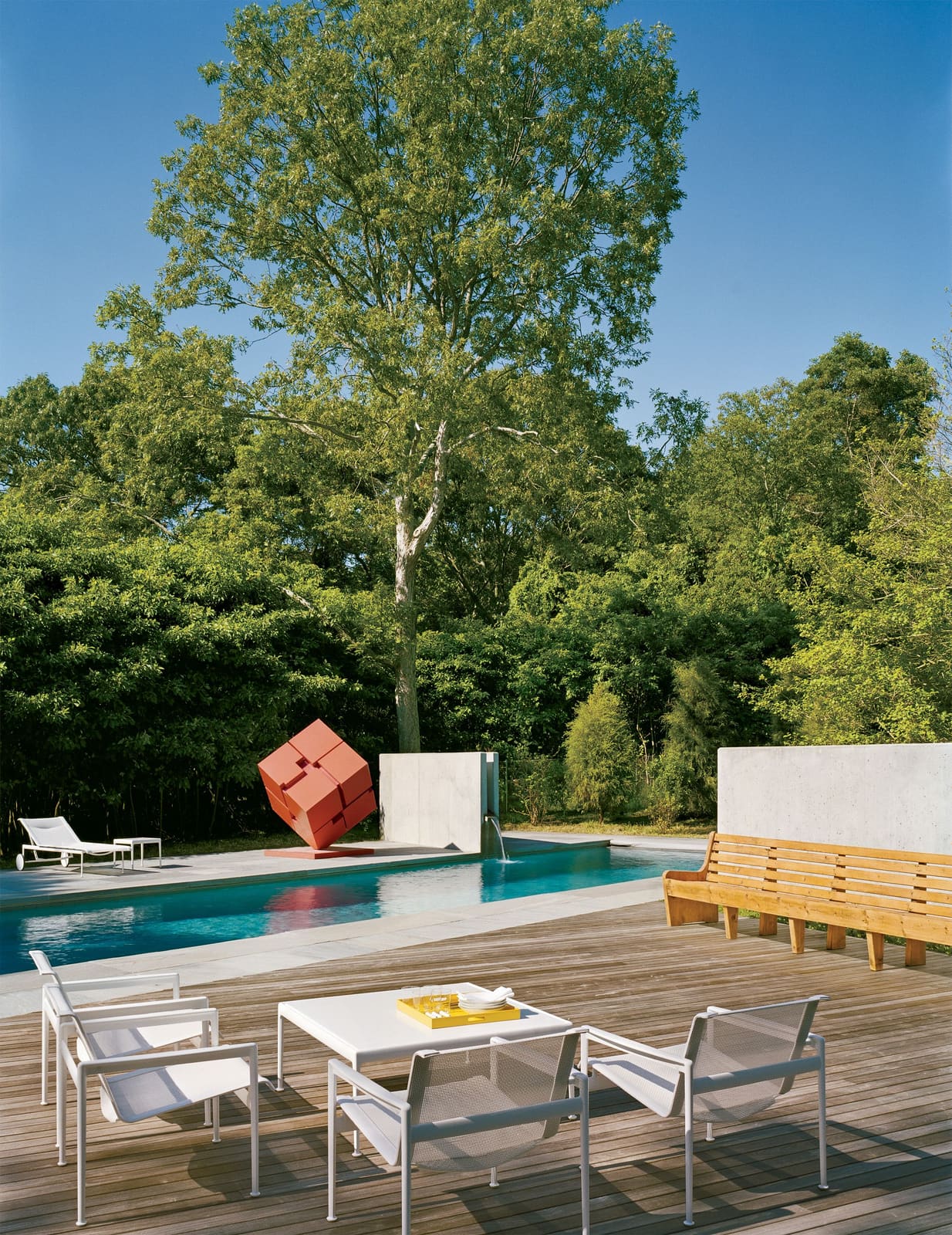
When Space Becomes the Primary Design Brief
The contemporary patio operates under contradictory demands. It must accommodate a dozen guests for summer dinners, then contract into an open terrace for morning yoga. It serves as both stage and storage, entertaining zone and contemplative retreat. Within this spatial negotiation, stackable outdoor chairs have quietly matured from functional afterthoughts into carefully considered design objects that acknowledge the reality of how we actually live outside.
At World Archi Design, we've observed a marked shift in how manufacturers approach collapsible seating typologies. Where earlier iterations prioritized sheer utility, often at the expense of visual coherence, recent examples demonstrate that economy of space need not compromise material quality or formal sophistication. The chairs emerging from studios today navigate a delicate balance between structural lightness, weather resistance, and the kind of presence that warrants a permanent place in your outdoor composition, even when stacked.
Material Intelligence and Structural Honesty
Niels Jørgen Haugesen's X-Line chair for Hay exemplifies this evolution. Fabricated from powder-coated steel mesh, the design makes no attempt to disguise its industrial origins. Instead, it leverages the material's inherent properties: the perforated surface permits airflow while maintaining structural integrity, and the angular geometry reads as intentionally minimal rather than accidentally sparse. At 19.75 inches wide and weighing considerably less than solid alternatives, the X-Line acknowledges that stackability begins with thoughtful material selection. Optional cushions are available, though the chair functions perfectly well without them, a testament to ergonomic consideration embedded in the frame itself.
Contrast this with Article's Elan chair, which layers powder-coated aluminum with teak accents and weather-resistant upholstery. Here, the stackable format accommodates hybrid materiality, each element contributing specific performance characteristics. The aluminum provides structural support and corrosion resistance, teak introduces warmth and visual weight, and the quick-dry foam cushioning addresses comfort without requiring removal after rain. The chair measures 22 inches wide and stacks efficiently despite its mixed-material construction, proof that complexity and compactness can coexist when engineering precedes decoration.
The Geometry of Nesting
Stackability imposes strict geometric constraints. Chairs must nest cleanly without scratching adjacent surfaces, maintain stability when piled, and occupy minimal vertical space relative to seat count. These requirements have historically pushed designers toward uniform profiles and conservative forms. Yet several manufacturers have identified opportunities within these limitations.
Woodard Furniture Company's Sculptura chair, originally conceived decades ago and now distributed through Design Within Reach, employs woven powder-coated iron in a barrel silhouette. The chair's curved back and armrests create a sculptural profile that appears antithetical to stacking logic, yet the form nests cleanly due to carefully calibrated radii and consistent wall thickness. At $1,295, it represents the premium end of stackable typologies, where the chair functions as both seating and spatial accent. Available in saturated red or understated navy, the Sculptura makes a case for stackable furniture as permanent collection rather than seasonal placeholder.
Ferm Living's Dapple chair pursues a different formal strategy. Perforated steel panels curve to form seat and backrest, the punctured surface creating dappled light patterns when positioned in direct sun. The effect is both functional and atmospheric, the perforations reducing material weight while introducing visual texture. The chairs measure 23.6 inches wide and stack with minimal effort, the uniform curvature ensuring stable nesting. Ferm Living positions the Dapple within a broader collection of outdoor furnishings, suggesting the chair as component within a larger compositional system rather than isolated purchase.
Precedent and Evolution
Stackable seating traces its lineage to mid-century experiments in mass production and material efficiency. Robin Day's polypropylene chair for Hille, Verner Panton's cantilevered S-chair, and Giancarlo Piretti's Plia folding chair all grappled with similar briefs: create seating that could be manufactured affordably, stored compactly, and deployed quickly. These designs prioritized industrial reproducibility and spatial economy, often for institutional contexts.
Contemporary outdoor stackables inherit this legacy but operate within different constraints. Whereas mid-century examples addressed indoor institutional needs, today's versions must withstand UV exposure, temperature fluctuation, moisture, and salt air while maintaining aesthetic coherence with increasingly sophisticated outdoor living spaces. Powder-coated aluminum and steel have largely replaced polypropylene, not merely for durability but for the material's ability to convey permanence rather than impermanence.
Crate & Barrel's Alfresco chair illustrates this shift. Constructed from aluminum with a slatted profile that mimics wood grain, the chair borrows visual language from traditional outdoor furniture while employing contemporary materials. The faux-wood finish allows the chair to integrate with existing teak or eucalyptus pieces without introducing actual timber's maintenance requirements. At $239 during promotional periods, the Alfresco targets a mid-market segment seeking design continuity across mixed furniture sources, stacking up to four units high without compromising structural integrity.
Color, Texture, and the Question of Visibility
One persistent tension in stackable design concerns visibility. Should these chairs assert themselves as design objects, or should they recede when not in active use? Manufacturers have pursued both strategies.
Blu Dot's Decade chair, fabricated from recycled plastic, arrives in an unusually broad color palette. The material choice addresses sustainability concerns while permitting saturated hues difficult to achieve with metal finishes. At 22 inches square and $215, the Decade functions equally well indoors and out, its lightweight construction and rounded seat profile suggesting adaptability across contexts. The color range invites mixing, allowing users to compose chromatic arrangements that shift with seasonal preferences or specific gatherings.
Conversely, CB2's Lucinda chair adopts a more restrained approach. The armless iron frame, finished in matte black, measures just 17 inches wide, making it among the most compact options available. The waterfall seat edge and ventilated back prioritize ergonomic function over visual drama. At $69, the Lucinda occupies the accessible end of the market, its understated profile designed to disappear into broader compositions rather than command attention.
Wicker's Unexpected Return
West Elm's Cassis chair reintroduces wicker, a material long associated with dated resort aesthetics, through careful integration with teak framing. Rather than constructing the entire chair from woven fiber, the design employs wicker selectively, draping it across the backrest and seat while maintaining a rigid teak structure. The result reads as contemporary rather than nostalgic, the material contrast adding textural interest without overwhelming the overall form. Sold in sets of two for $999, the Cassis positions wicker as a deliberate design choice rather than default outdoor material.
This selective material deployment reflects broader trends in outdoor furniture design. Where previous generations pursued material purity, contemporary approaches embrace hybridity, combining metal, wood, textile, and synthetic elements within single pieces. Stackability, rather than limiting material exploration, has become an opportunity to demonstrate engineering sophistication, each material contributing specific structural or performative characteristics while maintaining the chair's ability to nest cleanly.
What This Means for Outdoor Living
The evolution of stackable outdoor chairs signals a broader maturation in how we conceptualize exterior spaces. These are no longer secondary zones furnished with leftover or weather-proof approximations of indoor furniture. Instead, outdoor environments increasingly receive the same design consideration as interior rooms, with furnishings selected for specific spatial, material, and aesthetic criteria.
Stackable seating acknowledges the fluid nature of outdoor living. A terrace might host eight for dinner, two for morning coffee, or zero during a week of travel. Rather than forcing a single configuration, stackable chairs permit spatial adaptation without requiring furniture removal to off-site storage. They remain present, stacked in a corner or along a wall, occupying minimal floor area while remaining immediately accessible.
This flexibility has become particularly relevant as outdoor spaces assume greater functional diversity. The same terrace that serves as dining room might also function as workspace, exercise zone, or solitary reading corner. Furniture that can be quickly reconfigured supports this programmatic fluidity, allowing the space itself to remain constant while its function shifts.
Specifying for Longevity
When evaluating stackable outdoor chairs, several technical considerations warrant attention beyond initial aesthetic appeal. Powder-coated finishes vary significantly in quality; inferior coatings chip and corrode within a season, while properly applied finishes endure for years. Aluminum offers superior corrosion resistance compared to steel, though steel permits finer detailing and often feels more substantial. Teak requires periodic maintenance but develops a silver patina many find desirable, while synthetic alternatives maintain consistent appearance with minimal care.
Stacking height matters. Some chairs nest tightly, allowing eight or ten units in a manageable pile. Others stack less efficiently, requiring more storage volume. Consider not just the chair's individual footprint but its vertical profile when stacked, particularly if storage space is limited.
Cushions introduce additional complexity. Integrated cushioning, like that found on the Elan chair, simplifies setup but limits laundry options. Removable cushions permit cleaning but require storage and reattachment. Chairs designed to function comfortably without cushions, like the X-Line, eliminate this consideration entirely, though some users will inevitably prefer added softness.
A Pragmatic Approach to Outdoor Seating
Stackable outdoor chairs represent a pragmatic response to spatial and functional constraints. They acknowledge that outdoor living rarely conforms to static arrangements, that weather and seasons dictate when and how we occupy exterior spaces, and that furniture should adapt to these rhythms rather than resist them. The chairs profiled here demonstrate that this pragmatism need not compromise design ambition, material quality, or formal sophistication. They stack, they endure, and they contribute meaningfully to the spaces they inhabit, whether deployed around a table or nested quietly in a corner, waiting for the next gathering.
Save this story. A free account keeps your reading list and the 07:00 email in one place.
CREATE FREE ACCOUNT →SIGN IN