
The Outdoor Room Comes of Age
There was a time when outdoor furniture meant weatherproof replicas of indoor typologies: a sofa that could survive rain, a table that wouldn't warp in humidity. That paradigm is shifting. Designers are increasingly treating exterior spaces not as derivative zones but as distinct environments with their own formal language, material logic, and programmatic needs. The collections we've been tracking this season reflect that maturity, approaching outdoor living through lenses as varied as camping nostalgia, modular systems theory, and brutalist materiality.
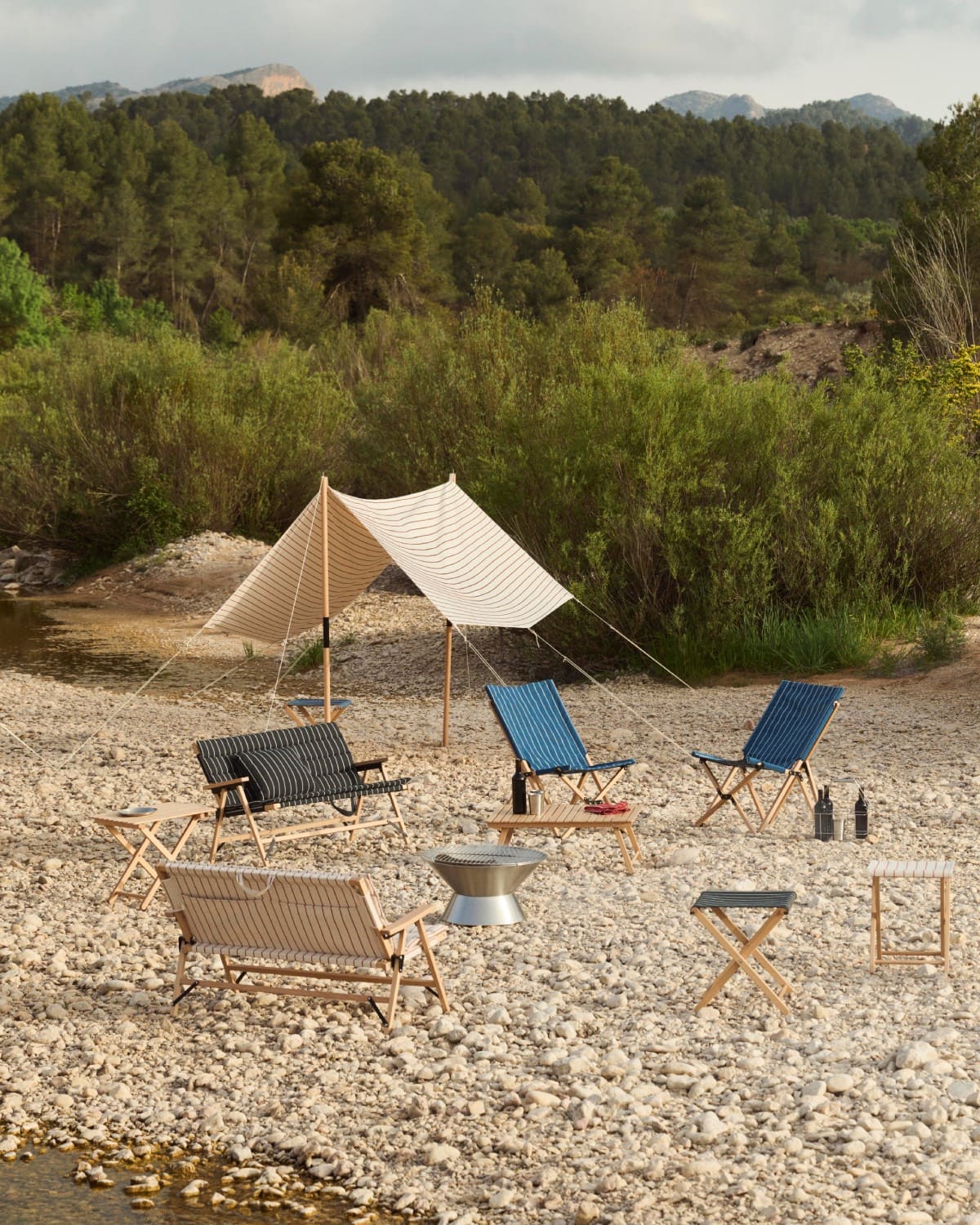
HAY Outdoor Market: Super Normal Meets the Campsite
Jasper Morrison's work for HAY has always leaned into what he calls "super normal" design: objects so quietly considered they disappear into use. The Outdoor Market collection extends that philosophy to camping and portable outdoor gear, reimagining the folding chair and cooler bag as part of a coordinated ecosystem rather than ad-hoc purchases.
What distinguishes the series is its material restraint. Water-lacquered beech keeps weight low without sacrificing structural integrity; stainless steel hardware resists corrosion; 100 per cent recycled polyester fabrics handle UV exposure and moisture. The result is a collection that feels less like rugged outdoor equipment and more like an extension of HAY's indoor catalogue, one that happens to fold flat and travel well.
The range spans folding sofas, chairs, tables, a sunshade canopy, hammocks, portable cooking tools, throw blankets, and cooler bags. Each piece is designed for rapid assembly and disassembly, a quality that matters as much in a compact urban balcony as it does at a beachside campsite. Morrison's approach here is less about innovation for its own sake and more about elevating the everyday rituals of outdoor leisure through thoughtful proportion and honest materials.
Loll Designs A La Carte: Modularity as Strategy
Modularity in outdoor furniture often translates to sectional seating. Loll Designs takes the concept in a different direction with A La Carte, a system of storage and prep units that can be configured into outdoor kitchens, gardening stations, or entertainment hubs.
The collection centres on four cabinet types, all built with powder-coated steel frames and surfaces made from 100 per cent recyclable HDPE, the majority of which is reclaimed from post-consumer milk jugs. Each unit measures 60 centimetres wide, a standardized dimension that allows for seamless pairing. Options range from fully enclosed cabinets to combined open-closed configurations and fully open shelving, giving users the flexibility to design setups tailored to specific programs.
Accessories extend the system's versatility. A stainless-steel cover protects HDPE surfaces from hot cookware, while HDPE boxes and trays (with optional lids) function as portable totes and interior organizers. The colour palette spans neutrals like white and black alongside saturated hues: apple red, sky blue, leaf green. It's a deliberately broad offering that speaks to Loll's recognition that outdoor spaces, like interior ones, demand aesthetic flexibility.
The modular logic here is less about reconfiguration for its own sake and more about responding to the varied ways people occupy exterior zones. A small urban terrace might accommodate a single cabinet configured as a bar; a sprawling suburban backyard could support a multi-unit outdoor kitchen. The system adapts without visual clutter.
Heller MB Collection: Bellini's Geometry in New Earth Tones
Mario Bellini's MB Collection for Heller, originally released in 2005, achieved near-instant recognition for its geometric clarity and tactile appeal. The lounge chair (MB 1), sofa (MB 2), and pouffe-table (MB 5) are all rotationally moulded from 100 per cent recyclable, self-cushioning polymer, a material choice that balances durability with a refined surface quality.
For years, the collection was available only in White and Dark Grey, two sophisticated neutrals that reinforced the furniture's minimalist ethos. Heller has now introduced five additional earth-inspired shades: Olive, Cookie, Slate, Silver, and Terra Cotta. The expanded palette reflects a broader trend in outdoor design toward warmer, more grounded colour stories that integrate with natural surroundings rather than contrast against them.
The new hues also align with Heller's Made to Order program, which offers custom colourization in more than 30 options. This level of customization is unusual in the outdoor furniture category, where colour choices are often limited by production efficiencies. Bellini's forms, with their sculptural silhouettes and tactile polymer surfaces, can now be specified to match or complement a wider range of architectural and landscape contexts, from private residences to hospitality and commercial projects.
Porter Green Silicone Drinkware: Unbreakable and Unapologetically Colourful
Australian sisters Jane Cox and Mary Warnest founded porter green in 2018 with a straightforward premise: drinkware for outdoor use should be sustainable, safe, and visually appealing. Their solution is silicone, an antimicrobial material that resists breakage, mould, and mildew while remaining flexible and lightweight.
The collection features multiple glass styles, each with playful acronymic names: Fegg (foldable, ethical, go-anywhere glass), Swepp (stylish wineglass, ethical, pliable, perennial), and Mecc (modern ethical cocktail coupe). The naming convention is cheeky, but the material choice is serious. Silicone offers a genuine alternative to glass (fragile) and plastic (environmentally problematic), particularly in outdoor contexts where breakage is a persistent concern.
Porter green's colour palette is expansive, spanning a spectrum of saturated tones that lend themselves to both casual poolside gatherings and more considered al fresco dinners. The pieces fold or compress for storage and transport, a practical feature that also reduces their spatial footprint when not in use. It's drinkware that acknowledges the realities of outdoor entertaining: mobility, durability, and the occasional need for visual levity.
KOLÓS Concrete Candleholders: Brutalism in Miniature
Founded in 2025 by Janna Schellens and Alejandro Mayer, KOLÓS approaches the outdoor candle as an architectural object. The Mexico City-based design house produces hand-crafted concrete vessels that reference brutalist and contemporary Mexican architecture, blending material heft with refined detailing.
The concrete blend incorporates reclaimed marble powder, a byproduct sourced from local stone-cutting operations. This addition lends the material a smoother, more polished finish than standard concrete, softening the typically rough texture associated with the material. Four colours draw from Mexican landscapes and architectural traditions: Sacred Ash (deep charcoal), Velvet Dust (soft mineral grey), Adobe Haze (warm reddish earth), and Agave Mist (muted green-grey).
KOLÓS offers two wax formulations. An indoor blend uses 100 per cent plant-based soy and palm wax; the outdoor version employs mineral wax resistant to temperature fluctuations and a reinforced wick designed to withstand wind. Three widths (22 cm, 28 cm, and 38 cm) give the candleholders a sculptural presence that reads as much like site-specific installation as functional lighting.
The reference to brutalism is deliberate. Concrete, often associated with large-scale infrastructure and monumental architecture, is scaled down here into handheld objects that carry the material's tectonic weight. It's a gesture that aligns with a broader interest among designers in material honesty and craft-based production, particularly in regions where local material traditions remain active.
Material Choices as Editorial Statements
What unites these collections is a shared attention to materiality. Recycled HDPE, rotationally moulded polymer, silicone, reclaimed marble-infused concrete: each material carries its own performance characteristics and environmental implications. These are not arbitrary selections. They reflect a design culture increasingly attuned to lifecycle thinking, where the origin, durability, and end-of-life fate of materials factor into aesthetic and functional decisions.
Outdoor design has long been constrained by the need for weather resistance, a requirement that historically limited material palettes to treated woods, powder-coated metals, and synthetic textiles. The collections here demonstrate that performance criteria need not dictate visual sameness. HAY's water-lacquered beech feels fundamentally different from KOLÓS's concrete, yet both materials perform admirably in exterior conditions. The challenge, as always, is matching material properties to programmatic demands without defaulting to the familiar.
Flexibility Without Formlessness
Modularity and adaptability appear repeatedly across these collections, but not in the same ways. Loll's A La Carte system is explicitly modular, designed for reconfiguration. HAY's Outdoor Market collection is portable and collapsible, prioritizing mobility over fixed arrangement. Heller's MB Collection offers colour customization rather than formal flexibility, allowing users to tailor pieces to specific contexts without altering their geometry.
These are different strategies for accommodating the varied ways people occupy outdoor spaces. A rooftop terrace in a dense urban core demands different furniture than a lakeside cottage or a suburban backyard. Rather than proposing a single solution, each collection carves out a distinct position within the broader outdoor living landscape. The result is a category that feels less monolithic, more responsive to the particularities of site, program, and user preference.
Precedents and Parallels
Morrison's super normal ethos has roots in the functionalist traditions of mid-century Scandinavian design, where beauty emerged from utility rather than ornament. Bellini's geometric forms recall the rational plasticity of Italian postmodernism, a movement that embraced synthetic materials without apology. KOLÓS's concrete work situates itself within a lineage of Mexican modernism that spans from Luis Barragán's chromatic planes to contemporary practices engaging craft and local material economies.
These are not derivative gestures but conscious engagements with design history. Each collection builds on established precedents while addressing contemporary concerns: sustainability, adaptability, aesthetic diversity. The outdoor furniture category, long dominated by a narrow set of typologies and materials, is slowly becoming a site for more expansive formal and material exploration.
A Broader Shift in Outdoor Spatial Thinking
At World Archi Design, we've been tracking a gradual but unmistakable shift in how designers and manufacturers approach exterior spaces. The old logic of indoor-outdoor continuity, where outdoor furniture simply mimicked interior forms in weather-resistant materials, is giving way to a more nuanced understanding of outdoor environments as distinct spatial conditions with their own requirements and possibilities.
These five collections exemplify that shift. They don't merely transpose interior typologies outdoors; they engage with the specific demands of exterior use, portability, weather exposure, and the social rituals that unfold in open air. Whether through modularity, material innovation, or formal restraint, each collection proposes a version of outdoor living that feels less provisional, more considered. Summer may be the season that brings these spaces into focus, but the design thinking behind them suggests a year-round commitment to elevating how we inhabit the spaces between buildings and sky.
Save this story. A free account keeps your reading list and the 07:00 email in one place.
CREATE FREE ACCOUNT →SIGN IN