
The Paradox of Invisible Infrastructure
We live with electricity the way we live with air: essential, omnipresent, rarely considered until it fails. Grid systems hum behind walls, substations hide behind chain-link, and battery banks occupy back rooms or basement vaults. The architecture of energy has long been an architecture of concealment. Yet as cities electrify faster than aging grids can adapt, a question emerges: what if storage systems stopped hiding and became part of the public realm?
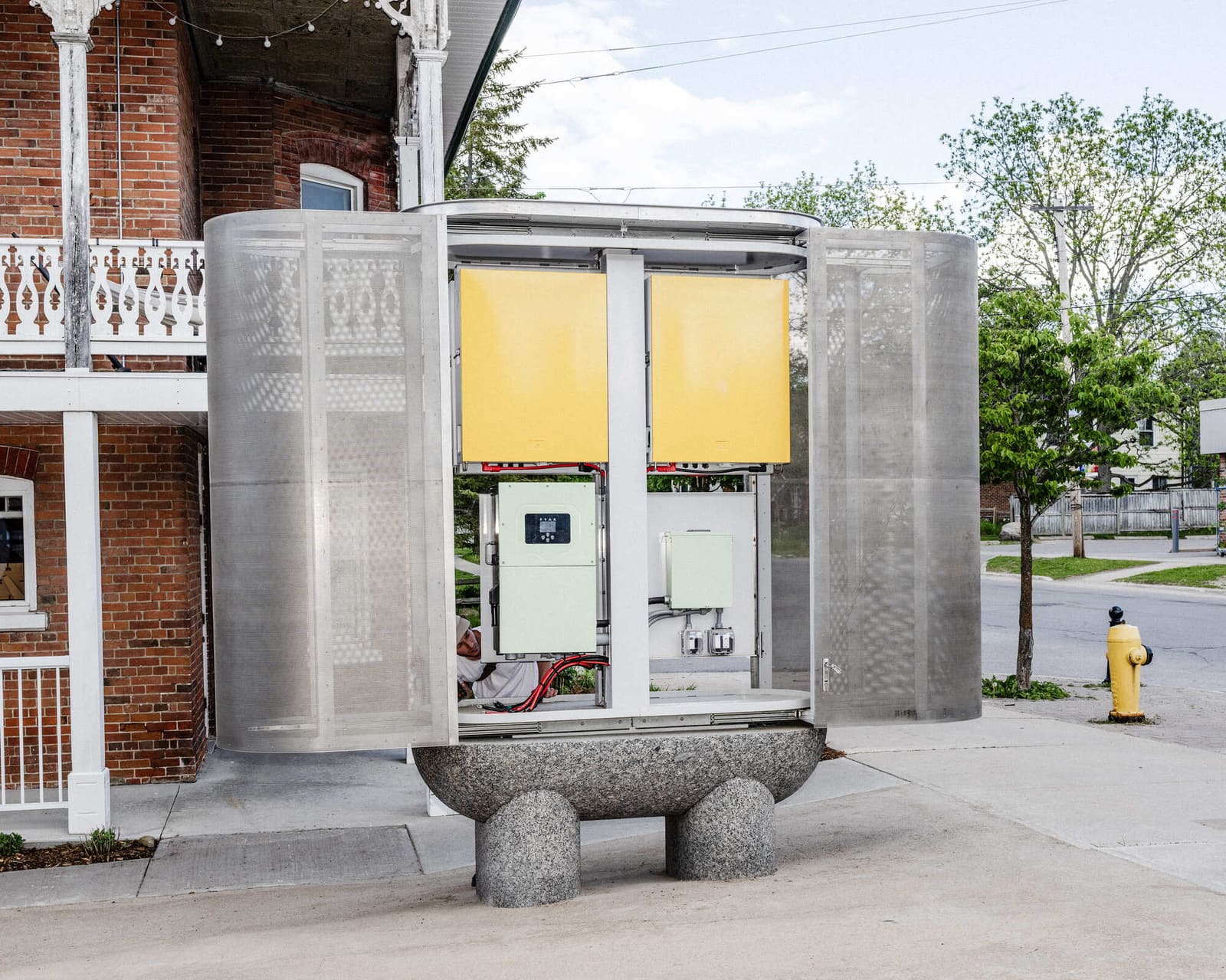
A prototype installed in Cannington, Ontario, offers one answer. Designed by architects Jack Self and Josh Harskamp for Toronto-based startup Civic Grid, the project is a monolithic battery system built as urban furniture. At 60 kilowatt-hours capacity, it charges during off-peak hours when energy prices drop, then discharges throughout the day to support local electrification, power charitable foundations, and provide backup during outages. The device also integrates public seating and charging ports, positioning energy storage not as hidden infrastructure but as civic equipment, visible and legible in shared space.
The project builds on a deployable energy system the architects developed with Lisbon Civil Defence for the Lisbon Architecture Triennale in 2025, which remains operational. The Ontario iteration scales that prototype into a permanent installation, paired with a working scale model. It is, in effect, architecture that stores power and delivers it where conventional grid connections fall short.
Electrification Outpacing the Grid
The premise behind the design is straightforward: demand for electricity is moving faster than the expansion of distribution networks. Dense urban areas, where space is constrained and installation costs are high, face particular difficulty accommodating conventional battery hardware. Civic Grid's approach is to make storage systems that fit into public space without requiring dedicated rooms, fenced enclosures, or industrial aesthetics.
The Cannington battery charges overnight, when grid demand and energy prices are lowest, then discharges during peak daytime hours. This time-shifting reduces the site's peak draw on the existing grid, effectively expanding capacity without requiring new substations or transmission lines. The strategy mirrors load-balancing techniques used in commercial buildings, but reframes the hardware as public architecture rather than hidden plant.
According to the International Energy Agency, grid-scale energy storage is classified as an emerging technology alongside green hydrogen and advanced renewables. It sits at the intersection of renewable energy deployment and grid modernization, addressing the intermittency of solar and wind while deferring costly infrastructure upgrades. The Ontario prototype demonstrates how storage might occupy the same category as bus shelters, drinking fountains, or kiosks: elements of the public realm that serve utilitarian functions while shaping the character of a place.
Material and Form Language
The battery is designed as a monolith, a single geometric volume that reads as furniture rather than machinery. Its form is deliberate: clean lines, integrated seating, no visible conduit or mechanical clutter. The aesthetic aligns with a broader trend in infrastructure design, where technical systems are given architectural treatment to justify their presence in public view.
We have seen precedents in other domains. Pump stations designed as sculptural pavilions, ventilation shafts clad in perforated metal, transformer substations wrapped in brick to match adjacent housing. The Cannington battery extends this logic to energy storage, proposing that batteries can be both functional devices and social nodes. The seating invites lingering; the charging ports make the device interactive. The result is infrastructure that people use, not just infrastructure that serves them passively.
The choice of materials and detailing is equally intentional. The monolithic form minimizes visual complexity, while the integration of seating and charging suggests continuity with other street furniture. There is no attempt to disguise the device as something else, nor to celebrate its technical components. Instead, the design occupies a middle ground: legible as a battery, comfortable as a bench, coherent as a piece of urban equipment.
Storage as Civic Architecture
The Ontario installation raises questions about the visibility of energy systems. For most of the twentieth century, utilities operated on a model of centralized generation and hidden distribution. Power plants sat at the urban periphery, transmission lines crossed the landscape on towers, and substations occupied fenced lots. Consumers interacted with electricity only at the outlet, the switch, the meter.
Distributed generation and storage disrupt that model. Rooftop solar, community wind, and now grid-scale batteries push energy production and storage closer to the point of use. The challenge is spatial: where do these systems go, and what do they look like when they arrive?
Civic Grid's answer is to make storage systems that belong in public space, not despite their function but because of it. The battery becomes a marker of the town's energy transition, a tangible representation of infrastructure that is otherwise invisible. It makes the grid legible, turning an abstract system into a physical object that residents can see, touch, and use.
This approach has implications beyond Cannington. If batteries can be designed as public architecture, then other infrastructure might follow the same trajectory. Stormwater management, telecommunications, waste processing - all are candidates for rethinking as civic elements rather than hidden systems. The prototype suggests a design language where infrastructure is integrated rather than isolated, where technical performance and public amenity are not mutually exclusive.
Performance and Context
The 60 kWh capacity is modest by utility standards but significant for a single site. It provides power to local charitable organizations, supports public charging, and offers backup during grid outages. The time-shifting function - charging at night, discharging by day - reduces peak demand and lowers energy costs for the site's operators. The device does not replace the grid; it complements it, filling gaps and smoothing demand curves.
The choice of Cannington as a site is instructive. A small town in Ontario, it is neither a dense metropolis nor a remote rural community. It represents the kind of mid-scale settlement where grid capacity is often constrained, where electrification is advancing but infrastructure is not keeping pace. The battery addresses a specific local need while serving as a prototype for broader application.
The project also acknowledges the economic and spatial constraints of urban battery deployment. Conventional systems require dedicated rooms, fire suppression, climate control, and security. By designing the battery as outdoor furniture, Civic Grid sidesteps many of these requirements, reducing installation costs and expanding the range of potential sites. The trade-off is capacity: a monolithic bench cannot store as much energy as a shipping-container-sized system. But the integration with public space may justify the compromise, particularly in contexts where conventional hardware would be prohibitively expensive or spatially impossible.
Toward a New Typology
The Cannington battery is part of a broader conversation about the relationship between architecture and infrastructure. At World Archi Design, we have been tracking projects that make technical systems visible, that treat utilities as opportunities for design rather than obstacles to be hidden. The Ontario prototype fits into this lineage, proposing that energy storage can be both high-performance infrastructure and thoughtful public architecture.
The question is whether the typology scales. A single 60 kWh battery in a renovated square is one thing; a network of such devices across a city is another. The design language would need to adapt to different contexts, different capacities, different uses. But the principle - that storage systems can occupy public space, that they can be legible and accessible - holds potential across scales.
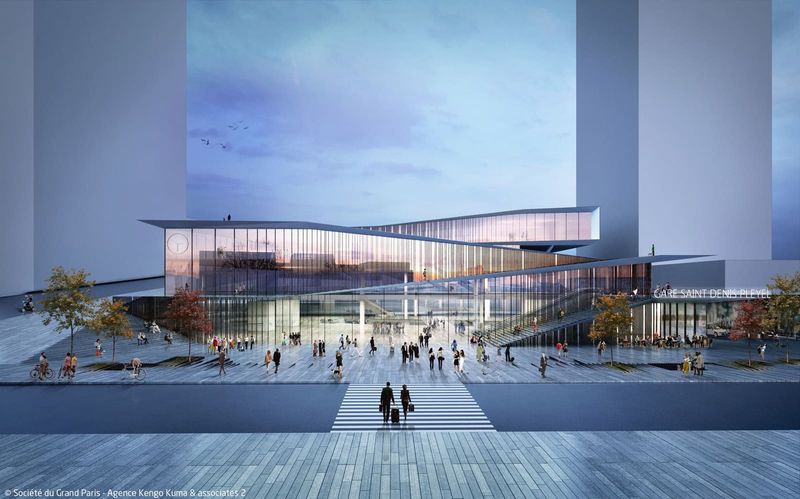
Other cities are exploring their own approaches to visible infrastructure. In Paris, the Grand Paris Express is building 200 kilometers of automated metro lines with 68 architect-designed stations, treating transit infrastructure as an opportunity for architectural intervention. In Japan, Project PLATEAU is creating open-access 3D models of more than 250 cities, making urban data legible and accessible. The Cannington battery operates in a similar register: it takes a technical system and makes it a civic asset, turning infrastructure into architecture.
Save this story. A free account keeps your reading list and the 07:00 email in one place.
CREATE FREE ACCOUNT →SIGN IN