
The Digital Paradox
Rendered interiors arrive on our screens already complete. Every surface aligns perfectly, every joint invisible, every material transition polished into frictionless continuity. Yet something essential vanishes in that computational smoothness: the thickness of construction itself, the record of hands shaping matter, the tolerance between intention and execution. Across recent Chinese interior work, a countermovement has emerged, not as romantic nostalgia but as architectural argument. These projects insist that imperfection can carry meaning when it registers the passage of material through human labor.
At World Archi Design, we've been tracking how craft operates in contemporary interiors less as applied decoration and more as spatial evidence. The projects we examine here span cafés, hotels, rural guesthouses, and cultural lobbies, yet they share a common refusal: they will not erase the marks of making. Instead, they allow timber cracks, aggregate irregularity, plaster thickness, and construction adjustments to remain legible. The result is interiors that feel answerable to their sites, their builders, and their material realities.
Recovered Structure: When Old Timber Speaks Again
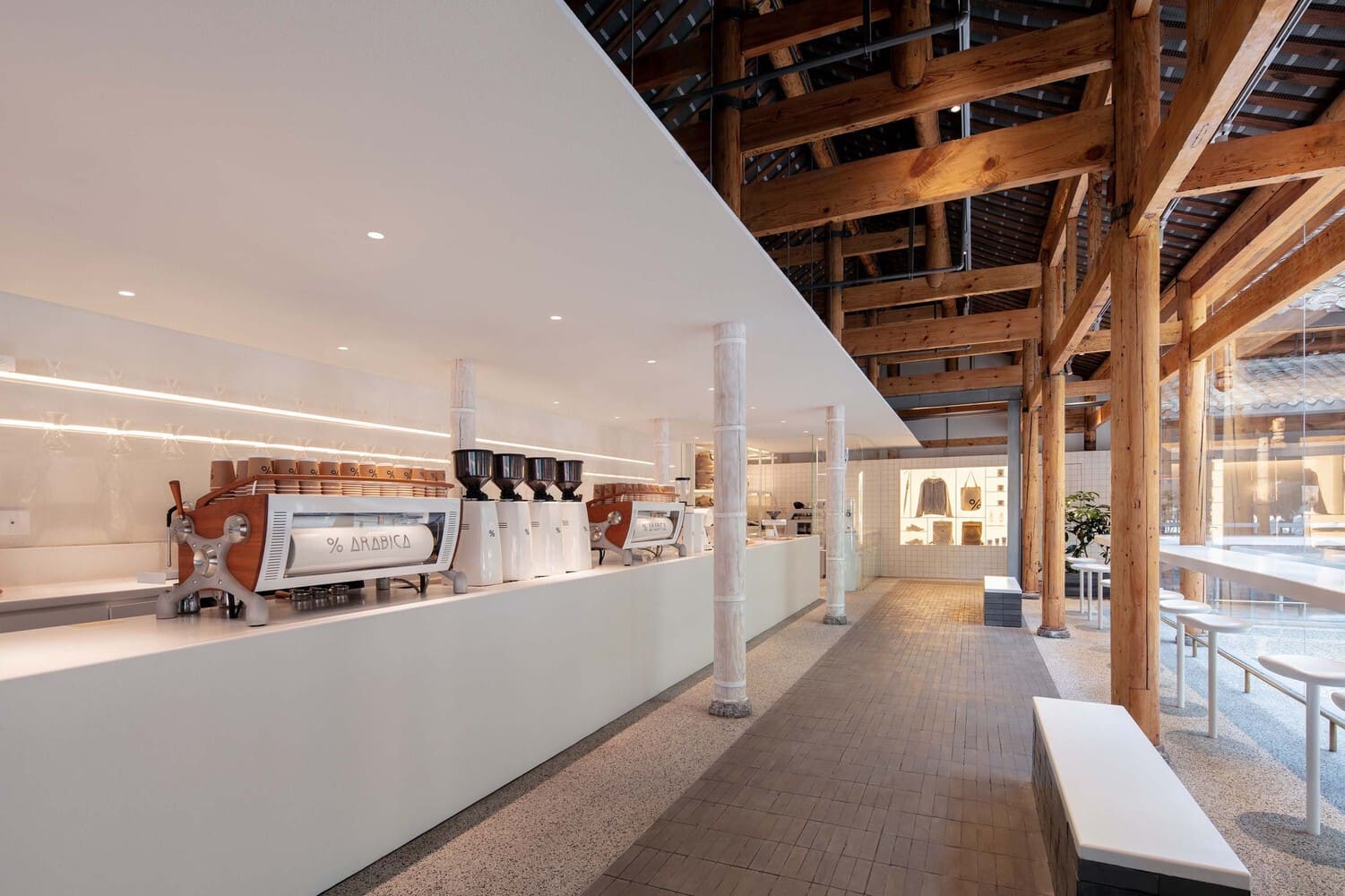
B.L.U.E. Architecture Studio's intervention in a traditional western-Sichuan residence in Chengdu begins not with addition but with subtraction. The architects stripped away later modifications and removed black paint that had obscured the original timber columns, revealing wood grain and color that had been hidden for decades. Steel reinforcement was introduced selectively, but the primary gesture was restoration through exposure. The handmade surface here predates the project; the architects simply allowed it to reappear.
The café that now occupies this courtyard building pairs that recovered timber with new material decisions. Old grey bricks pave the looped interior circulation, while a semi-enclosed seating area uses handcrafted bricks whose irregular surfaces produce tactile variation. The minimal white service bar and glass enclosures read as contemporary insertions, but they defer to the rougher, older surfaces. Craft becomes a method of historical conversation rather than historical erasure.
This approach contrasts sharply with Unknown design's Barn Inside, where timber structure is introduced as a deliberately unrefined element. Wooden piles form the interior skeleton, but they retain visible cracks, annual rings, and surface irregularities. The architects describe these marks as records of material time, accepting coarseness as expressive texture. Here, craft is not about refinement but about proximity to the raw state of the material. The wood is shaped just enough to become architecture, but not so much that it loses its origin story.
Plaster, Paint, and the Negotiation of Finish
Team BLDG's Terraced Courtyard offers a different kind of craft legibility, one rooted in the construction process itself. The architects produced more than eighty mock-ups during the building phase, testing color, texture, and thickness with local workers. When skilled labor for washed stone proved difficult to secure, they shifted to texture paint, working through repeated on-site adjustments. The resulting surface is rough and uneven, but those qualities were not failures. They were outcomes of negotiation between design intent and available technique.
The red-toned plaster responds to the surrounding mountain soil, grounding the building in its landscape. Construction errors were not eliminated but adjusted and absorbed into the final surface. This suggests a definition of craft that extends beyond manual skill to include judgment: knowing when to correct, when to accept, and when imperfection strengthens the building's relationship to place. Craft here is less about perfection and more about fit.
New Practice Studio's Chapter and Verse Hotel in Wuzhen takes a more composed approach to similar materials. Natural wood, handcrafted plaster, and custom terrazzo are deployed not as isolated statements but as contributors to a larger atmospheric continuity. Wooden screens filter light at the street facade, while plaster and terrazzo surfaces give the interior a calm, tactile coherence. The craft operates through mood rather than roughness alone, suggesting that handmade surfaces can support subtlety as effectively as they support rawness.
Concentrated Craft: The Single Surface That Recalibrates the Room
OPEN Architecture's Art Vessels demonstrates how craft can operate through concentration rather than saturation. A glowing wall made from traditional handmade paper, laminated into glass, functions as both lighting and spatial divider in the lobby. The material is fragile in its original form, but becomes architectural when translated into a luminous surface. The irregularity of the paper fibers changes the quality of light, softening it and giving the space an atmospheric presence that no industrially produced material could replicate.
This single surface is part of a broader craft strategy within the project, which includes glazed ceramic tiles, custom bronze handles, interlocking reception blocks, and intricately shaped ventilation panels. Yet the handmade paper wall stands out because it shows how craft can be translated into light itself. Its value lies not only in tactile texture but in the way material irregularity alters the experience of the room.
Studio8's Anadu Pine Villa offers another model of concentrated craft, this time rooted in reclaimed wood. Eighty percent of the woodwork was handcrafted by local artisans, much of it sourced from reclaimed timber found in nearby markets. The wood is shaped to harmonize with the scale and character of the surrounding environment, continuing local craft knowledge through the interior. The reclaimed surfaces carry both material reuse and human labor, functioning as finish and as condensed record of sourcing and adaptation.
Together, these two projects suggest that craft does not need to dominate an entire interior to transform it. A single paper wall, a reclaimed timber surface, or a carefully shaped panel can recalibrate the spatial experience. The handmade accent works precisely because it is concentrated, slowing the eye and reminding the visitor that even highly controlled contemporary interiors can contain surfaces marked by process.
Thickness, Tolerance, and the Evidence of Making
What connects these six projects is not a single aesthetic but a shared resistance to seamlessness. They allow interiors to hold evidence of construction: timber grain, cracks, aggregate, plaster thickness, paper fiber, reclaimed wood, uneven handcrafted traces. These surfaces do not simply decorate the room. They make construction legible, registering the passage of material through tools, hands, and site conditions.
This may be one of craft's most important roles in the digital age. It reminds architecture that material meaning is not produced only through concept, form, or image, but through the way a surface meets the hand, the tool, the worker, and the site. In the Chinese interiors we've examined here, imperfection becomes more than an atmospheric preference. It becomes a form of responsibility toward material memory, local knowledge, and the human labor through which architecture becomes real.
The digital rendering will continue to offer the seductive image of frictionless completion. But these projects argue for a different kind of image: one that includes tolerance, adjustment, and the marks of making. They suggest that contemporary interiors can be both precise and imperfect, both controlled and marked by human touch. In doing so, they offer a counterweight to the computational smoothness that increasingly dominates architectural representation, insisting that architecture is not complete until it has passed through the resistance of the real.
Save this story. A free account keeps your reading list and the 07:00 email in one place.
CREATE FREE ACCOUNT →SIGN IN