The Question of Porosity
Architecture has long borrowed from nature in metaphor: the branching column, the shell-like roof, the honeycomb façade. But what happens when the reference shifts from visual mimicry to structural logic, when a building envelope begins to behave like a membrane rather than a wall? Rameshwari Jonnalagedda, a London-based architect and designer, has built her practice around this question. Her work probes the intersection of computation, digital fabrication, and biological systems, asking how minimal surface geometry can invite living processes into the discipline.
At World Archi Design, we've been tracking the rise of bio-integrated design frameworks that move beyond sustainability checklists toward genuine material and spatial symbiosis. Jonnalagedda's approach stands out not for its technological novelty alone, but for the conceptual rigor with which she treats geometry as a mediator between the inert and the animate.
Minimal Surfaces as Architectural Parti
Minimal surfaces, those mathematical forms that occupy the least area for a given boundary, have fascinated architects since Frei Otto's soap-film experiments in the 1960s. Otto's tensile structures at the Munich Olympic Park demonstrated how material economy and structural elegance could converge. Jonnalagedda extends this lineage, but with a crucial shift: where Otto sought optimization for human shelter, her work explores how such surfaces might support non-human ecologies.
Her studio, Serame, investigates geometries that maximize surface area relative to volume, a property critical to biological exchange. Consider the alveoli in lungs or the folded membranes of mitochondria. These structures achieve efficiency not through minimalism in the reductive sense, but through maximized interface. Jonnalagedda's architectural prototypes adopt this principle, using computational tools to generate forms that could theoretically host microbial colonies, facilitate air filtration, or enable nutrient exchange.
The implications are tectonic. If a wall can become a substrate for biofilm, the traditional separation between building envelope and environmental system dissolves. The façade is no longer a barrier but a participant in metabolic cycles.
Computation as Biological Translator
Digital fabrication has democratized complex geometry, but Jonnalagedda's use of these tools resists the trap of formalism. Her computational workflows draw from algorithms inspired by morphogenesis, the biological process by which organisms develop shape. Rather than imposing a predetermined aesthetic, she allows parameters like curvature, porosity, and growth constraints to guide the design.
This methodology echoes the work of Neri Oxman's Material Ecology group at MIT, which pioneered the concept of "material computation," where fabrication logic and material behavior co-evolve. Yet where Oxman's projects often operate at the scale of pavilions or installations, Jonnalagedda's research asks how these principles might scale to habitable architecture. Can a residential envelope integrate living moss systems that regulate humidity? Can a public structure's geometry encourage lichen colonization that sequesters carbon?
The technical challenges are considerable. Minimal surfaces, while mathematically elegant, are notoriously difficult to rationalize for construction. Fabrication tolerances, material limitations, and structural performance under load all impose constraints that pure geometry ignores. Jonnalagedda's practice navigates this tension by working iteratively between digital simulation and physical prototyping, often using robotic fabrication to test geometries that would be impossible to construct by hand.
Precedent and Departure
The integration of biology into built form has precedents. Michael Pawlyn's Exploration Architecture has championed biomimicry since the early 2000s, translating principles from termite mounds and lotus leaves into building systems. Rachel Armstrong's work on synthetic biology and "living architecture" proposes buildings that grow and repair themselves. Jonnalagedda's contribution lies in her focus on geometry as the enabling framework, the scaffold that makes biological inhabitation architecturally legible.
Her approach also diverges from the parametricism of Zaha Hadid Architects or the algorithmic formalism of Greg Lynn. Those practices used computation to generate novel spatial experiences for human occupants. Jonnalagedda's geometries prioritize non-human agents, micro-ecologies that operate at scales invisible to the naked eye. The architecture becomes less about visual spectacle and more about invisible performance, a shift that challenges conventional metrics of design success.
Material Experiments and Fabrication Constraints
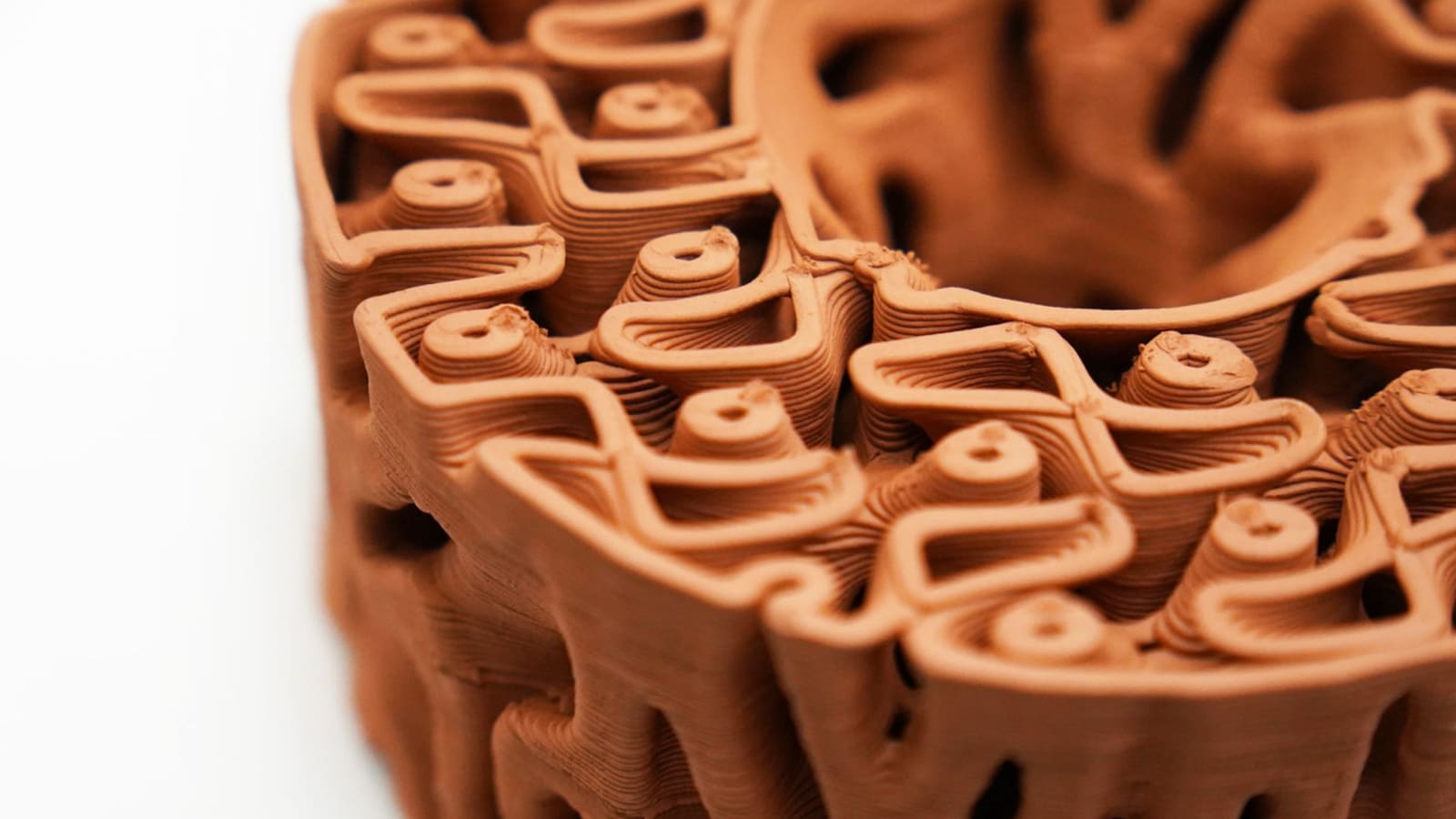
Serame's prototypes often employ materials that blur the boundary between substrate and organism. Mycelium composites, bacterial cellulose, and bio-receptive concrete all feature in her research. These materials are not merely "sustainable" in the sense of reduced carbon footprint; they are alive, or designed to host life. The architectural implications are profound. A mycelium-based panel doesn't just insulate; it continues to grow, densify, and potentially repair itself over time.
Yet the regulatory and durability questions loom large. Building codes have no framework for evaluating a façade that changes properties as it matures. Fire safety, structural integrity, and long-term weathering remain open research areas. Jonnalagedda's work operates largely in the speculative and prototype realm, testing ideas that the construction industry has yet to accommodate.
This is not a critique but a recognition of where the discipline stands. The gap between laboratory innovation and site implementation has always been wide in architecture. What matters is the conceptual ground being prepared. If bio-integrated envelopes are to become viable, the geometric and fabrication logic must first be proven at small scale.
Toward a Living Envelope Typology
One of Jonnalagedda's recent explorations involves modular panels based on Schwarz P and D surfaces, minimal surfaces named after the 19th-century mathematician Hermann Schwarz. These geometries tessellate in three dimensions, creating continuous, porous networks. In her prototypes, each module functions as a micro-habitat, with cavities that can trap moisture, host microorganisms, or facilitate airflow.
The concept recalls the perforated brick screens of traditional South Asian architecture, the jali, which modulate light and ventilation through geometric patterning. But where jali achieves environmental performance through subtractive geometry, Jonnalagedda's surfaces are generative, their complexity emerging from computational rules rather than craft tradition. The result is a hybrid: vernacular environmental intelligence encoded in digital workflows.
Her work also engages the temporal dimension. A minimal surface envelope doesn't remain static. As biological agents colonize its geometry, the system's thermal, acoustic, and even structural properties evolve. This introduces a degree of unpredictability that conventional architecture resists. Architects are trained to deliver fixed outcomes; Jonnalagedda's practice suggests a different model, one where the designer establishes initial conditions and then steps back, allowing emergent processes to complete the work.
The Broader Implications
If minimal surface geometry can serve as a scaffold for biological integration, what does that mean for the future of building envelopes? At the very least, it suggests that the Modernist ideal of the hermetically sealed curtain wall is reaching the end of its conceptual life. Climate change, biodiversity loss, and resource scarcity all demand that architecture reconsider its relationship to ecological systems. Jonnalagedda's work offers one pathway: not architecture that mimics nature, but architecture that literally incorporates it.
This is not without risk. Introducing living systems into building fabric raises questions of control, maintenance, and unintended consequences. What happens when a bio-receptive façade hosts species the designer didn't anticipate? How do you "decommission" a building whose envelope is alive? These are not hypothetical concerns but real design challenges that will need institutional, regulatory, and cultural frameworks to address.
Yet the potential rewards are significant. Buildings that actively participate in nutrient cycles, that sequester carbon, that provide habitat for urban biodiversity, these are not fantasies but plausible outcomes of the research Jonnalagedda and others are conducting. The question is whether the architecture profession, and the construction industry it serves, can adapt quickly enough to make use of them.
A Shift in Design Priorities
Rameshwari Jonnalagedda's practice represents a quiet but fundamental reorientation in how we think about architectural form. By centering minimal surface geometry and biological systems, she challenges the anthropocentric bias that has dominated the discipline for centuries. Her buildings, or proto-buildings, are not monuments to human presence but infrastructures for multi-species coexistence.
This shift has precedent in landscape architecture, where designers like Kongjian Yu and James Corner have long advocated for ecological performance over formal composition. But translating that ethos into building-scale architecture requires new tools, new materials, and new ways of evaluating success. Jonnalagedda's work provides a glimpse of what that translation might look like: precise, computationally rigorous, and unapologetically experimental.
As climate and biodiversity crises deepen, the question is no longer whether architecture should engage with living systems, but how. Minimal surface geometry, with its inherent efficiency and capacity for complexity, offers one compelling answer. Whether it scales from prototype to practice remains to be seen. But the conceptual ground is being laid, one mathematically optimized surface at a time.
Save this story. A free account keeps your reading list and the 07:00 email in one place.
CREATE FREE ACCOUNT →SIGN IN