
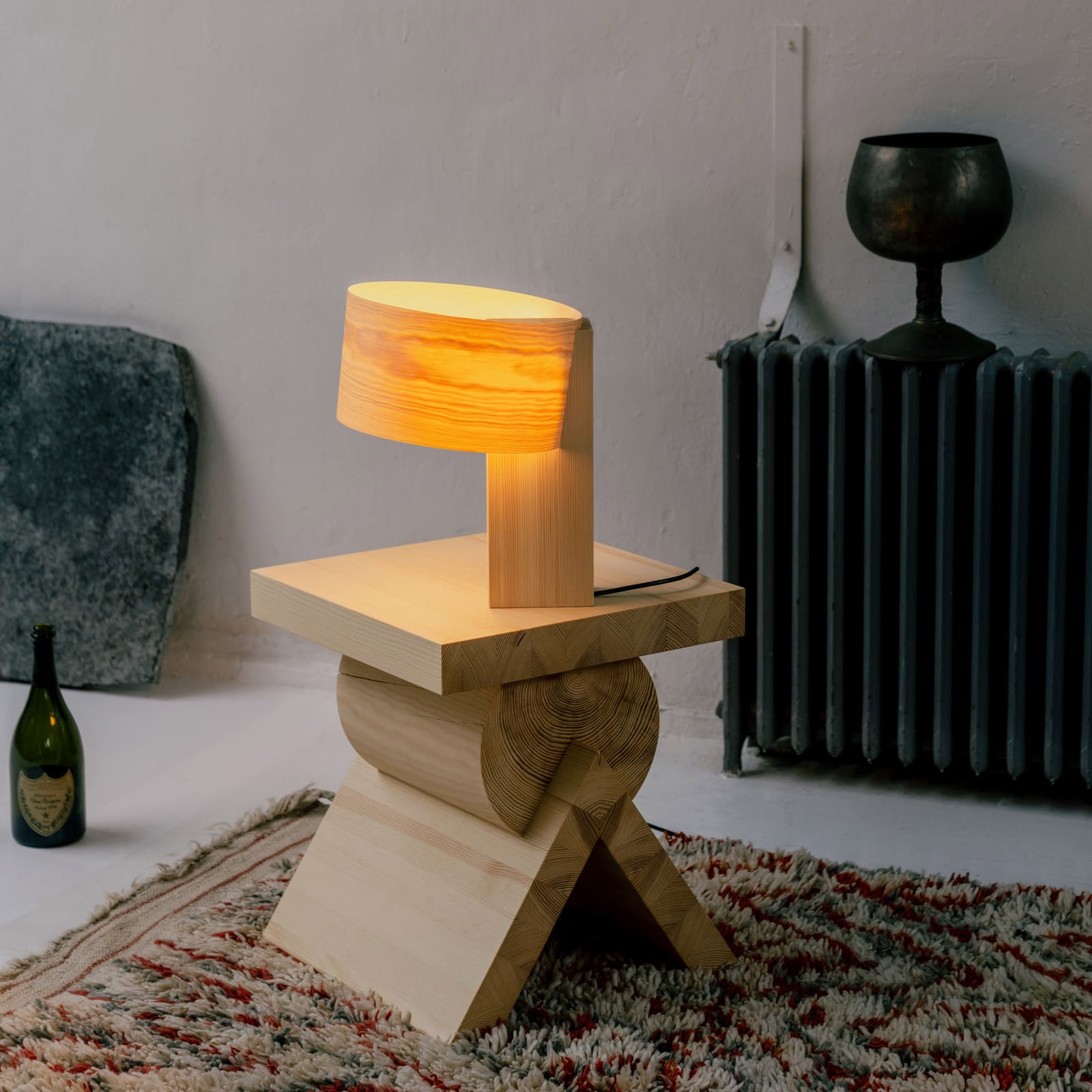
A Material Conversation Between Mass and Light
There is something refreshing about a design that begins not with form, but with a question about what a material can do. John Tree's Hoop Table Lamp for Finnish brand Vaarni is precisely this kind of inquiry: a sculptural lighting piece that treats pine not as a neutral substrate but as an active participant in shaping the final object. The lamp comprises two contrasting pine components - a monolithic solid timber base and a thin veneer hoop that functions as both shade and diffuser - each exploiting different properties of the same species.
Vaarni sourced the pine from sustainably managed Finnish forests and manufactured the lamp locally in Jurva. The choice of pine is hardly incidental. For a brand whose identity centres on this singular material, the Hoop lamp represents an exploration of range: how the same wood can perform radically different structural and optical roles within a single design.
Geometric Reduction and Material Constraint
Tree describes the design process as an exercise in reducing two elements to their simplest geometric forms, yet one governed entirely by what the material would permit. The solid pine base functions as a stable structural anchor, cut through with a single precise slot to support the second element. That second element - a thin veneer hoop - holds an integrated light source and diffuses the glow in what Tree characterises as an almost magical way.
The thickness of the veneer was determined not by aesthetic preference but by optical necessity. Tree calibrated it to allow light to pass through, testing the boundary between opacity and translucency. Similarly, the diameter of the hoop was constrained by the veneer's structural behaviour. Beyond a certain size, the veneer began to distort under its own weight. Thickening it would have solved the structural problem but would have blocked the light, so the final form emerged from this negotiation between competing material demands.
This kind of design logic - where form is the outcome of material interrogation rather than its starting point - echoes the work of architects such as Peter Zumthor, who famously allows materiality to dictate spatial and formal decisions. In Hoop, Tree applies a similar discipline at the scale of a table lamp.
Precision as Elevation
Tree notes that while he has worked with pine before, he had not previously had the opportunity to explore its properties to this extent. The collaboration with Vaarni, whose expertise in pine fabrication is considerable, enabled precise and complex technical detailing that elevated what Tree describes as a humble material.
The lamp's construction required exactitude. The single cut through the solid base had to be clean and accurate enough to hold the veneer hoop securely without additional fixings. The veneer itself, thin enough to transmit light, had to be formed into a perfect circle and integrated with the light source in a way that maintained structural integrity. These are not trivial challenges, and they required manufacturing capabilities that go beyond standard joinery.
Vaarni's local production in Finland allowed for this level of control. The proximity between designer, manufacturer, and material source created a feedback loop in which design decisions could be tested, refined, and adjusted in response to the material's behaviour. This is a different model from the more common practice of specifying materials and forms independently, then resolving conflicts later in the production chain.
Pine as a Design Thesis
The Hoop lamp is, in Tree's words, a celebration of pine - a material often overlooked in favour of more exotic or expensive timbers. Pine's ubiquity in Scandinavian design has historically been tied to economy and availability rather than prestige. Yet Vaarni's body of work, including previous collaborations with designers such as Faye Toogood and showcases at 3 Days of Design, consistently argues for pine's capacity to be both brutal and sophisticated.
What makes pine compelling in this context is its versatility. The same species can be milled into thick structural blocks, sliced into translucent veneers, or shaped into curved forms. It accepts oil and wax finishes that deepen its colour and grain. It is light enough to work with easily but dense enough to feel substantial. These are not abstract qualities; they are material affordances that directly inform what a designer can do.
In the Hoop lamp, Tree exploits this range. The solid base reads as heavy and grounded, with the grain visible and the material's density apparent. The veneer hoop, by contrast, feels almost weightless, its thinness emphasised by the glow that passes through it. The juxtaposition is striking not because it is novel but because it makes visible the material's inherent contradictions.
Form Defined by Threshold
One of the more interesting aspects of the Hoop lamp is how its final form was determined by identifying thresholds - the point at which the veneer begins to distort, the thickness at which light no longer transmits, the diameter at which structural stability fails. These are not arbitrary limits; they are intrinsic to the material and the manufacturing process.
This approach contrasts with a design method that begins with a desired form and then seeks materials and techniques to realise it. Instead, Tree allowed the material to define the boundaries of possibility, and the form emerged from mapping those boundaries. The result is a design that feels inevitable rather than imposed.
This is not to say the lamp lacks authorship. Tree's decisions about proportion, the relationship between the two elements, and the quality of the light are all deliberate. But those decisions are made in dialogue with the material rather than in spite of it. The lamp's sculptural quality comes from this tension between intention and constraint.
Precedents and Context
The Hoop lamp sits within a broader tradition of Scandinavian design that privileges material honesty and functional clarity. Designers such as Alvar Aalto and Hans Wegner built entire practices around the expressive potential of wood, often using lamination, bending, and joinery techniques to reveal rather than conceal the material's properties.
More recently, designers working with Vaarni and similar brands have revisited these principles with a contemporary sensibility. Faye Toogood's chair and footstool for Vaarni, for instance, used pine in a deliberately raw, almost unfinished manner, emphasising its tactile and visual character. Tree's Hoop lamp takes a different approach, using precision and refinement to achieve a similar goal: making the material itself the subject of the design.
The lamp also participates in a wider conversation about sustainability and local production. By using Finnish pine from managed forests and manufacturing locally, Vaarni positions the lamp within a framework of reduced environmental impact. This is not greenwashing; it is a practical outcome of working with a regional material and a local supply chain.
Light as Material Consequence
Ultimately, the Hoop lamp is as much about light as it is about wood. The thin veneer hoop transforms the light source into a diffused glow, softening the illumination and creating a warm ambient effect. The thickness of the veneer modulates the intensity and colour of the light, adding another layer of material specificity to the design.
This integration of light and material is not new - designers from Isamu Noguchi to Ingo Maurer have explored it extensively. But Tree's approach is distinctly architectural. The lamp reads less as a decorative object and more as a small-scale tectonic assembly, where each element has a clear structural and functional role.
The Hoop lamp is a reminder that material exploration does not require exotic substances or advanced technologies. Sometimes it simply requires asking what a familiar material can do when pushed to its limits, and having the expertise and patience to find out.
Save this story. A free account keeps your reading list and the 07:00 email in one place.
CREATE FREE ACCOUNT →SIGN IN