
The Question Architecture Forgot to Ask
We design for movement, for efficiency, for spectacle. We calibrate our plazas to accommodate crowds, our benches to discourage sleeping, our curbs to serve the able-bodied. But what if the measure of a city's success lies not in its capacity to process bodies efficiently, but in its willingness to hold them gently?
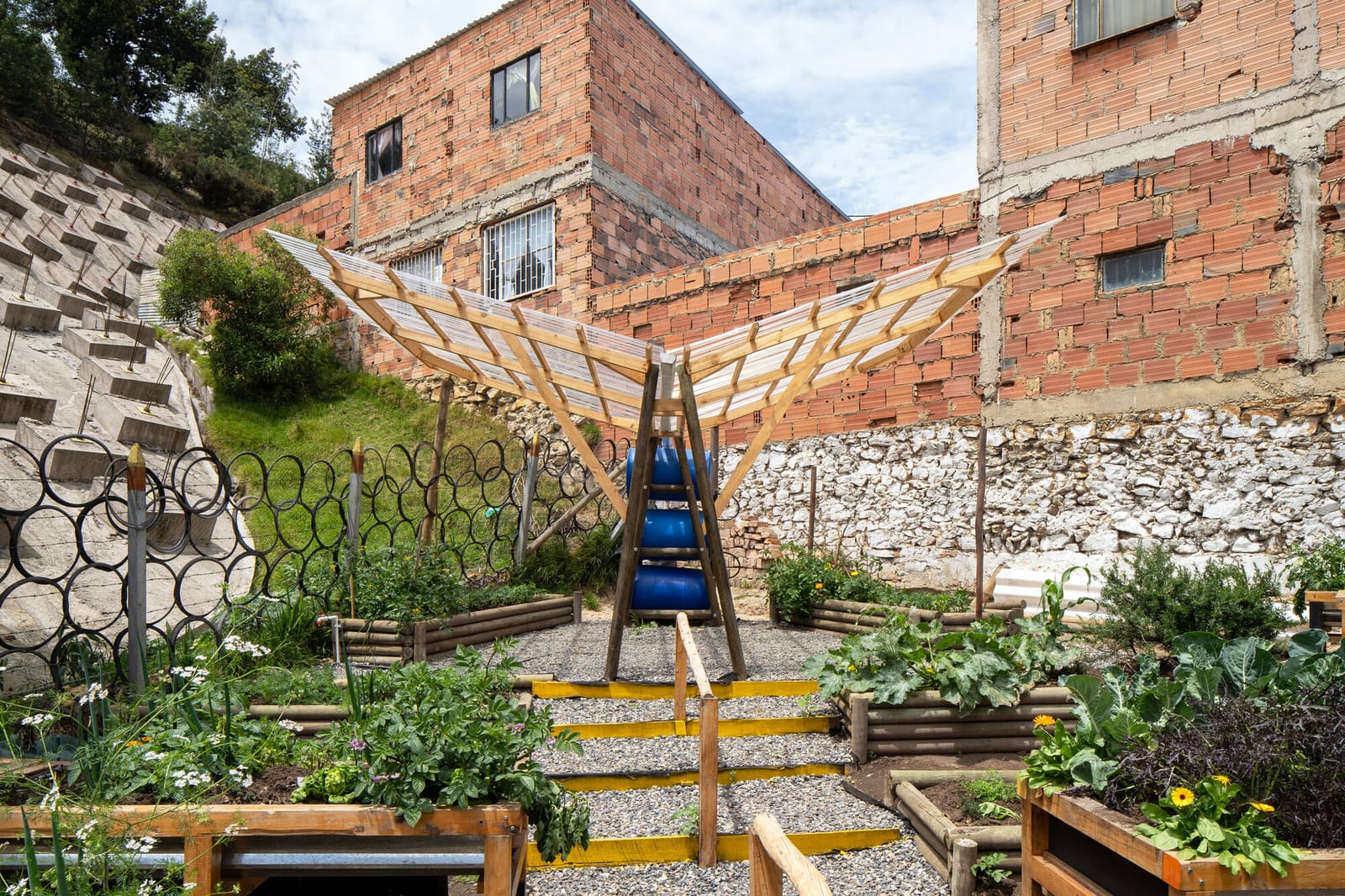
That question sits at the heart of a small urban garden completed in 2025 by Yemail Arquitectura, working alongside HelpAge International. Spanning just 362 square meters, the project occupies a sliver of urban fabric in Latin America - a neighborhood where the pace of life is often calibrated to younger, faster rhythms. Here, lead architects Antonio Yemail, Natalia Carrero, and Sebastián Torres propose a different tempo, one that acknowledges frailty, honors slowness, and treats aging not as decline but as a condition deserving spatial recognition.
At World Archi Design, we have tracked how the discourse around inclusive design has matured over the past decade - from accessibility compliance to universal design, and now toward something more nuanced: care as a spatial proposition. This project marks a subtle but significant shift in that trajectory.
Architecture That Recognizes the Fragile Body
The garden's layout resists the orthogonal logic that dominates so much urban planning. Instead of gridded beds and linear pathways, the design unfolds through a series of curved planting zones, each calibrated to different scales of reach and engagement. Low-lying herb beds allow for seated tending; raised planters reduce the need for bending; wide circulation routes accommodate walkers and wheelchairs without the narrow pinch points common in retrofitted public spaces.
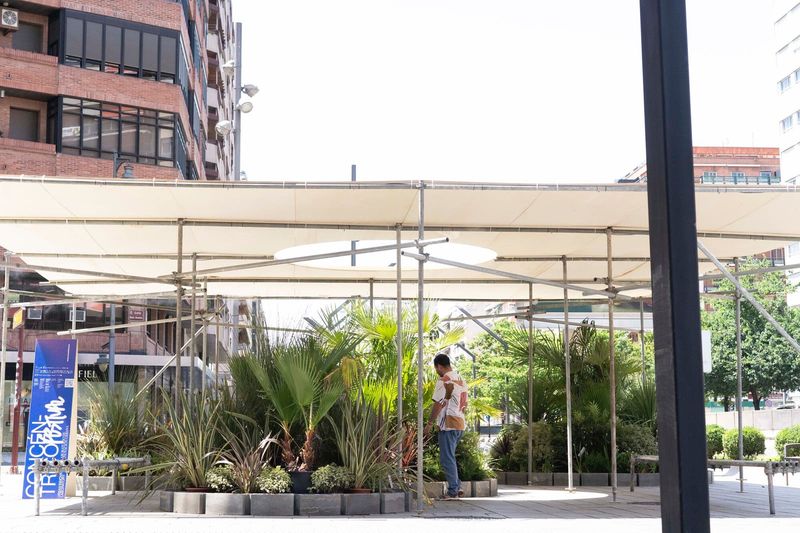
Material choices reinforce this ethos. Surfaces are firm but forgiving - compacted earth rather than concrete, timber edging rather than steel. Shade structures, minimal in form but generous in coverage, acknowledge that aging skin burns more easily, that heat exhaustion is not merely discomfort but danger. The palette is muted: earth tones, weathered wood, soft greens - a deliberate rejection of the high-contrast, high-stimulation aesthetic that has become shorthand for contemporary urbanism.
Agroecology specialist Andrea Fajardo contributed to the planting strategy, selecting species that require minimal maintenance while offering tangible yield. This is not ornamental horticulture for passive viewing; it is productive landscape, designed to be touched, harvested, and eaten. The act of cultivation becomes a form of agency, a way for older residents to assert presence in a city that often renders them invisible.
Precedents in Care-Centered Design
The project invites comparison with recent interventions that similarly foreground care. In Barcelona, the superblock experiments have begun to include "estancias" - pocket parks designed explicitly for rest and social reproduction. In Tokyo, the Sugamo district has evolved organically into a neighborhood scaled to older pedestrians, with wider sidewalks, frequent seating, and slower traffic flows. What distinguishes Yemail Arquitectura's approach is its synthesis of productive landscape with spatial accommodation, merging the agrarian logic of community gardens with the ergonomic rigor of therapeutic design.
There is also a lineage here that connects to the work of architects like Elsa Morante and her studies on domestic space for the elderly, or Peter Zumthor's thermal baths at Vals, where architecture becomes a medium for bodily ease. The HelpAge garden operates at a different scale and budget, but it shares a commitment to designing environments that do not demand performance from their users - spaces where simply being is enough.
The Politics of Gentleness
To design for care is, inevitably, to engage with politics. Public space in many Latin American cities has been shaped by decades of austerity, privatization, and security-driven planning. Parks are locked at night; benches are armored against homeless sleepers; surveillance cameras outnumber trees. Against this backdrop, a garden designed for fragile bodies is a quiet form of resistance.
The project was coordinated by Diego Collazos and technical specialist Sion Jones, with project officer Daniela Vásquez overseeing community engagement. That collaborative structure - bringing together architects, agronomists, international development professionals, and local residents - reflects a recognition that care cannot be imposed from above. It must be co-produced, negotiated, adapted to the specificities of place and population.
Communications lead Nelson Tamayo documented the process through participatory workshops, capturing how older residents articulated their needs: not for grand gestures, but for shade, for somewhere to sit without feeling watched, for plants that smell familiar, for paths that do not punish unsteady gait. These are not the metrics that win architecture awards, but they are the ones that determine whether a space is used or abandoned.
Material and Tectonic Choices
The construction logic is deliberately low-tech. Timber posts support tensile fabric canopies; recycled brick defines planting beds; gravel paths drain quickly after rain. This is not architecture that announces itself through formal bravura. Instead, it recedes, allowing the plants and the people to become the primary visual elements.
That restraint is itself a design position. In a discipline often preoccupied with signature forms and Instagrammable moments, Yemail Arquitectura opts for something quieter: a backdrop rather than a stage set. The photography by Bé estudio, Paola Pabón, and Santiago Beaumé captures this quality - images of hands in soil, dappled light through fabric, weathered faces framed by foliage. The architecture is present but not insistent.
Structural simplicity also enables future adaptation. As the community's needs evolve, elements can be reconfigured without major reconstruction. Planting beds can be rearranged; shade structures can be relocated; pathways can be widened. The design anticipates change rather than resisting it, treating the garden as a living system rather than a fixed object.
Implications for Urban Practice
This project will not transform the discipline overnight. It is too small, too modest, too far from the centers of architectural discourse to register as a major statement. But that is precisely why it matters. Most of the world's built environment is not shaped by star architects or unlimited budgets. It is assembled incrementally, by local practitioners working with constrained resources and complex stakeholders.
What Yemail Arquitectura demonstrates is that care-centered design is not a luxury reserved for wealthy clients or cultural institutions. It is a framework that can be applied at the scale of a neighborhood, a vacant lot, a forgotten corner. It requires not technological innovation but conceptual reorientation - a willingness to ask who has been excluded from our definition of the public, and how space might be reconfigured to welcome them back in.
As cities age - demographically, not just physically - this question will become more urgent. By 2050, the global population over 60 is projected to double. Urban design that ignores this shift is not just unkind; it is obsolete. The HelpAge garden, for all its modesty, offers a template: not a universal solution, but a proof of concept, evidence that architecture can soften its edges without losing its rigor.
The Work Ahead
We are only beginning to understand what it means to design cities for bodies that tire easily, that move slowly, that require rest and shade and gentle transitions. The tools are available - ergonomic research, participatory planning, adaptive materials. What has been lacking is not technical capacity but political will, a collective decision to value care as much as we value efficiency or spectacle.
Yemail Arquitectura's urban garden does not solve this problem. But it asks the right question, and it does so in built form, with 362 square meters of proof. That is where change begins: not in manifestos or master plans, but in small demonstrations of what becomes possible when we stop designing for an idealized body and start designing for the ones we actually have.
Photo: Bé estudio
Save this story. A free account keeps your reading list and the 07:00 email in one place.
CREATE FREE ACCOUNT →SIGN IN