
The Festival as Urban Laboratory
Most architecture festivals operate like museums: controlled environments where visitors admire work from a comfortable distance. Concéntrico has spent over a decade doing the opposite. When the festival returned to Logroño this past June for its twelfth edition, it once again converted the Spanish city into something closer to a construction site than a gallery, placing more than twenty full-scale installations directly into the circulatory system of everyday urban life.
The distinction matters. At World Archi Design, we've observed a persistent gap between speculative design discourse and the messy reality of public space. Concéntrico bridges that gap by insisting on physical presence. Architects, designers, and researchers from multiple geographies converged on Logroño not to exhibit drawings or models, but to build structures that residents would encounter on their way to work, that children would climb on, that weather would test. The festival, founded in 2015, has cultivated an identity rooted in this principle: architecture gains meaning through use, not contemplation.
This year's program spanned streets, plazas, and vacant lots, each intervention contributing to what the organizers framed as a citywide experiment. The work ranged widely in scale, material, and conceptual ambition, but shared a common condition: temporary occupation of public ground, designed to provoke new relationships between people and their surroundings.
Three Curatorial Threads
Concéntrico organized its participants around three thematic lines, each addressing a different register of architectural agency. The first, Identity and Fiction, treats the city as a repository of narrative. Projects under this heading excavate stories embedded in urban fabric, using design to make visible the memories and mythologies that shape collective experience. This approach positions architecture less as object-making and more as historiography, a method for recovering what has been overlooked or suppressed.
The second thread, Ephemeral Agents, focuses on temporality as a design strategy. Here, the emphasis falls on structures and devices that exist only briefly, mobile interventions that generate social encounters before disappearing. The ephemeral becomes a feature rather than a limitation. By rejecting permanence, these projects test ideas that might never survive the scrutiny of long-term planning, regulatory approval, or capital investment. They operate in the gaps between official architecture, claiming space that conventional building cannot reach.
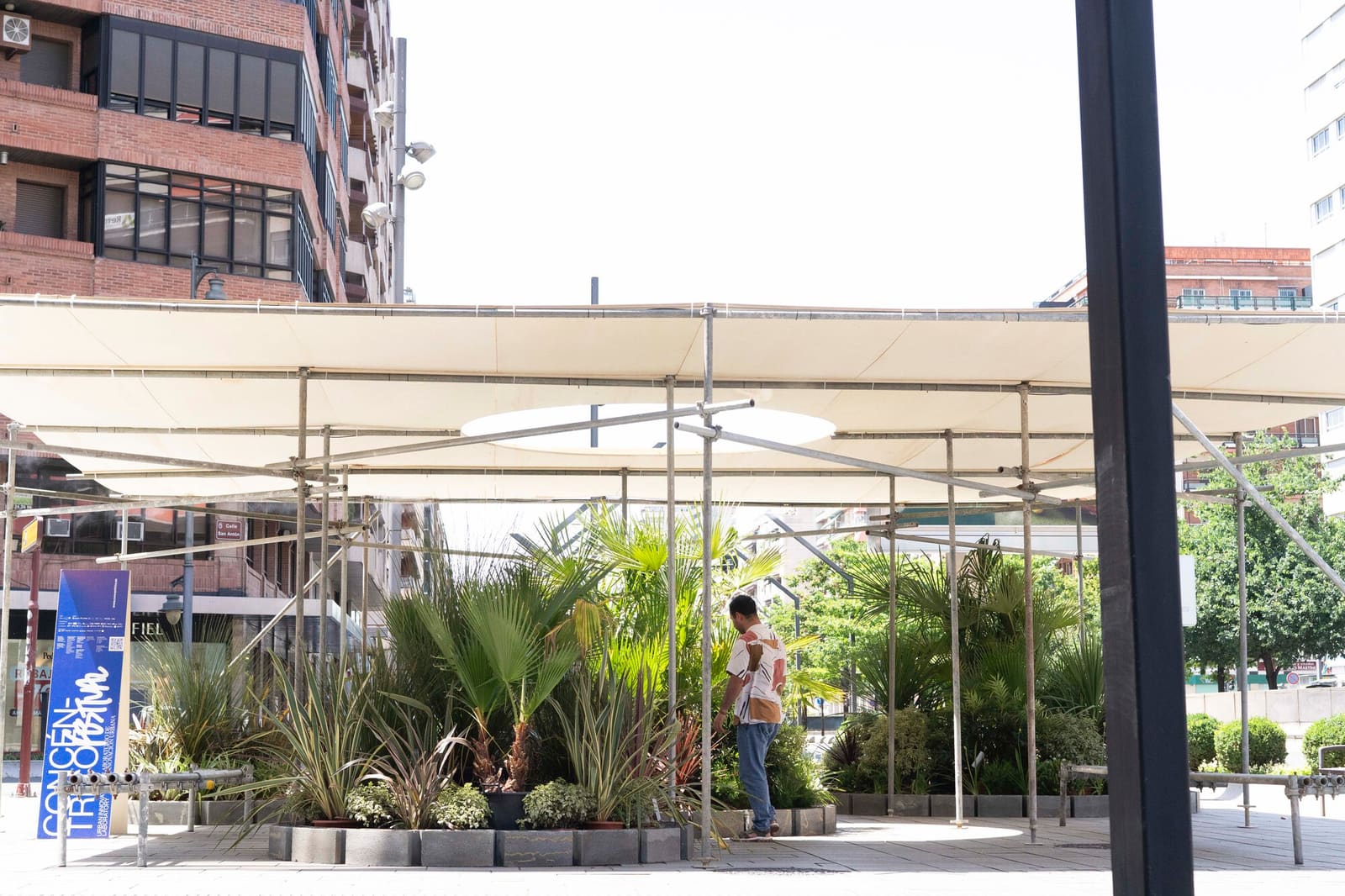
The third line, Urban Ecologies, addresses the material and climatic pressures reshaping contemporary cities. This curatorial strand asks how architecture responds to environmental stress, resource scarcity, and the changing conditions of landscape. Projects here grapple with questions of shade, water, vegetation, and thermal comfort, particularly urgent in a Mediterranean context where summer heat increasingly defines public habitability.
Material Tactics and Climatic Response
Several installations engaged directly with the problem of cooling, a concern that has moved from technical detail to existential question in much of southern Europe. Shade structures, misting systems, and passive ventilation strategies appeared across the festival, each proposing a different relationship between body, atmosphere, and built form.
These interventions recall earlier experiments in adaptive comfort, from Frei Otto's tensile canopies to the evaporative cooling systems developed for Expo '92 in Seville. But Concéntrico's projects operate at a different scale and with different constraints. They lack the budgets and engineering resources of world's fairs, relying instead on ingenuity, local fabrication, and rapid prototyping. The results are often rougher, more provisional, but also more instructive. They demonstrate what can be achieved with limited means in real urban conditions, offering models that municipalities and community groups might actually replicate.
Material choice plays a crucial role. Lightweight textiles, reclaimed timber, modular scaffolding, and mesh fabrics dominate the festival's palette. These materials allow for quick assembly and disassembly, essential for a program that must leave no permanent trace. But they also produce a distinct architectural language: permeable, translucent, responsive to wind and light. The installations filter rather than enclose, modulate rather than seal. They acknowledge that public space cannot be fully controlled, only inflected.
Participation and the Politics of Temporary Use
Concéntrico's insistence on occupying active urban space introduces a political dimension often absent from architecture exhibitions. When a structure appears in a plaza that residents cross daily, it becomes part of the negotiation over who public space serves and how it operates. Children appropriate these installations in ways designers never anticipated. Elderly residents pause in their shade. Street vendors position themselves nearby. The work enters a social field where its success depends not on critical reception but on whether people choose to engage.
This mode of practice aligns with a broader shift in architectural thinking over the past two decades, from object-focused design toward process-oriented, participatory approaches. Collectives like Assemble, Studio Ossidiana, and NOOF Group have all explored how temporary interventions can create openings for rethinking urban space. Concéntrico provides an annual platform for this work, concentrating multiple experiments in one location and inviting comparison.
Yet the festival format also raises questions about what happens after. Temporary interventions generate excitement and media attention, but they rarely lead to lasting change in the built environment. The structures disappear, the festival ends, and the city returns to its previous condition. Critics have noted this limitation in other participatory architecture projects, arguing that ephemeral work can serve as a substitute for real investment in public infrastructure, a way for municipalities to appear progressive without committing resources.
Concéntrico does not resolve this tension, but it does make visible what is possible when regulatory barriers lower and experimentation becomes permissible. The festival creates a zone of exception where ideas can be tested at full scale, generating knowledge that might inform future permanent work. Whether that knowledge transfers depends on factors beyond the festival's control: political will, funding structures, and the capacity of local institutions to absorb innovation.
Logroño as Test Site
The choice of Logroño as host city matters more than it might initially appear. A mid-sized city in Spain's Rioja region, Logroño lacks the international profile of Barcelona or Madrid, but precisely that modesty makes it a useful laboratory. The city's scale allows interventions to register more strongly. A structure placed in a neighborhood plaza can shift the character of an entire district in ways impossible in a metropolis. Residents encounter the same installations repeatedly, allowing relationships to develop over the festival's duration.
Logroño also benefits from a municipal government willing to cede control over public space, at least temporarily. Permitting processes that would take months elsewhere happen quickly here, enabling the festival's rapid construction schedule. This administrative flexibility, rare in European cities, distinguishes Concéntrico from other architecture events and explains why it has been able to sustain its model for over a decade.
The city's climate reinforces the urgency of certain design questions. Summer temperatures in Logroño regularly exceed 35 degrees Celsius, making shade and cooling infrastructure essential for public life. Interventions addressing thermal comfort thus serve immediate practical needs, not just conceptual exploration. They become part of the city's adaptation strategy, testing approaches that could inform longer-term planning.
Beyond the Festival Circuit
Concéntrico occupies a particular niche within the global architecture festival landscape. Unlike Venice Biennale's pavilion model or Serpentine Gallery's single annual commission, it multiplies sites and voices, distributing attention across many projects rather than concentrating it on a few. This approach produces a more diffuse experience, harder to summarize or market, but potentially more generative. Visitors encounter work in unexpected locations, without the framing devices of gallery walls or didactic labels. The architecture must communicate through form, material, and spatial experience alone.
The festival's influence extends through the networks it cultivates. Participants return to their home practices carrying lessons learned in Logroño, techniques refined under the pressure of quick construction and public exposure. Some projects developed for Concéntrico have been adapted and rebuilt elsewhere, their designs open-sourced or licensed. The festival thus functions as both showcase and workshop, a place where ideas circulate and methods spread.
Looking across the projects we've covered this year, a pattern emerges: the most compelling contemporary architecture often exists at the margins of conventional practice, in temporary structures, community-led initiatives, and experimental collaborations. Concéntrico provides infrastructure for this work, legitimizing approaches that might otherwise struggle for recognition. It demonstrates that architecture's value lies not only in permanence but in the capacity to imagine and test alternatives, to make tangible what cities might become if different priorities governed their design.
The twelfth edition confirmed what earlier years suggested: that festivals willing to embrace risk, impermanence, and public engagement can produce architectural knowledge unavailable through traditional channels. Whether that knowledge translates into broader change remains an open question, one that Concéntrico continues to explore each June in the streets of a Spanish wine city that has become, against expectation, one of Europe's most interesting sites for architectural experimentation.
Save this story. A free account keeps your reading list and the 07:00 email in one place.
CREATE FREE ACCOUNT →SIGN IN