
From Infrastructure to Amenity
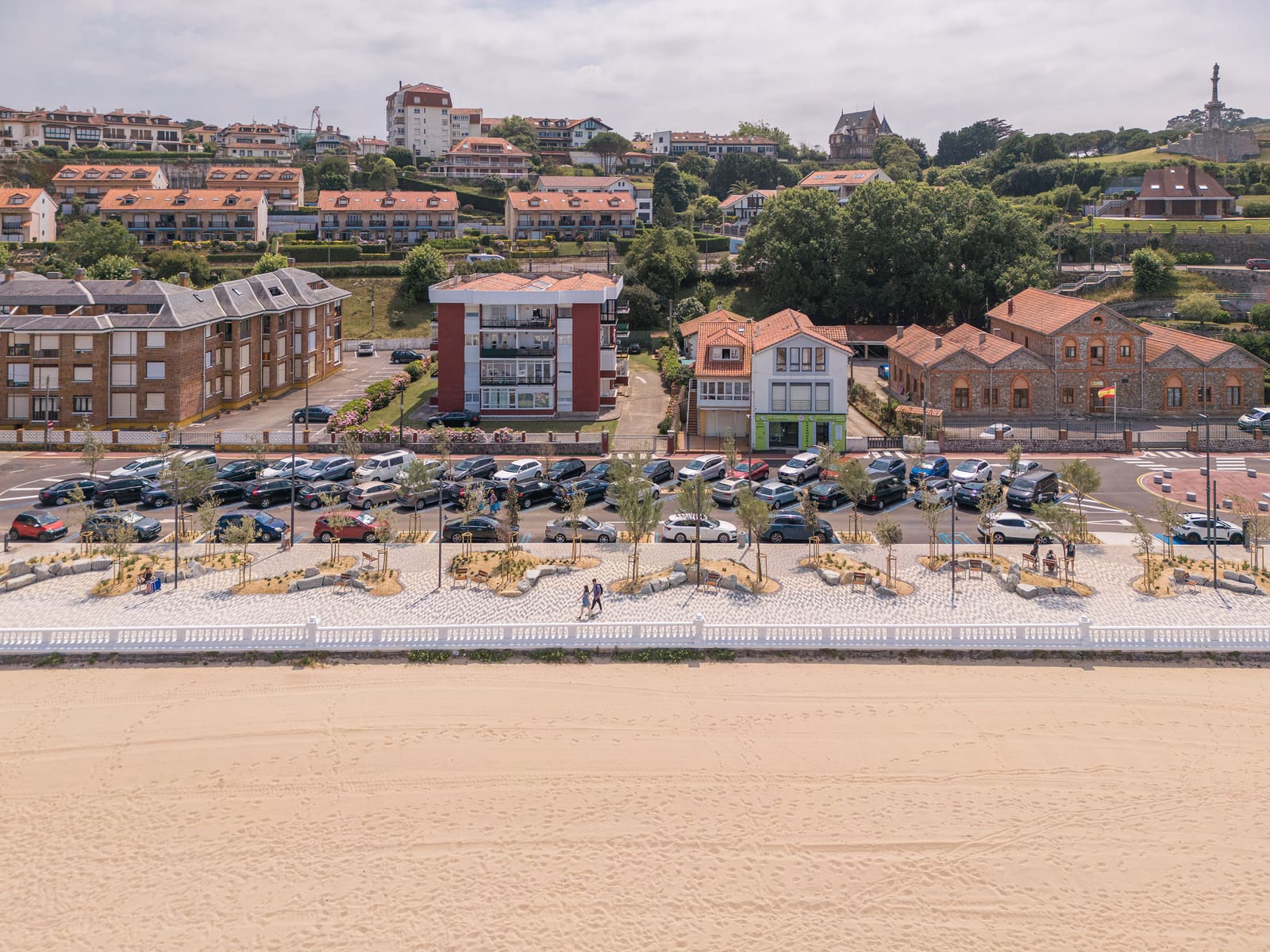
Many coastal municipalities inherit waterfronts designed for cars rather than people. In Comillas, a town on Spain's Cantabrian coast, a stretch of prime seafront had long been dominated by vehicle infrastructure: a narrow footpath squeezed alongside an expansive parking lot. The 2026 intervention by Hector Navarro and ARKHITEKTON, working with landscape architect Diego Jardinería and project manager Pedro F. Goicoechea, reconfigures that relationship. Spanning 5,400 square metres, the promenade reallocates space from asphalt to pedestrian use, creating what the design team describes as a new seafront rather than merely upgrading an old one.
The distinction matters. Refurbishment typically works within existing spatial hierarchies; this project redistributes them. By removing the parking lot and widening the pedestrian corridor, the intervention shifts the town's relationship to its coastline from transient access to sustained occupation. We've seen similar reconfigurations in waterfront regeneration projects across Europe - Barcelona's Barceloneta beachfront, Copenhagen's harbour baths, Bilbao's Abandoibarra promenade - but each coastal typology demands its own response. Comillas is neither metropolitan nor industrial; its coastline is characterised by rocky outcrops, small coves, and a domestic scale of building fabric. The promenade needed to mediate between the town's vernacular architecture and the dramatic geology of the Cantabrian shore.
Spatial Organisation and Material Palette
The promenade establishes a linear public realm that stitches into Comillas's existing network of streets and squares. Rather than imposing a singular datum, the design acknowledges the topography of the site, stepping and folding to negotiate changes in level between the town and the water's edge. This tectonic response - a series of platforms, ramps, and retaining walls - creates pockets of varied spatial character along the route. Some sections open wide to frame views of the sea; others compress to accommodate planting or seating alcoves.
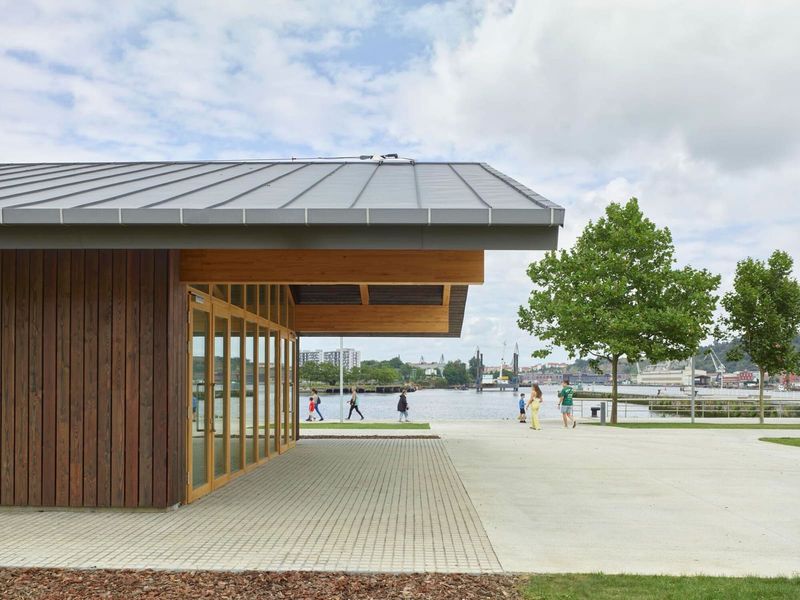
Material selection reinforces the regional context. According to the project documentation, manufacturers BENITO, PTV Tudela, and Urbidermis supplied elements for the scheme. The palette favours durable, low-maintenance finishes suited to marine exposure: stone paving, weathering steel, timber decking. These materials age visibly, accumulating patina rather than degrading - a quality particularly important in salt-laden air. The detailing avoids the high-gloss vocabulary of resort boardwalks; instead, the language is restrained, closer to the robust pragmatism of harbour infrastructure.
Planting beds integrate native species adapted to coastal conditions. The landscape architecture, led by Diego Jardinería, uses vegetation not as decoration but as structural definition, screening service areas and shaping circulation. Tree canopies provide shade over seating zones, mitigating the intensity of summer sun. This biophilic integration, modest though it is, softens the promenade's hard surfaces and anchors it in the ecological character of the Cantabrian littoral.
Precedent and Typology
Waterfront promenades occupy a curious position in the taxonomy of public space. They are neither park nor plaza, neither street nor square, yet they perform functions of all four. Historically, the promenade emerged in the nineteenth century as a bourgeois leisure typology - a place to see and be seen, to take the air, to stroll without purpose. The British seaside pier and the French esplanade codified this social programme in built form. By the mid-twentieth century, however, many European waterfronts had been claimed by industrial or vehicular uses. The recent wave of promenade projects - from Copenhagen's Kalvebod Waves by JDS Architects to Lisbon's Ribeira das Naus by Global Arquitectura Paisagista - represents a reclamation, realigning the waterfront with pedestrian leisure rather than logistical function.
Comillas's promenade participates in this broader movement but resists the signature-architecture impulse that characterises some high-profile examples. There are no parametric canopies, no sculptural benches, no gesture toward iconic form. The design is deliberately quiet, prioritising continuity and accessibility over spectacle. This restraint may reflect the scale of the town - Comillas has fewer than 2,500 residents - or it may be a conscious decision to foreground the coastline itself rather than the architecture that frames it.
Connectivity and Urban Integration
A promenade's value lies not only in its intrinsic qualities but in how it connects to the surrounding urban fabric. At World Archi Design, we've observed that successful waterfront interventions function as armatures, linking disparate districts and activating underused edges. The Comillas project extends the town's pedestrian network to the water, creating a continuous route that can be walked end to end without crossing vehicular traffic. This connectivity transforms the promenade from a destination into a corridor - a through-route as well as a place to linger.
Ground-floor uses along the promenade's inland edge will shape its social life. The project documentation does not specify commercial programming, but the spatial organisation suggests zones where cafés, kiosks, or small-scale retail could occupy the interface between promenade and town. These thresholds are critical. A promenade without adjacent activity risks feeling windswept and empty outside peak hours; one with too much commercial pressure can feel privatised. Striking that balance depends on planning policy as much as design.
Accessibility standards appear integral to the scheme. The ramps and level changes accommodate wheelchairs, pushchairs, and mobility aids, ensuring the promenade serves the full demographic spectrum. Universal design is not an add-on here; it structures the circulation strategy from the outset.
Coastal Resilience and Long-Term Performance
Coastal infrastructure faces accelerating pressures. Rising sea levels, increased storm intensity, and coastal erosion are not hypothetical futures; they are present-day design constraints. The Comillas promenade must perform not only as public amenity but as a defensive edge, mediating between the built environment and an increasingly volatile sea.
The project's sectional strategy - raising portions of the promenade above the immediate shoreline - provides a buffer against wave action. Retaining walls and stepped platforms distribute hydraulic forces, reducing the risk of undermining. Material durability, as noted earlier, extends the infrastructure's lifespan in corrosive conditions. Yet resilience is not only a matter of engineering. Ecological resilience - the capacity of coastal ecosystems to absorb disturbance - depends on maintaining vegetated buffers and avoiding impermeable surfaces where possible. The promenade's integration of planting beds and permeable paving contributes, however modestly, to this longer-term stability.
Climate adaptation will test the longevity of many recent waterfront projects. Those designed with flexibility - able to accommodate future modifications, raised sections, or retreat strategies - will fare better than those locked into fixed configurations. Whether the Comillas promenade has built in such adaptability remains to be seen.
The Politics of Public Space
Every promenade is a political statement. Removing parking to create pedestrian space is never neutral; it redistributes access, privileges certain modes of movement, and redefines who the waterfront is for. In car-dependent regions, such decisions provoke resistance. The fact that Comillas proceeded with this reallocation suggests either strong municipal leadership or a community consensus around the value of reclaiming the coastline.
Public space, particularly in tourist-dependent towns, also raises questions of whose public. Seasonal influxes can overwhelm local infrastructure, turning amenities designed for residents into attractions for visitors. The promenade's design - its lack of spectacle, its emphasis on continuity rather than novelty - may help it retain its identity as a civic space rather than a tourist set piece. But the pressure will come. How Comillas manages that tension will determine whether the promenade remains a shared resource or becomes another backdrop for selfies and short-term rentals.
What This Adds to the Discourse
The Comillas waterfront promenade is not a landmark project. It will not appear in retrospectives of twenty-first-century urbanism. But its value lies precisely in its ordinariness. Small-scale interventions like this one - unglamorous, locally specific, quietly competent - constitute the bulk of how cities and towns actually improve. They demonstrate that reclaiming space from cars, investing in pedestrian infrastructure, and prioritising durability over novelty can produce tangible public benefit without requiring signature architects or international competitions.
As coastal municipalities worldwide confront the need to rethink their waterfronts, the Comillas project offers a pragmatic template. It shows that transformation need not be total, that a parking lot can become a promenade without erasing the town's character, and that good public space can emerge from careful material choices and spatial clarity rather than formal invention. The architecture is quiet because the coastline is loud. That, in the end, may be the most instructive decision of all.
Save this story. A free account keeps your reading list and the 07:00 email in one place.
CREATE FREE ACCOUNT →SIGN IN