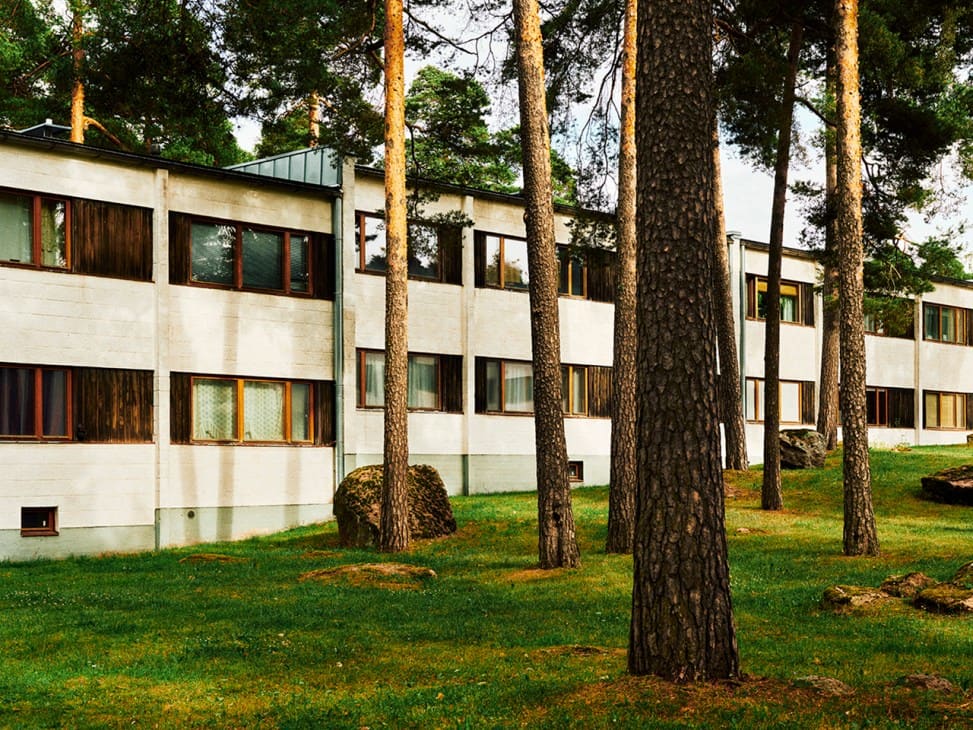
The Paradox of Permanence
There's an uncomfortable irony embedded in the recent World Heritage designation of thirteen landmark Finnish structures. The architects who created these spaces believed fundamentally in architecture's capacity to adapt, to breathe, to transform alongside the communities they served. Yet the very mechanism designed to honor that legacy may end up suffocating it.
At World Archi Design, we've been tracking the growing tension between institutional preservation frameworks and the dynamic, user-centered philosophy that defined mid-century Nordic modernism. The Finnish case crystallizes a question that extends far beyond one nation's borders: when does recognition become restriction?
Crumbling Icons and Empty Coffers
Walk through the National Pensions Institute building in Helsinki today and you'll encounter a structure in distress. The red brick and copper cladding that once signaled progressive institutional design now require intervention estimated between €130 million and €170 million. In Imatra, moisture has infiltrated the Church of the Three Crosses to such an extent that portions of the interior have been closed for safety.
Heritage designation carries legal obligations but no corresponding treasury. Finland's government, operating under fiscal constraints, has made clear that public funds will not cover restoration costs of this magnitude. The calculus relies instead on philanthropic intervention, a model that transforms architectural stewardship into a perpetual fundraising campaign.
This funding gap isn't unique to Finland. Across Europe and beyond, municipalities discover that international recognition often arrives as an unfunded mandate. The prestige is global; the bill is local. For buildings that were never intended as monuments but as functional civic infrastructure, this creates an existential bind.
Access Denied: The Democracy Problem
The Aalto studio's work rested on a core principle: architecture should serve the broadest possible public. Daylight, spatial flow, material warmth - these weren't aesthetic flourishes but democratic commitments, expressions of a belief that good design belonged to everyone, not just elites.
Yet several of the newly designated sites remain effectively inaccessible. The Kela headquarters continues to function as an active administrative center, its interiors closed to anyone without institutional business. The Sunila residential quarter comprises private homes, where occupants reasonably resist becoming involuntary museum exhibits. The Muuratsalo Experimental House can be reached only via guided boat excursions during a narrow summer season.
Heritage guidelines require that host nations "present and promote" listed properties, language that Finnish authorities have interpreted to mean physical access to exteriors. From a regulatory standpoint, this satisfies the letter of the agreement. From a design standpoint, it misses the point entirely.
These are total environments. The Villa Mairea's significance doesn't reside solely in its massing or fenestration but in the orchestrated experience of moving through its rooms, in the interplay between custom lighting fixtures and bespoke furniture, in the relationship between interior volume and exterior landscape. Viewing such buildings from the perimeter is akin to judging a symphony by its printed score.
The Philosophy of Stasis
There's a deeper conceptual friction at work here, one that goes beyond logistics or funding. Heritage frameworks, even as they've evolved to accommodate adaptive reuse, still privilege material authenticity and compositional integrity. Structures must retain original materials, craftsmanship, formal arrangements. Change is permissible only within tightly bounded parameters.
But the architects who created these buildings explicitly rejected stasis. They designed for institutions and communities they knew would evolve. Their work anticipated future modifications, welcomed them even, as evidence that the architecture remained relevant. To freeze these structures in their 1950s or 1960s configurations is to fundamentally misread their tectonic logic.
Consider Snøhetta's recent intervention at the Paimio Sanatorium, where the Norwegian firm is attempting to balance contemporary wellness programming with conservation requirements. It's a high-wire act, one that requires constant negotiation between regulatory constraint and spatial possibility. Not every site will attract a studio of Snøhetta's caliber or resources. Most will face a simpler, starker choice: fossilize or risk decertification.
Precedents and Alternatives
This tension isn't new, though its current manifestation is particularly acute. When the Bauhaus buildings in Dessau received heritage status, similar debates emerged about how to preserve structures born from an ethos of experimentation and impermanence. The Eames House in California confronts comparable questions: how do you maintain a building that was itself a prototype, a test case for ideas its designers knew they'd refine?
Some institutions have found creative workarounds. The Van Nelle Factory in Rotterdam secured heritage designation while maintaining active commercial tenancy, demonstrating that listed buildings can remain economically productive. The Salk Institute in California has carefully documented its original design intent, allowing for reversible contemporary interventions that don't compromise Louis Kahn's parti.
Yet these examples tend to involve single buildings with clear institutional stewardship and robust endowments. Finland's challenge encompasses thirteen sites across diverse typologies - churches, civic buildings, residential neighborhoods, industrial complexes - each with different ownership structures, funding mechanisms, and community relationships.
The Tourism Calculus
Proponents of the heritage designation point to potential tourism revenue and regional economic stimulus. There's precedent for this optimism: Brasília's World Heritage status has boosted international visitation, and Le Corbusier's work across multiple countries draws architecture pilgrims year-round.
But tourism predicated on inaccessible interiors and degraded fabric offers diminishing returns. Visitors who travel to Finland expecting immersive encounters with human-centered modernist design will instead encounter locked doors and scaffolding. The gap between expectation and reality breeds disappointment, not repeat visits or positive word-of-mouth.
More fundamentally, positioning these buildings primarily as tourist attractions rather than living civic infrastructure represents a category error. They were never meant to be pilgrimage sites. Their value lay precisely in their ordinariness, their day-to-day usefulness, their integration into the rhythms of Finnish life.
Stewardship as Creative Practice
If there's a path forward, it likely involves reconceiving heritage stewardship as an active, creative practice rather than a passive curatorial one. This means treating conservation guidelines as starting points for dialogue, not immutable constraints. It means prioritizing functional vitality over material purity when the two come into conflict. It means accepting that some degree of change - thoughtful, documented, reversible change - may be the truest form of fidelity to the original design philosophy.
It also means confronting uncomfortable truths about funding. If Finland wants these buildings to remain vital rather than vestigial, public investment will be necessary. Philanthropy can supplement but cannot replace governmental commitment. The alternative is a slow deterioration punctuated by emergency interventions, a pattern that serves neither preservation nor public interest.
And it means wrestling seriously with the access question. Not every site can or should be fully open, but the current model - exteriors viewable, interiors largely forbidden - represents the worst of both worlds. Rotating access programs, digital documentation, partnerships with architecture schools for supervised visits: these are hardly radical proposals, yet they remain largely unimplemented.
Architecture's Afterlife
At stake is nothing less than how we understand architecture's relationship to time. Is a building's meaning fixed at the moment of completion, a pristine statement to be guarded against contamination? Or does meaning emerge through ongoing use, through the accumulation of repairs and modifications and small adaptations that mark a structure's continued relevance?
The modernists, by and large, embraced the latter view. They saw buildings as participants in social processes, not monuments standing apart from them. To honor that legacy through mechanisms that insist on permanence and material fixity is to engage in a kind of conceptual betrayal, however well-intentioned.
Finland faces a choice. It can treat these thirteen sites as museum objects, preserved behind glass - or, more accurately, behind locked doors and safety cordons. Or it can embrace a more difficult, more ambiguous form of stewardship, one that accepts change as evidence of vitality rather than symptom of decline.
The first path is easier to regulate, easier to evaluate, easier to defend in international forums. The second is messier, requires constant judgment calls, invites criticism from purists. But it's also the only path that takes seriously the values these buildings were designed to embody: flexibility, accessibility, integration into daily life.
Looking Forward
Other nations will watch Finland's navigation of these tensions with interest. As more twentieth-century buildings enter heritage frameworks, the questions raised here will recur: How do we preserve architecture that was designed not to be preserved? How do we balance material authenticity against functional vitality? Who benefits from designation, and who bears its costs?
These aren't merely technical challenges for conservators and policy specialists. They're fundamentally philosophical questions about what we value in built form and how we transmit that value across generations. The answers Finland develops - through trial, error, negotiation, and compromise - will reverberate far beyond its borders.
For now, the designation stands as both achievement and admonition. It recognizes the global significance of a design philosophy that placed human needs at the center of architectural thinking. But it also imposes obligations that may prove incompatible with that philosophy's core commitments. Whether recognition ultimately preserves or petrifies these buildings remains an open question, one that will be answered not through policy documents but through hundreds of small decisions about funding, access, and adaptation in the years ahead.
The stakes are high. Get it right, and Finland offers a model for heritage stewardship that honors both past vision and present need. Get it wrong, and these buildings become cautionary tales - proof that sometimes the greatest threat to architectural legacy isn't neglect but the wrong kind of attention.
Save this story. A free account keeps your reading list and the 07:00 email in one place.
CREATE FREE ACCOUNT →SIGN IN