
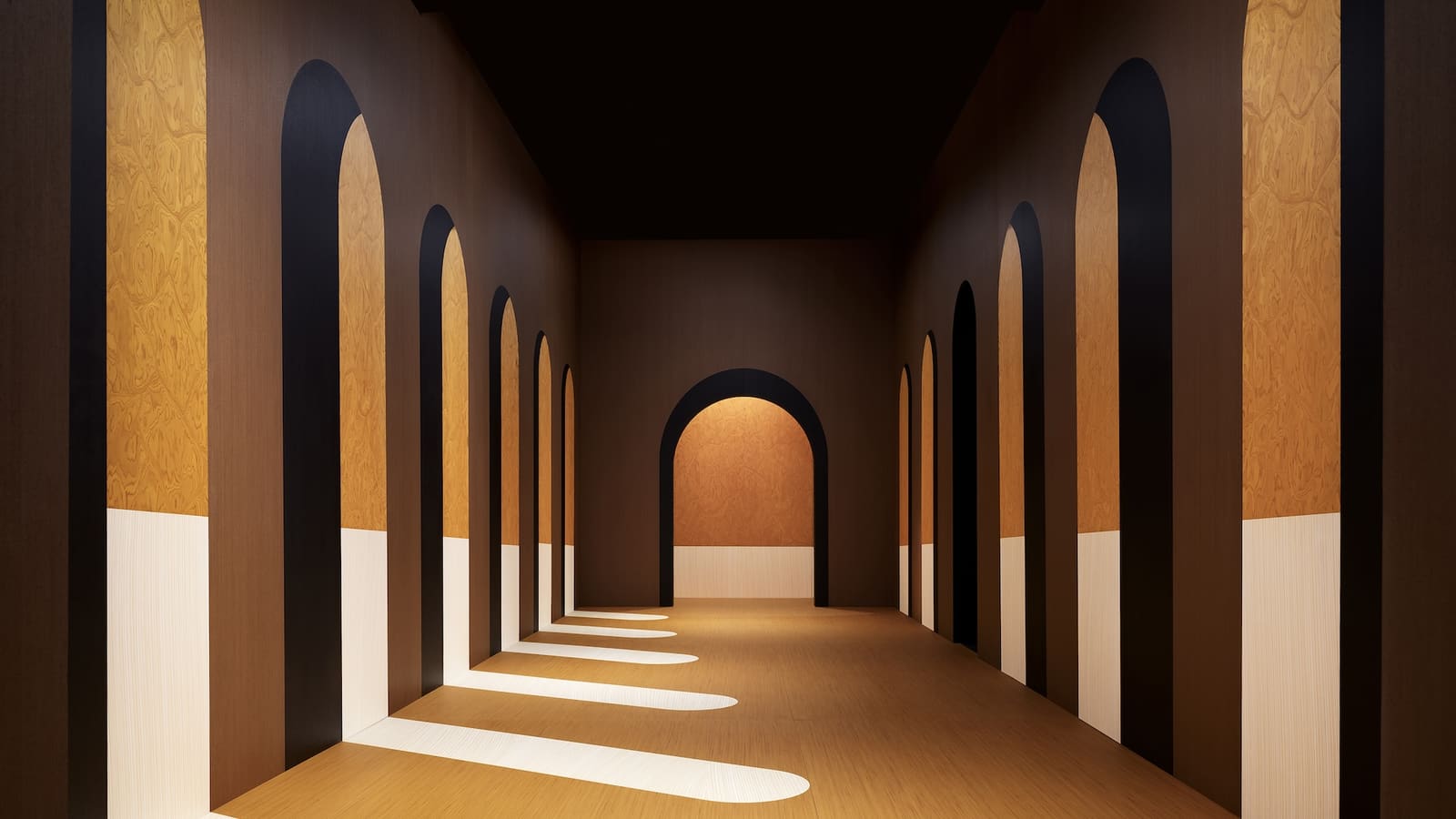
The Veneer Beyond Surface
We tend to think of wood veneer as a finish, a thin layer applied to furniture or walls. But what happens when that material escapes its two-dimensional fate? ALPI, the Italian wood manufacturer known for its engineered surfaces, teamed with Copenhagen-based GamFratesi to answer precisely that question during 3 Days of Design, presenting Inner Landscape, an installation that treats veneer as architecture rather than appliqué.
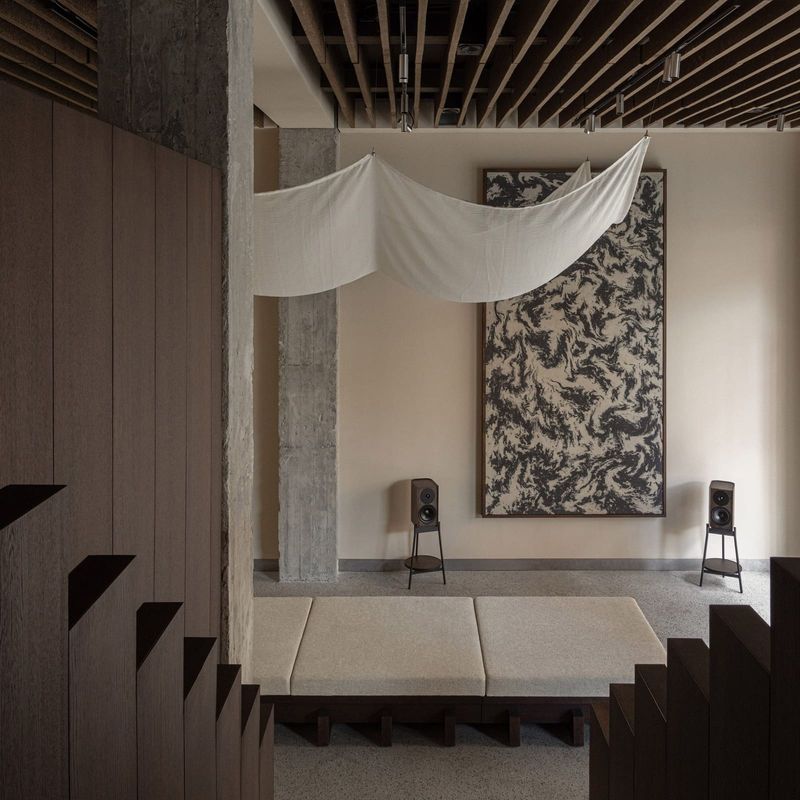
The project occupies an unusual territory. It is not furniture, though it borrows furniture's intimacy. It is not a partition system, though it divides space with quiet authority. Instead, Inner Landscape operates as a volumetric field, a series of undulating timber planes that fold, rise, and recede to create what the collaborators describe as a "silent landscape." The phrase is apt. There is no drama here, no cantilever or structural gymnastics. The intervention whispers rather than shouts.
Materiality as Method
At the heart of the work lies ALPI's proprietary veneer technology, which allows the studio to manipulate grain, color, and texture with unusual precision. GamFratesi, whose practice has long navigated the intersection of Scandinavian restraint and Italian craft traditions, selected a palette of muted tones: soft grays, warm taupes, and near-whites that shift under changing light. The effect is less about contrast than about gradation, a chromatic field that feels atmospheric rather than graphic.
The veneer itself is laminated onto curved substrates, forming large-scale panels that cantilever gently from vertical supports. Each panel curves in two directions, creating a topography that reads as geological rather than mechanical. The installation recalls precedents in textile design and landscape architecture more than it does conventional interior installations. One thinks of Isamu Noguchi's paper lamps or the folded planes in Peter Zumthor's Serpentine Pavilion, where material intelligence drives spatial experience.
Spatial Choreography and Human Scale
What makes Inner Landscape compelling is not the material alone but how it organizes movement and perception. The installation does not present a single vantage point. Instead, it encourages circulation, inviting viewers to move around and between the timber volumes. As you shift position, the panels overlap and separate, creating new apertures and sightlines. The experience is durational, unfolding over time rather than revealing itself in a single glance.
GamFratesi has spoken in previous projects about their interest in "tactile minimalism," a phrase that captures their approach here. The surfaces are smooth but not slick, warm but not overly textured. The installation does not demand to be touched, but it does not forbid it either. This ambiguity, between object and environment, between backdrop and protagonist, gives the work its particular character.
The scale, too, is carefully calibrated. The panels rise to roughly 2.5 meters, tall enough to interrupt sightlines but not so tall as to feel monumental. The result is an environment that feels human-scaled, even intimate, despite the industrial precision of its fabrication.
Context and Continuity
Inner Landscape builds on a longer conversation within contemporary design about the role of natural materials in increasingly synthetic environments. Over the past decade, we have seen a proliferation of projects that treat timber not as a rustic signifier but as a high-performance material capable of nuance and variation. Kengo Kuma's latticework, Studio Mumbai's tectonic assemblies, and even the recent wave of cross-laminated timber structures all participate in this discourse.
What distinguishes the ALPI-GamFratesi collaboration is its focus on veneer as a medium in its own right. Rather than celebrating the mass and grain of solid timber, the installation foregrounds the veneer's thinness, its capacity to wrap, bend, and modulate light. This is wood as membrane rather than structure, as surface with depth rather than volume with skin.
The collaboration also reflects a broader shift in how manufacturers and designers work together. ALPI has increasingly positioned itself not merely as a supplier but as a creative partner, engaging studios early in the design process to explore what their materials can do. This model, common in the textile and ceramics industries, remains relatively rare in wood manufacturing, making projects like Inner Landscape both a product showcase and a research prototype.
The Installation as Prototype
One of the more intriguing aspects of Inner Landscape is its status as a prototype for future applications. The installation debuted during 3 Days of Design, the Copenhagen trade event that has become a key platform for material innovation in Northern Europe. But the techniques developed here, the curved laminations, the modular panel system, the tonal palette, are designed to migrate into other contexts: retail interiors, hospitality projects, residential commissions.
This dual function, as both autonomous artwork and applied research, reflects a pragmatic strain in Scandinavian design culture. The installation is beautiful, yes, but it is also fundamentally useful. It tests ideas that can be scaled, adapted, and commercialized. GamFratesi's studio has a track record of moving fluidly between limited-edition pieces and mass production, and Inner Landscape sits squarely within that continuum.
Silence as Design Strategy
The title, Inner Landscape, suggests interiority and introspection. But it also points to a design strategy that prizes quietness over spectacle. In an era dominated by parametric facades and digitally fabricated complexity, there is something almost radical about an installation that relies on subtle curvature and tonal variation to create spatial interest.
This is not to say the project is simple. The engineering required to achieve those gentle curves, the calibration of panel widths and support points, the selection of veneers that read as coherent across multiple sheets, all of this demands considerable technical sophistication. But the sophistication is embedded, hidden within the apparent simplicity of the final form.
The result is an installation that rewards sustained attention. It does not announce itself with a single bold gesture. Instead, it accumulates meaning slowly, through repeated encounters and shifting perspectives. In that sense, it aligns with a lineage of Scandinavian and Japanese design that values restraint, duration, and the intelligence of materials over formal pyrotechnics.
Looking Forward
Inner Landscape arrives at a moment when the design world is grappling with questions about material sourcing, carbon sequestration, and the lifecycle of building products. Wood, as a renewable resource, occupies a privileged position in these conversations. But not all wood products are created equal, and the environmental calculus of veneer, which maximizes yield from each log, differs significantly from that of solid timber.
ALPI has invested in certified supply chains and low-emission adhesives, positioning its products within a broader sustainability narrative. Whether Inner Landscape will influence how architects and designers think about veneer applications remains to be seen. But the installation makes a compelling case for wood as a material of subtlety and spatial intelligence, capable of creating environments that feel both contemporary and deeply rooted in craft traditions.
In the end, Inner Landscape succeeds because it does not overreach. It takes a familiar material, applies rigorous design thinking, and produces an environment that feels both new and strangely timeless. That balance, between innovation and restraint, is perhaps the most difficult achievement in contemporary design, and it is what makes this collaboration worth paying attention to.
Photo: Federico Cedrone
Save this story. A free account keeps your reading list and the 07:00 email in one place.
CREATE FREE ACCOUNT →SIGN IN