
A Dwelling for the In-Between
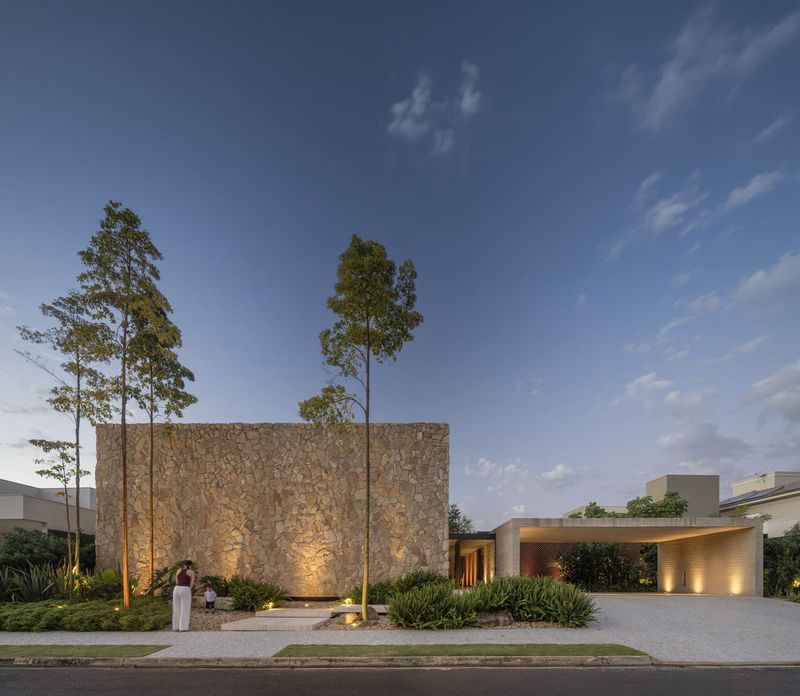
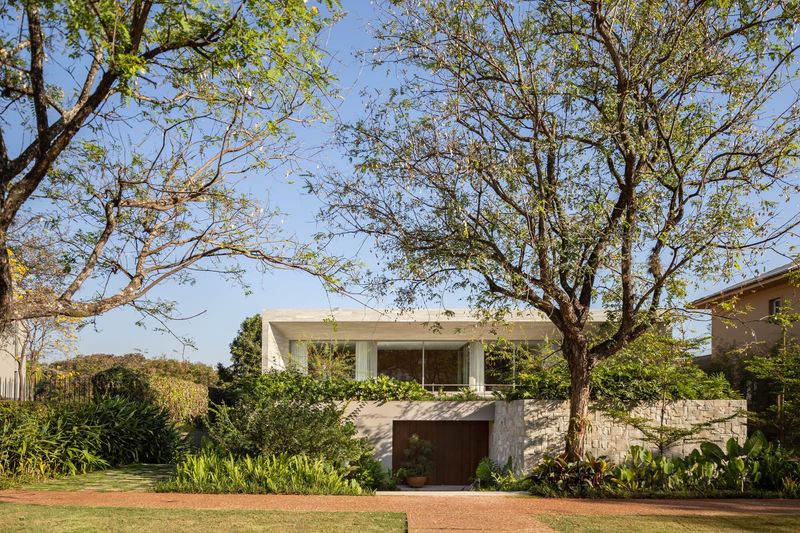
There exists a peculiar tension in houses built for retreat: they must shelter without isolating, open without surrendering privacy. Casa Mesaguamo, completed in 2022 in the municipality of Támesis, navigates this paradox through spatial rhythm rather than walls. Designed by Adriana Zelaya and Trópico Arquitectura, with contributions from María José Arango and Candelaria Posada, the 750-square-metre residence unfolds across the mountainous topography of Colombia's Cauca River canyon, where heat and dense vegetation dictate a different relationship to enclosure.
The project does not announce itself. Instead, it proposes a question: how does one construct intimacy while remaining permeable to the wider landscape? The answer here is serial rather than singular, a succession of outdoor rooms and sheltered volumes that refuse to privilege one condition over the other.
The Patio as Structural Device
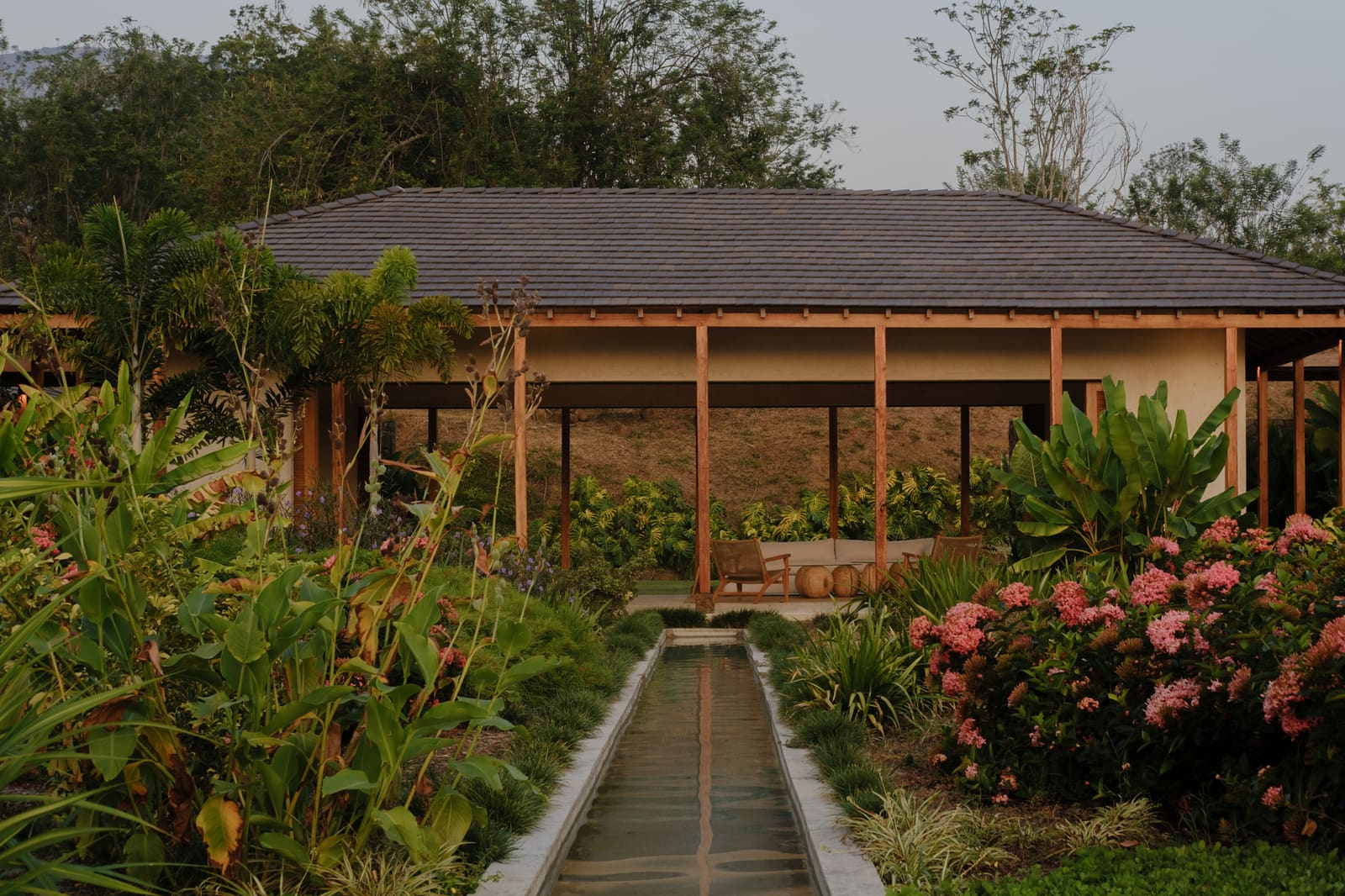
Casa Mesaguamo organises itself around multiple courtyards, each calibrated to a different scale of experience. This is not the introversion of the traditional Spanish patio, which turns its back to the street and gathers a household inward. Rather, these voids operate as hinges, mediating between the immediacy of domestic life and the long view toward the canyon beyond.
The sequence matters. A visitor moves through gradations of enclosure: from open terrace to semi-covered gallery, from shaded courtyard to fully enclosed room, then back out again. The rhythm is deliberate, a spatial cadence that mirrors the slow passage of time the house is designed to accommodate. In tropical climates, where the boundary between inside and outside is perpetually negotiated, such devices are not decorative but environmental, pulling breezes through, filtering light, and creating microclimates within the larger whole.
Precedent for this strategy can be traced to the work of Rogelio Salmona in Colombia, whose courtyards functioned as both social and climatic infrastructure, or to the modernist experiments of Luis Barragán in Mexico, where patios became instruments of colour, shadow, and solitude. Casa Mesaguamo shares this lineage but simplifies it, stripping away ornament in favour of spatial clarity.
Material Restraint and Thermal Logic
The material palette is narrow: concrete, timber, and stone, chosen not for their aesthetic novelty but for their thermal mass and durability in a hot, humid environment. Concrete floors and walls absorb heat during the day and release it slowly at night, moderating interior temperatures without mechanical systems. Timber screens and louvres filter direct sunlight, breaking glare while maintaining views.
This restraint extends to the landscape design, led by Mesa y Uribe Paisajistas. Native vegetation is allowed to encroach on the architecture, blurring the boundary between cultivated and wild. The planting strategy is low-intervention, relying on species adapted to the region's rainfall and soil conditions. The result is a house that feels embedded rather than imposed, its forms emerging from rather than dominating the site.
The Programme of Rest
Casa Mesaguamo is explicitly programmed for slowness. There are no grand gestures, no double-height voids or monumental staircases. Instead, the house offers a series of places to pause: a shaded bench, a covered terrace, a room with a single opening framing a distant ridge. The spatial sequence is processional but unhurried, inviting occupation at different times of day as light and temperature shift.
This is architecture that resists the pressures of productivity, a deliberate counterpoint to the accelerated rhythms of urban life in Medellín, a few hours away. It asks its inhabitants to adjust their pace, to align with the slower cycles of heat, rain, and growth that govern the canyon.
The Distant View as Anchor
While the house turns inward through its courtyards, it never loses sight of the broader landscape. Key living spaces are oriented to frame views across the canyon, where the terrain drops away and the horizon expands. This relationship between the near and the far, the intimate and the panoramic, is the project's central tension.
The strategy recalls the fenestration logic of mid-century modernism, where large openings were carefully positioned to capture specific views while maintaining privacy elsewhere. Here, however, the openings are not merely visual but spatial, thresholds that extend the living area outward into the landscape. The house does not so much sit on the land as reach into it, each courtyard and terrace a point of contact between built form and topography.
A House Without Haste
What Casa Mesaguamo achieves is a spatial condition rarely articulated in contemporary residential work: the architecture of duration. It is not designed for the quick photograph or the singular moment but for the accumulation of days, for the slow discovery of how light moves across a wall or how a breeze shifts direction at dusk.
In a discipline often obsessed with novelty, this project offers something quieter. It does not invent a new formal language or deploy cutting-edge technology. Instead, it synthesises familiar strategies - the courtyard, the covered terrace, the framed view - into a coherent whole, calibrated to the specific demands of its climate and site. The result is a house that feels both rooted and open, intimate and expansive, a place where the act of dwelling becomes inseparable from the landscape that surrounds it.
Save this story. A free account keeps your reading list and the 07:00 email in one place.
CREATE FREE ACCOUNT →SIGN IN