
A City Rebuilt Through Modernism
When we think about UNESCO World Heritage Sites, our minds typically drift toward ancient temples or medieval cathedrals. Yet the recent inscription of ten modernist buildings in Tashkent challenges that expectation, placing Soviet-era concrete, steel and civic ambition into the same conservation framework as Renaissance palazzi. The decision, following years of research and advocacy by the Uzbekistan Art and Culture Development Foundation, raises a fundamental question about architectural heritage: at what point does the recent past become worth protecting?
The answer, in Tashkent's case, lies in the city's unique position within the Soviet Union's vast territorial reach. As the most populous urban center in Central Asia and one of the largest Soviet cities overall, Tashkent became a laboratory for architectural experimentation during the 1960s through 1980s. The ten newly inscribed buildings span two decades of design thinking, from the Panoramic Cinema's columnar drama in 1964 to the Heliocomplex Sun's mirror-clad futurism in 1987. Together, they document how a city rebuilt itself after catastrophic seismic damage, using modernist principles to imagine new forms of collective life.
Gayane Umerova, who chairs the Uzbekistan Art and Culture Development Foundation, frames the recognition in terms of both historical accounting and future obligation. The buildings, she notes, represent how Tashkent visualized public identity and civic aspiration through built form. But UNESCO status also demands ongoing stewardship, requiring that these structures remain integrated into urban life rather than fossilized as relics.
The Research Architecture
The path to World Heritage listing required substantial groundwork. Milan-based practice Grace, working alongside academic Boris Chukhovich, the Politecnico di Milano, and Laboratorio Permanente, undertook extensive documentation of Tashkent's modernist stock. This multi-year effort, known as the Tashkent Modernism XX/XXI project, involved archival research, structural surveys, and the kind of comparative analysis that positions regional work within global movements.
That methodology matters because Soviet Central Asian architecture has long occupied an ambiguous position in modernist historiography. Too often dismissed as provincial derivatives of Moscow templates or exoticized as "oriental" hybrids, these buildings demand evaluation on their own terms: as responses to climate, culture, seismic risk, and the specific political pressures of designing for a multiethnic socialist republic.
Ten Buildings, Multiple Logics
The inscribed structures resist easy categorization. Some, like the Lenin Museum from 1970, served explicit ideological functions. Designed by Yevgeny Rozanov and Vsevolod Shestopalov to mark the centennial of Vladimir Lenin's birth, the building became a prototype for thirteen similar museums across Soviet republics. What distinguished the Tashkent iteration was its integration of reinterpreted traditional elements into a modernist vocabulary, a synthesis that even critics of historical pastiche acknowledged for its formal grace.
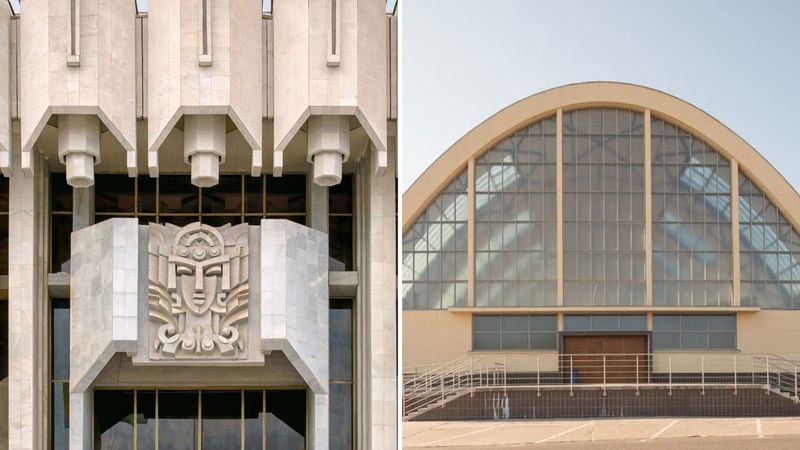
Other buildings pursued more radical formal experiments. The State Museum of Arts, completed in 1974 by Iskander Abdulov and Anatoly Nikiforov, was among the first purpose-built modern art museums in the Soviet Union. Originally clad in abstract square panels, the building aspired to what Grace co-founder Ekaterina Golovatyuk and Chukhovich describe as a "metaphysical and transcendental" quality, transforming the museum typology into something approaching a secular temple. A 1990s renovation altered the facades; the foundation now contemplates restoring the original surfaces, a conservation decision that will test how authenticity gets defined for buildings barely half a century old.
The State Circus, finished in 1976 by Genrikh Aleksandrovich and Gennady Masyagin, demonstrates local architects' resistance to centralized design mandates. While most Soviet cities received standardized circus buildings based on Moscow-approved plans, Tashkent's version features a distinctive UFO-like dome and a custom foyer concept. Its placement on historic Khadra Square created a deliberate dialogue between futurist form and urban memory.
Vernacular Reinterpretation and Structural Innovation
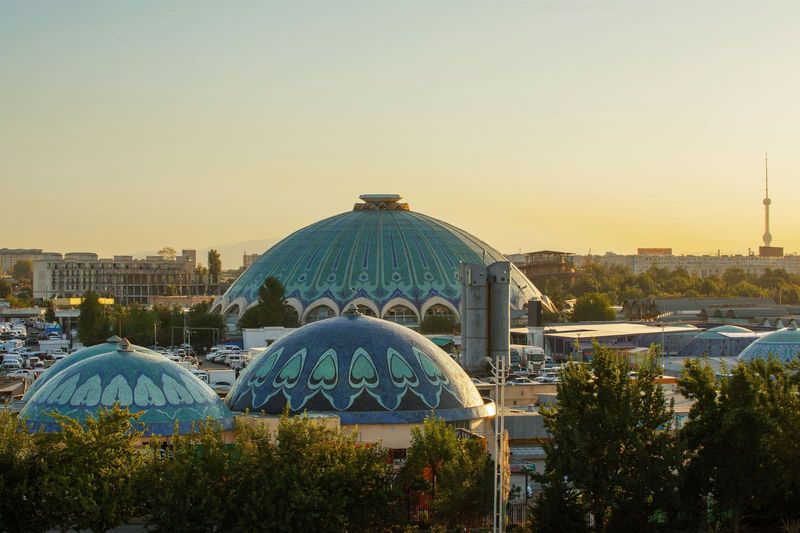
Two projects on the list engage directly with Uzbek spatial traditions, though through contrasting strategies. The Chorsu Market, completed in 1980 by Vladimir Azimov and Sabir Adylov, encloses the city's largest farmers' market beneath a green-tiled dome. Research by Golovatyuk and Chukhovich traced the project's typological origins not to Soviet precedents but to a market in Sidi Bel Abbas, Algeria, illustrating how architectural models migrate and transform across geographies. The exposed steel frame inside the market hall makes the structure's tectonic logic visible, a move that aligns with modernist transparency while accommodating traditional market functions.
Zhemchug, an 1985 residential tower by Ophelia Aidinova, takes a more conceptually ambitious approach. The building reinterprets the mahalla, Central Asia's traditional courtyard-based neighborhood form, by stacking three-story collective courtyards vertically. Aidinova rejected prefabricated concrete panels in favor of in-situ construction, producing what Golovatyuk and Chukhovich call a "brutalist masterpiece" with no global equivalent. The hanging courtyards attempt to preserve social patterns threatened by industrialized housing, a goal that resonates with Team 10's critiques of CIAM orthodoxy and Alison Smithson's interest in "streets in the sky."
Infrastructure as Civic Identity
Three of the ten inscribed structures serve infrastructural or civic gathering functions, categories that Soviet planners treated as opportunities for monumental expression. The People's Friendship Palace, designed by Rozanov in 1981, employed a massive scale and a technology-inflected facade, with concrete representations of bolt heads wrapping the exterior. Though part of a building type replicated across the USSR, the Tashkent iteration incorporated materials and spatial volumes intended to evoke, in highly abstracted terms, Uzbek architectural heritage.
The Prospekt of Cosmonauts metro station, completed in 1984 by Spartak Ziganshin, exemplifies how transportation infrastructure doubled as ideological theater. Tashkent's metro, operational since 1977, was Central Asia's first, and station designs were expected to communicate national identity and Soviet achievement. The Cosmonauts station features marble finishes, decorative glass lighting, and reliefs by artist Boris Klochkov celebrating Soviet space exploration. The richness of materials and spatial quality distinguish it from the utilitarian efficiency that characterized many later Soviet metro expansions.
The Outlier: Industrial Science on a Hillside
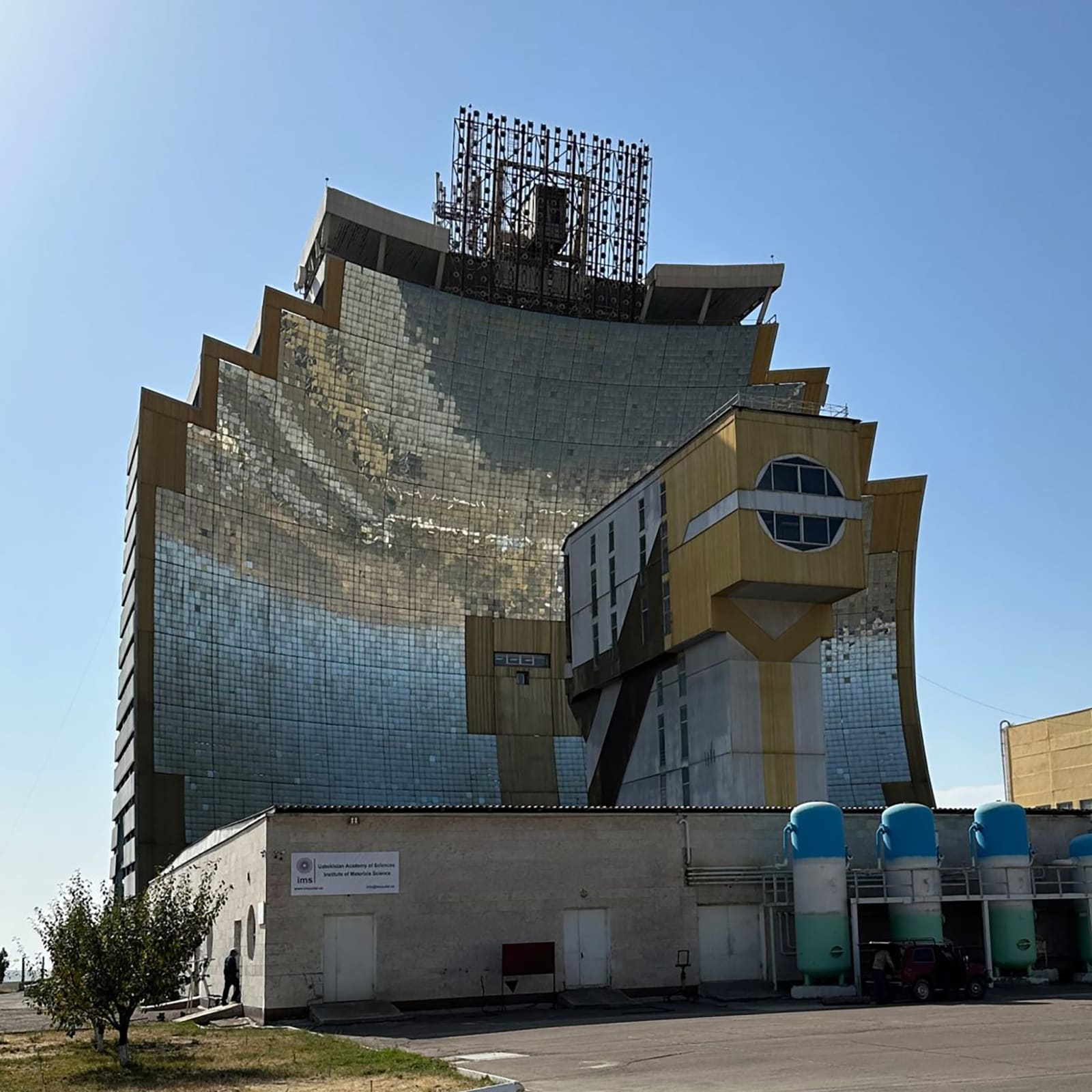
The Heliocomplex Sun, built in 1987 approximately 45 kilometers from Tashkent, stands apart from the other nine structures in both function and location. As one of the world's largest solar furnaces, the complex uses 12,090 mirrors to concentrate sunlight, achieving temperatures up to 3,000 degrees Celsius. Only one comparable facility exists, in Odeillo, France, but the Parkent installation surpasses it in ambition and formal expression.
Where the French furnace prioritizes pure utility, the Uzbek complex incorporates futurist aesthetics and a dramatic hillside siting that frames the structure against the landscape. Still operational, the Heliocomplex demonstrates modernist architecture's adaptability to diverse programs and terrains, from urban civic centers to remote scientific research. Its inclusion in the UNESCO list expands the definition of heritage beyond buildings designed for human occupation, acknowledging infrastructure as a carrier of cultural and technological aspiration.
Conservation Challenges and Urban Pressures
World Heritage inscription brings prestige but also complications. Several of the listed buildings have undergone alterations: the Panoramic Cinema's transparent foyer block has been enclosed, the State Museum of Arts received new facades in the 1990s, and maintenance standards have varied across decades of economic and political transition. Conservation now requires balancing authenticity with continued use, a tension familiar from debates over modern heritage worldwide.
Tashkent's ongoing development adds another layer of difficulty. As a capital city of over two million people, pressure for redevelopment and infrastructure expansion constantly threatens modernist structures that lack legal protection. UNESCO listing provides that protection but also demands resources for maintenance and expertise in conserving materials like exposed concrete, decorative mosaics, and custom steel assemblies that age differently than traditional masonry.
The Uzbekistan Art and Culture Development Foundation's role extends beyond advocacy to stewardship. The State Museum of Arts now serves as the foundation's headquarters, a practical arrangement that ensures institutional oversight. Whether similar models can work for the other nine buildings remains to be tested, particularly for structures like the circus or market that serve active public functions with demanding operational requirements.
Precedent and Implication
At World Archi Design, we've been tracking the slow but accelerating recognition of modern heritage within UNESCO's framework. The inclusion of Tashkent's postwar buildings follows earlier inscriptions of Le Corbusier's work, Brasília's urban plan, and Tel Aviv's White City. Yet the Tashkent designation carries distinct significance: it validates architecture produced within a socialist system, designed by architects whose names remain largely unknown outside specialist circles, and built in a region often marginalized within modernist narratives.
This matters for how we construct global architectural history. If modernism's story is told only through Western Europe, North America, and a handful of canonical figures, we miss the movement's actual geographic and political range. The research that supported Tashkent's listing demonstrates what becomes visible when scholars look beyond established centers: hybrid vocabularies, locally specific responses to climate and culture, and design strategies that complicate simplistic narratives of Soviet standardization.
The precedent also opens questions about other understudied modernist concentrations. Cities across the former Soviet Union, postcolonial Africa, and post-independence Asia contain significant mid-century building stock that faces demolition or insensitive renovation. Tashkent's success suggests that systematic documentation, international collaboration, and sustained advocacy can shift conservation priorities, but the process requires years of effort and institutional commitment.
What Preservation Means
Umerova's comment about passing knowledge to future generations points toward an educational dimension of heritage work. For younger Uzbeks, these buildings are simply part of the inherited urban fabric, often taken for granted or viewed as outdated. Conservation requires cultivating an appreciation for design qualities that may not be immediately legible: the spatial generosity of the museum galleries, the structural ingenuity of the market's dome, or the social ambition embedded in Zhemchug's stacked courtyards.
This is where architectural criticism intersects with preservation policy. UNESCO listing confers official status, but sustained public engagement determines whether buildings remain valued or merely tolerated. The challenge is making the case for these structures not as nostalgic relics of a vanished political system but as sophisticated responses to enduring design problems: how to create civic space, how to build densely while preserving social connections, how to adapt global modernist principles to local conditions.
The ten Tashkent buildings now join a roster of fewer than 1,200 World Heritage Sites worldwide. That designation places them in conversation with structures spanning millennia, from Paleolithic caves to postwar concrete. Whether they can hold their own in that company depends less on their age than on their ability to communicate ideas that transcend their specific historical moment. In that sense, UNESCO recognition is not an endpoint but an invitation to deeper engagement with what these buildings attempted and what they might still teach.
Save this story. A free account keeps your reading list and the 07:00 email in one place.
CREATE FREE ACCOUNT →SIGN IN