
When Roof Becomes Staircase Becomes Metro Station
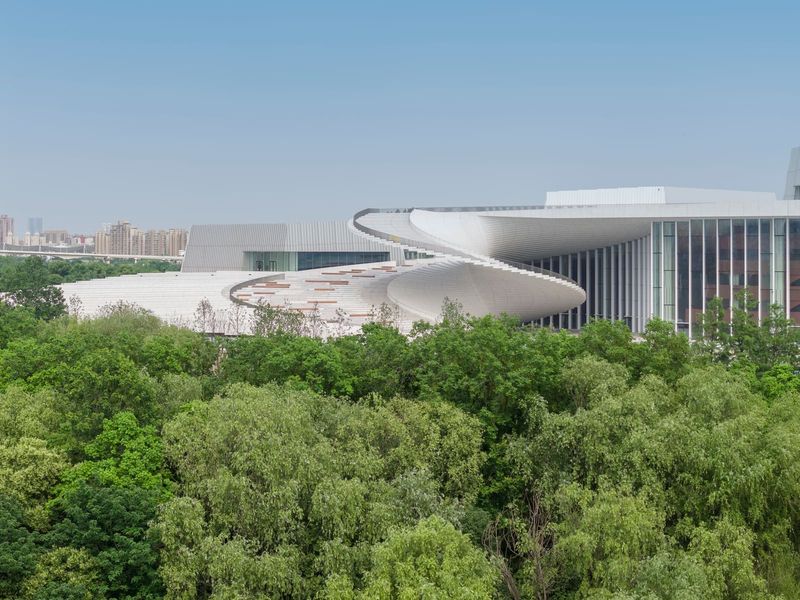
The question Snøhetta posed to itself a decade ago was not how to build another opera house. It was how to make a building that refuses to end at its own walls. In Shanghai, where the Huangpu River bends through a forest of towers and the metro tunnels below like capillaries, the answer took the form of a helical roof that begins at the sky and spirals downward, transforming from canopy to public stair to underground transit link in one continuous gesture.
The Shanghai Grand Opera House will open its doors on October 17, according to Snøhetta. The 146,786-square-meter complex is the product of collaboration between the Oslo-founded practice and the East China Architectural Design and Research Institute, and it represents a conscious rejection of the sealed-box typology that has defined performing-arts centers for generations. Richard Wood, Snøhetta's managing director for Asia, describes the intention as creating something "bigger than themselves," a civic square that belongs to the city rather than to ticket holders alone.
The roof, inspired by the unfolding motion of a traditional bamboo fan, is the building's organizing principle. It is not merely shelter but circulation, not merely form but infrastructure. Cheng Gong, Snøhetta's studio director for China, explains that the roof "links the performance hall to the exterior but also connects the ground to the sky and the building to the park and water." In other words, it is a tectonic hinge, a piece of architecture that negotiates between multiple urban scales and uses at once.
Red Volumes and Transparent Production
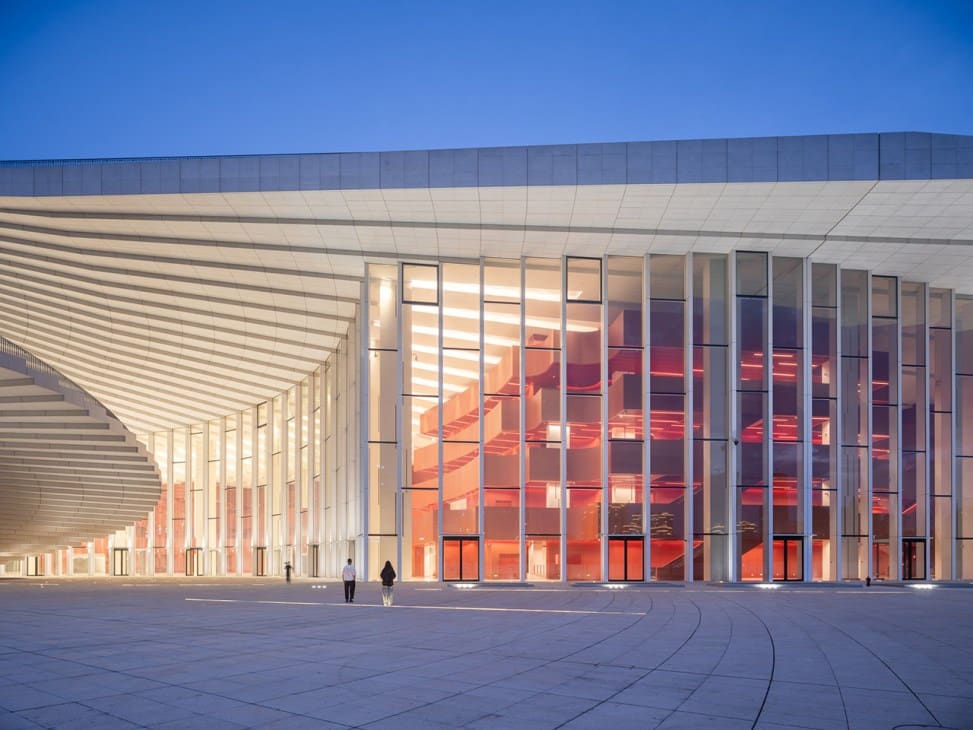
At the entrance, the simplicity of that sweeping roof meets its counterpoint: a stack of sculptural red volumes that signal drama, anticipation, the moment before the curtain rises. The contrast is deliberate. Where the roof is horizontal and generous, the red forms are vertical and compressed, a visual prelude to the intensity of performance.
Inside, the complex houses three performance halls of varying capacities, but Snøhetta has devoted equal attention to what happens offstage. A full production facility, encompassing set design, costume workshops, and prop fabrication, occupies the same building. This is unusual. Most theaters farm out production to external sites, a logistical separation that breaks the creative chain. Here, the entire process unfolds in one place, a seamless flow from sketch to stage.
More striking still, Snøhetta has chosen to make parts of this production facility visible from the street. Passers-by can peer through glass into the workshops where the magic is assembled. It is a gesture that demystifies the theater, that treats the labor of cultural production as worthy of public view. Wood frames this as part of a broader shift in cultural architecture toward openness, a shift in which Snøhetta sees itself as an active participant.
The Civic Square Precedent
The idea of the opera house as civic square is not new, but it remains rare in execution. The Oslo Opera House, completed by Snøhetta in 2008, pioneered the typology of the climbable roof, the building as urban landscape. Since then, the practice has refined the concept in projects like the Lascaux IV Cave Museum in France, where the architecture mediates between natural topography and human program.
Shanghai's version adapts that language to a denser, more vertical context. The helical roof does not sprawl; it spirals. It compresses the Oslo model's horizontal generosity into a tighter coil, a response to the scarcity of ground-level public space in a metropolis where every square meter is contested. The connection to the metro station is critical here. It ensures that the building is not merely accessible but embedded in the city's daily rhythms, a place you pass through as well as a place you visit.
Back-of-House as Public Theater
The decision to expose production spaces to the street is worth dwelling on. Traditionally, back-of-house areas in theaters are treated as service zones, hidden and utilitarian. Snøhetta's move to make them visible is both practical and symbolic. Practically, it animates the street, gives pedestrians something to watch, turns the building into a constant performance even when the halls are dark. Symbolically, it acknowledges that the making of culture is as valuable as the consumption of it, that the carpenter and the seamstress are as essential to the opera as the soprano.
This transparency also has pedagogical potential. By allowing the public to witness the construction of sets and costumes, the building becomes an informal school, a place where the craft of theater is on display. It is a form of urban intimacy, a way of inviting the city into the process rather than presenting only the polished result.
The Test of Time and Human Encounter
Wood's measure of success is telling. He imagines meeting a couple a decade from now who tell him they first met on the upper roof of the opera house. It is a modest ambition, one that prioritizes everyday encounter over architectural spectacle. It is also a recognition that buildings succeed or fail not in photographs but in the stories people tell about them, in the ways they are appropriated and loved.
Whether the Shanghai Grand Opera House will become such a place remains to be seen. The opening season will feature 82 performances across 47 productions, according to Snøhetta, a packed schedule that will test the acoustics, the circulation, the capacity of the building to handle crowds. But the real test will come later, in the quiet moments between performances, when the building is no longer new and the city has decided whether to claim it as its own.
Asia's Cultural Infrastructure Surge
The Shanghai Grand Opera House is part of a broader wave of cultural investment across Asia. In Bangkok, Decentral is transforming a former denim factory into a non-profit art center, with Beau Architects designing a tropical garden to link the disparate structures. The project, backed by the Central Group, is slated to open in April 2027 and will feature commissioned works by Thai contemporary artists. A second Decentral location in Chiang Mai is already in development.
Shenzhen, long known as China's technology hub, is making a parallel push into culture. The Róng Museum of Art, a private institution funded by Tencent co-founder Pony Ma, is scheduled to open in June 2027. Büro Ole Scheeren designed the 4,500-square-meter building, and Pi Li, formerly of Hong Kong's Tai Kwun Contemporary, is curating the opening exhibition. The museum is part of Houhai Hybrid Campus, a mixed-use development that also includes a new Upper House hotel.
In Manila, the Ayala Foundation is developing the Kontempo Center for Contemporary Art, designed by LA-based Thai architect Kulapat Yantrasast. The project, which does not yet have a fixed opening date, will focus on exhibitions, commissions, and public programming rather than building a large permanent collection. Reuben Keehan, formerly of Queensland Art Gallery, has joined as artistic director.
What Shanghai's Opera House Signals
These projects share a common logic: culture as infrastructure, not amenity. They are not vanity projects but attempts to build the social and symbolic architecture that cities need to function as more than economic engines. The Shanghai Grand Opera House, with its porous boundaries and its insistence on connecting disparate urban systems, is the clearest articulation of this logic.
It is also a test of whether the civic-square model, developed in the context of Scandinavian social democracy, can translate to a Chinese megacity. The question is not whether the architecture is beautiful - it is - but whether it will be used, whether it will become part of the city's daily life or remain a destination reserved for special occasions. The helical roof, the transparent production spaces, the metro connection: these are all invitations. Whether the city accepts them is another matter.
Wood's fantasy of the married couple meeting on the roof is, in the end, a way of asking whether architecture can create the conditions for love, for chance encounter, for the small moments that make a city feel like home. It is a high bar, but it is the right one. Buildings that aim for less rarely achieve even that.
Save this story. A free account keeps your reading list and the 07:00 email in one place.
CREATE FREE ACCOUNT →SIGN IN