
When Infrastructure Becomes Canvas
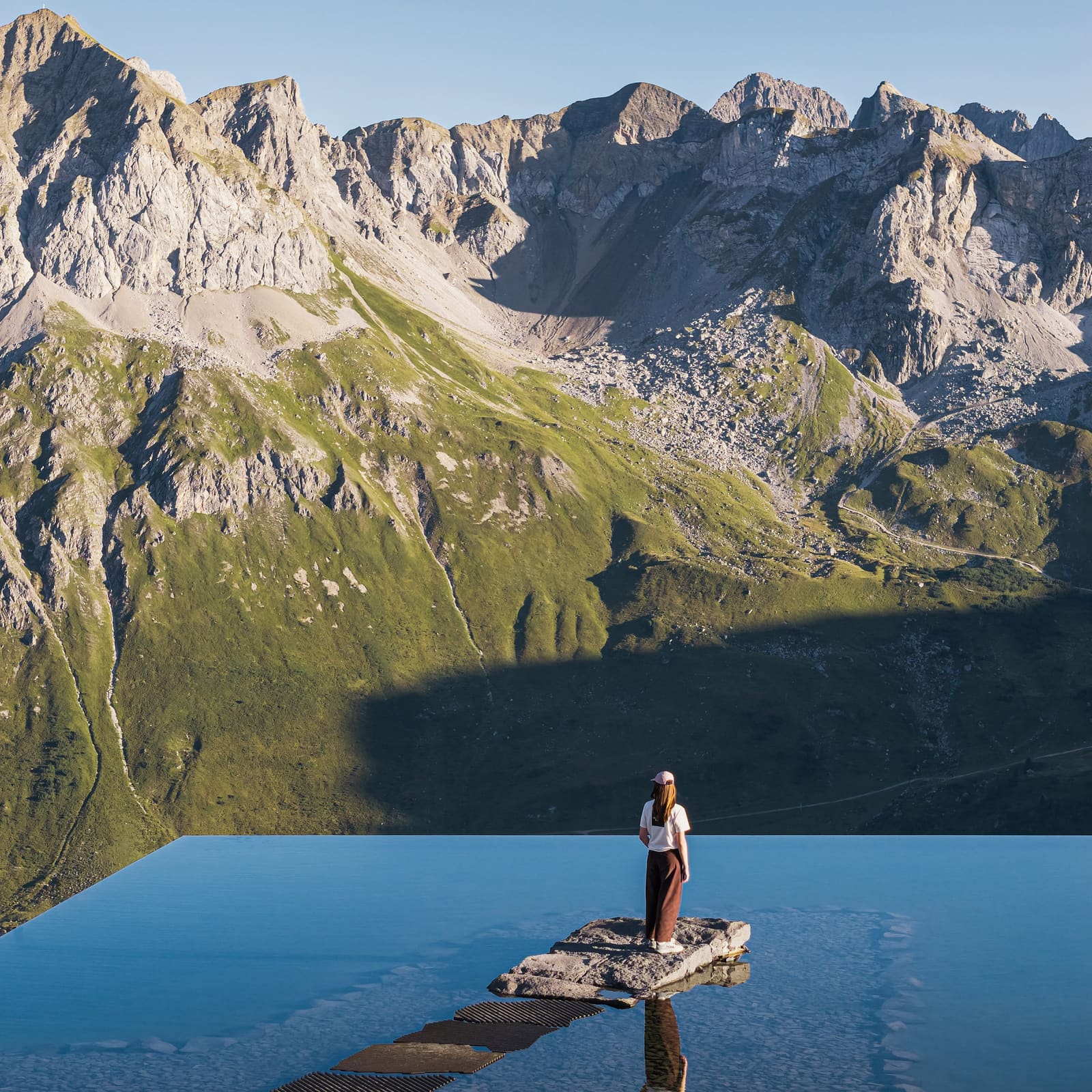
There is a particular challenge in mountain architecture: how to add to a landscape that requires nothing. The peaks, the shifting weather, the play of light across rock faces already constitute a complete aesthetic system. Any intervention risks becoming either invisible or intrusive. Snøhetta's Lech Mountain Mirror, completed in 2026 atop the Zugerbergbahn cable car station in Austria's Vorarlberg region, navigates this tension by proposing not an object but a condition: a shallow pool of water that captures the surrounding topography and returns it to the visitor as something both familiar and estranged.
The project exemplifies what we might call infrastructural opportunism. Rather than constructing a standalone pavilion or viewing platform, the studio's Innsbruck office recognised the cable car station roof as an underutilised horizontal plane with panoramic exposure. The intervention is minimal in its material palette: water, stone, and larch timber. Yet the experiential ambition is significant. By placing visitors within a mirrored plane, the installation collapses the distinction between observer and observed, between standing on the mountain and being reflected by it.
Materiality and Atmospheric Flux
The Lech Mountain Mirror comprises a carefully engineered basin holding a controlled depth of water across the station roof. A series of striped stepping stones, their banding reminiscent of sedimentary layering, traverse the pool and converge on a single boulder that rises from the surface. The stone is local, its presence grounding the installation in geological continuity with the surrounding massif. The larch seating elements that frame the pool reference Vorarlberg's vernacular timber construction traditions, though their form is pared down to essential geometric volumes.
What distinguishes this project from conventional viewing platforms is its incorporation of atmospheric variability as a design parameter. On clear days, the water surface becomes a precise optical plane, doubling the Alpine panorama with photographic fidelity. Wind introduces ripples that fragment and abstract the reflection, transforming the stable image into kinetic pattern. Cloud movement, shifting sun angles, and precipitation each recalibrate the visual field. According to Snøhetta partner Patrick Lüth, the installation captures the mountain environment in an unusual way, offering opportunities to experience the landscape from an altered perspective.
This sensitivity to weather as a compositional element aligns with precedents in land art, particularly James Turrell's Roden Crater or Robert Smithson's engagement with entropic processes. Yet where those projects operate at vast scale and in remote contexts, Snøhetta's intervention is modest in footprint and situated within an active tourism infrastructure. It demonstrates that phenomenological ambition need not correlate with physical monumentality.
Programme and Seasonal Recalibration
Lech has long been established as a winter sports destination, its economy calibrated to the ski season. The Mountain Mirror is part of a broader municipal strategy to diversify the temporal rhythm of tourism, extending visitor engagement into the warmer months. The installation is free to access and designed to function as a destination in itself, rather than merely a waypoint along a hiking route.
This programmatic intent situates the project within a larger constellation of art and architecture interventions being developed across the region. Works by Antony Gormley and James Turrell are reportedly in various stages of planning, suggesting an emerging model in which Alpine municipalities deploy site-specific installations to reframe their cultural identity beyond winter sport. The strategy is not without precedent: Bolzano's MMM network, conceived by Reinhold Messner and realised through collaborations with architects including Zaha Hadid, has successfully repositioned mountain infrastructure as a year-round cultural attraction.
The question, of course, is one of density. How many interventions can a fragile Alpine ecology absorb before the cumulative effect shifts from enhancement to saturation? Snøhetta's project succeeds in part because it occupies existing infrastructure, adding programme without expanding the physical footprint. Future developments in the area will need to exercise similar restraint if the region is to avoid the theme-park dilution that has compromised other mountain destinations.
Tectonics of Reflection
The formal language of the Lech Mountain Mirror is deliberately reductive. There is no enclosure, no cantilevered drama of the sort Snøhetta employed in their Nordkette Path of Perspectives interventions nearby. Instead, the project operates through subtraction and framing. The pool edge defines a boundary; the stepping stones prescribe a choreography of movement; the boulder offers a terminus. Beyond these elements, the architecture recedes, allowing atmospheric and topographic phenomena to dominate.
This restraint is architectural in the deepest sense. It demonstrates an understanding that in certain contexts, the designer's role is not to impose form but to curate perception. The striped patterning of the stepping stones introduces rhythm and scale calibration, preventing the water surface from reading as an undifferentiated void. The larch seating, positioned at the pool's perimeter, provides a secondary mode of engagement for those who prefer observation over immersion.
The project recalls Peter Zumthor's Therme Vals, another Alpine intervention where water, stone, and carefully controlled sightlines generate a heightened awareness of materiality and atmosphere. Both projects resist the picturesque in favour of the phenomenological, prioritising embodied experience over scenic consumption. Yet where Zumthor encloses and compresses space, Snøhetta opens and expands it, using the reflective plane to double the available visual field.
Context and Continuation
Snøhetta, founded by Kjetil Thorsen and Craig Dykers in 1989, has built a practice around interventions that negotiate the boundary between natural and constructed environments. Their portfolio includes the Norwegian National Opera and Ballet in Oslo, where the roof becomes a public plaza sloping into the fjord, and the Tverrfjellhytta mountain lodge, which embeds itself into the Norwegian plateau. The Lech Mountain Mirror extends this trajectory, demonstrating the studio's continued interest in projects where architecture facilitates rather than dominates landscape experience.
The Innsbruck office, responsible for this commission, has developed particular expertise in Alpine contexts. Their Path of Perspectives, a sequence of interventions along the Nordkette trail system overlooking Innsbruck, explores similar themes of framing, threshold, and atmospheric engagement. The Lech project distils these concerns into a single, concentrated gesture.
As Alpine regions confront climate change and the economic pressures of tourism monoculture, projects like the Mountain Mirror offer a potential model: interventions that are materially light, programmatically flexible, and experientially rich. Whether this approach can scale, or whether each installation remains a site-specific exception, will depend on the discipline exercised by both designers and clients in the years ahead. For now, the pool at Lech stands as evidence that infrastructure need not be merely functional, and that reflection, both optical and conceptual, can constitute a legitimate architectural programme.
Save this story. A free account keeps your reading list and the 07:00 email in one place.
CREATE FREE ACCOUNT →SIGN IN