
The Problem of Crossing
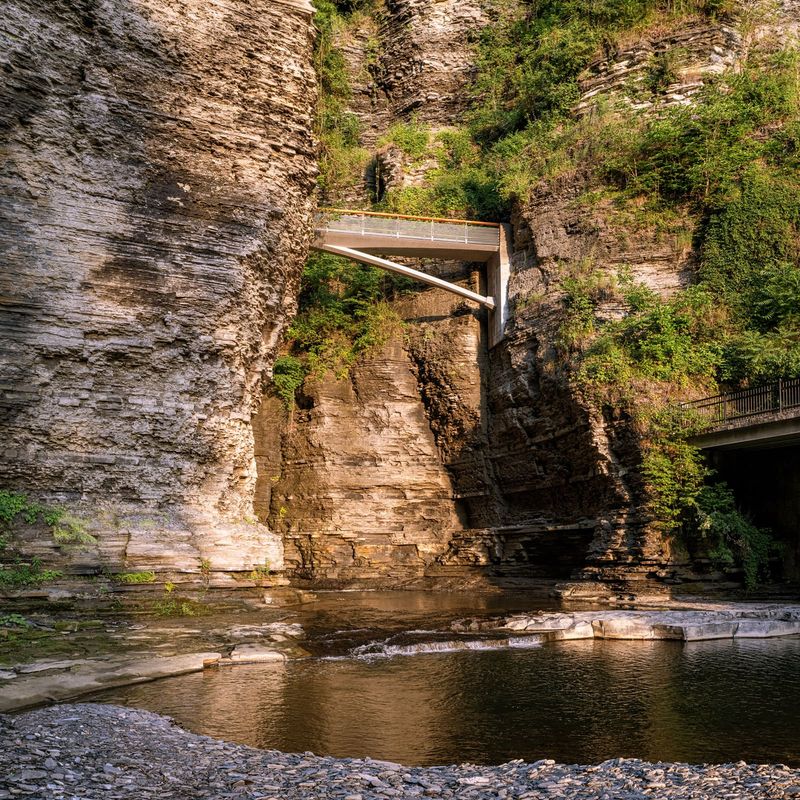
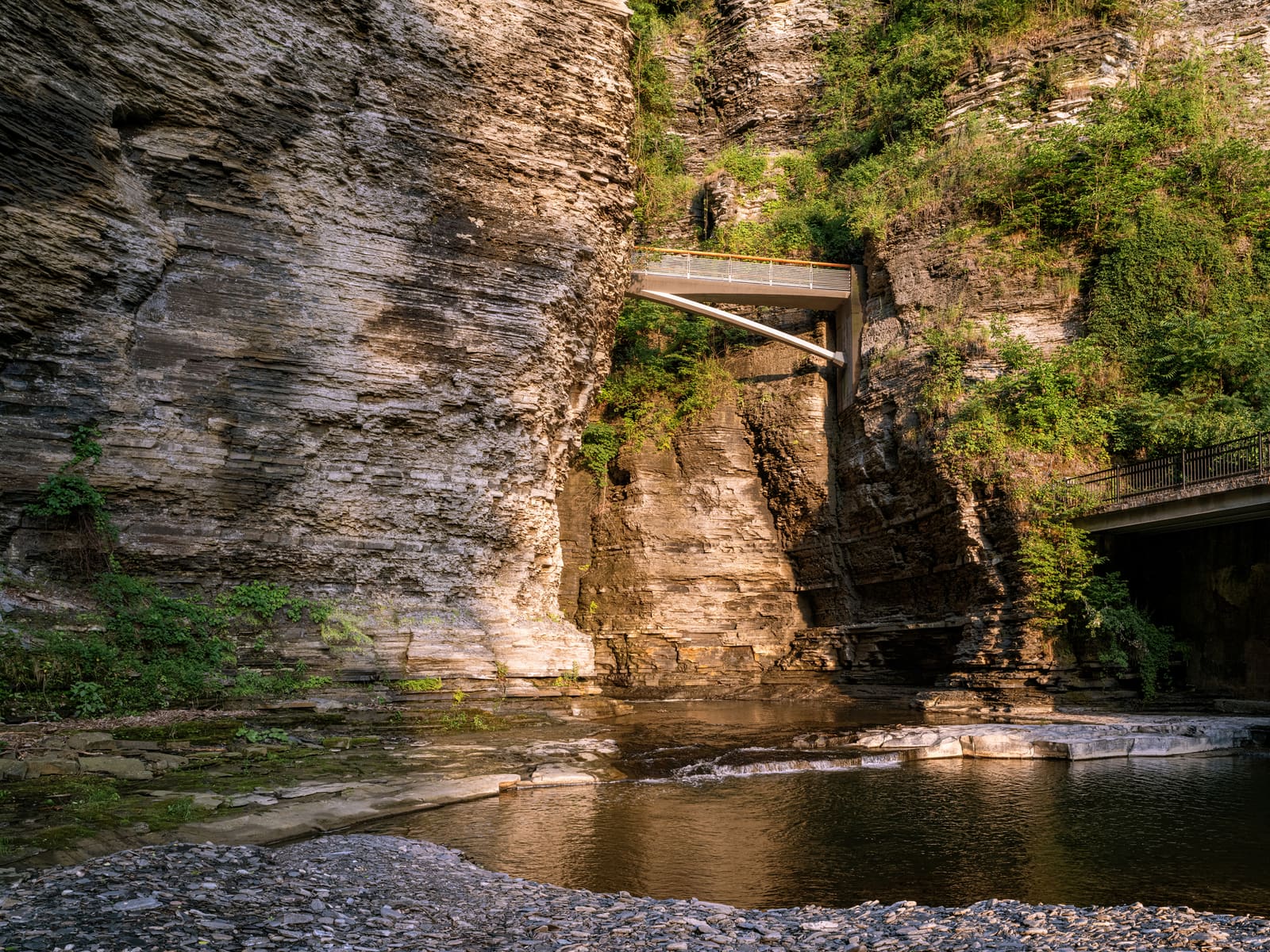
There is a particular kind of design problem that arises when a path must leap across a chasm. The engineer sees a span; the architect sees a gesture; the preservationist sees risk. At Watkins Glen State Park, where water has carved a 400-foot gorge through Devonian shale over millennia, these three viewpoints converged in the design of the Sentry Bridge, a modest but technically sophisticated crossing that opened this year.
Snøhetta and schlaich bergermann partner - studios with complementary strengths in landscape-scale thinking and structural engineering - were tasked by the New York State Office of Parks, Recreation and Historic Preservation with replacing a deteriorated pedestrian bridge at one of the park's key entry points. The brief was deceptively simple: create a gateway structure that could handle seasonal visitor loads without overwhelming the site's historic character or competing with the gorge itself.
The resulting 30-square-meter bridge is less an object than an act of calibration. It is visible, but not insistent. It is engineered for precision, but reads as elemental. And it manages to be both contemporary and contextual - a balance that has eluded many recent interventions in historic landscapes.
Structural Parti: Tension and Compression
The bridge's form is driven by its structural logic. schlaich bergermann partner, a firm known for its work on long-span cable structures and lightweight engineering, conceived the crossing as a tension system. Two slender steel cables carry the deck, anchored at either end into bedrock. The deck itself is a steel grating, chosen for its minimal visual mass and its ability to allow light and water to pass through.
This is not a suspension bridge in the classical sense - there are no towers, no dramatic catenary curves. Instead, the cables are pre-tensioned and locked into a shallow profile that follows the natural sight lines of the gorge. The result is a structure that feels taut rather than draped, a line drawn across space rather than a volume inserted into it.
The engineering team worked closely with geotechnical consultants from Langan to ensure that the anchor points could be embedded without disturbing the park's fragile shale formations. Old Structures Engineering, brought on for historic preservation expertise, advised on how to minimize visual and physical impact on the surrounding 19th-century stonework - much of it part of the original Civilian Conservation Corps construction that defined the park's character in the 1930s.
Material Choices and Weathering
Snøhetta's role centered on the landscape and material expression of the bridge. The studio has long advocated for what it calls "slow architecture" - designs that age gracefully and integrate with their surroundings over time. Here, that philosophy translated into a restrained material palette: weathering steel, bronze hardware from Erie Bronze & Aluminum, and a deck surface that would patina rather than corrode.
The handrails, fabricated by Matthews International, are minimal in section but robust in feel - a tube rail with tensioned wire infill that maintains visibility across the gorge while meeting safety codes. The bronze fittings were chosen not for decorative effect but for their durability in the park's humid, spray-laden microclimate. Over time, the weathering steel will develop a rust-orange surface layer that echoes the iron oxide staining on the gorge walls - a deliberate nod to the site's geology.
This is a material strategy we have seen deployed effectively in other Snøhetta projects, from the Norwegian Wild Reindeer Centre Pavilion to the more recent expansions at the San Francisco Museum of Modern Art. The idea is not to hide the structure, but to let it become part of the site's visual ecology.
Wayfinding and the Arrival Sequence
The bridge does not exist in isolation. It is part of a larger arrival sequence that includes new wayfinding signage by Moniteurs Communication Design and a lighting scheme integrated into the bridge structure itself. The lighting, also designed by schlaich bergermann partner, is embedded along the underside of the deck and within the handrail posts, providing orientation without introducing extraneous fixtures.
This attention to the pedestrian experience - how the bridge is approached, crossed, and remembered - is where the collaboration between Snøhetta and sbp becomes legible. The bridge is positioned to frame specific views of the gorge as visitors enter the park, turning the crossing into a threshold moment rather than a utilitarian link. The deck is narrow enough to slow foot traffic slightly, encouraging pause and observation.
Moniteurs' signage system uses cast bronze plaques set into stone plinths, a typographic intervention that feels more like epigraphy than wayfinding. The language is spare, the information minimal - just enough to orient without narrating. It is a refreshing counterpoint to the over-explained interpretive infrastructure common in many American parks.
Precedents and Context
The Sentry Bridge invites comparison with other recent pedestrian crossings in sensitive landscapes. One thinks of the Glacier Skywalk in Jasper National Park, a cantilevered glass walkway that prioritizes spectacle over subtlety. Or the Rakotzbrücke restoration in Germany, where historical fidelity was paramount. The Watkins Glen project occupies a middle ground: it is neither a reconstruction nor a statement piece, but a careful insertion that acknowledges both past and present.
Closer in spirit, perhaps, is the work of Swiss engineer Jürg Conzett, whose minimalist timber and steel bridges in the Graubünden region achieve a similar balance between engineering clarity and landscape sensitivity. Like Conzett, the Snøhetta-sbp team seems to have asked not "What can we build here?" but "What is the least we need to build?"
The bridge also reflects a broader shift in American park infrastructure toward collaboration between architects and engineers from the outset, rather than treating design as a cosmetic overlay on structural problem-solving. Projects like the Glacier Point viewing platform at Yosemite and the recent rehabilitations at Acadia National Park suggest that agencies like the New York State Office of Parks are increasingly willing to invest in design quality for utilitarian structures.
A Question of Scale
What makes the Sentry Bridge noteworthy is not its size - 30 square meters is barely a footnote in most architecture surveys - but its precision. In an era when landscape interventions often lean toward the monumental or the Instagram-optimized, this project is a reminder that scale and impact are not synonymous.
The bridge will be crossed by thousands of visitors each season, most of whom will likely register it as simply "the bridge." But for those who pause to consider how it was made - how the cables were tensioned, how the deck was detailed, how the lighting was integrated - the project reveals itself as a small masterclass in restraint. It does not compete with the gorge. It does not announce its own cleverness. It simply performs its function, beautifully.
Looking Forward
As climate change accelerates the weathering and erosion of park infrastructure nationwide, projects like the Sentry Bridge offer a model for how to approach renewal. The design team's decision to embrace weathering steel and bronze - materials that age rather than fail - suggests a long-term view that is rare in public works. The structure is designed to be maintained, not replaced.
Snøhetta and schlaich bergermann partner have produced a bridge that is, in the best sense, unremarkable. It does not seek to be a landmark. It does not strive for iconic status. It is content to be a crossing, a threshold, a line of steel and stone that connects two sides of a gorge. In that modesty lies its considerable achievement.
Save this story. A free account keeps your reading list and the 07:00 email in one place.
CREATE FREE ACCOUNT →SIGN IN