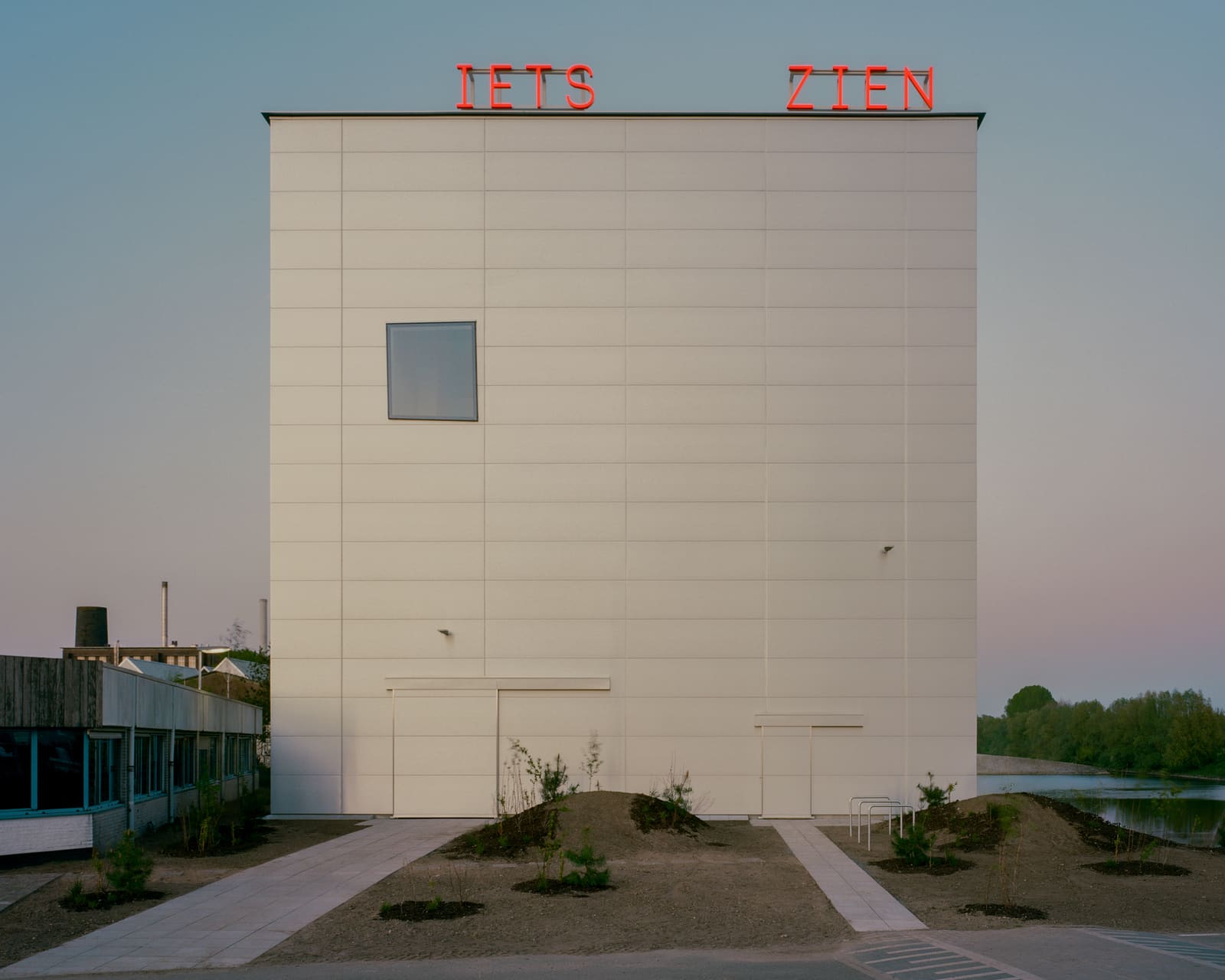
The Geometry of Restraint
Perfect cubes are rare in architecture. They demand discipline - each dimension locked to the others, every elevation mirror to the next. Space Encounters, the Rotterdam-based studio known for their tectonic clarity, has delivered exactly that along the port basin of the Nederrijn in Arnhem. Showdepot DE.GROEN measures precisely 18 metres in all three axes, a monolithic volume that stands in stark contrast to the sprawling factory sheds of Cleantech Park, the post-industrial quarter where it has landed.
The project serves collector-and-artist duo Marjolein de Groen and Peter Jordaan, who after a decade in a protected heritage building in Arnhem's historic core, required a purpose-built environment for their expanding holdings of contemporary art. The brief called not for a gallery in the traditional sense, but a showdepot - a hybrid typology that blurs storage, study space, and occasional display. It is architecture for looking, but also for keeping.
Material Presence in a Heterogeneous Landscape
Cleantech Park is not a context that begs for subtlety. The area is a patchwork of corrugated metal, concrete aprons, and retrofitted industrial volumes, each structure speaking its own utilitarian dialect. Into this visual cacophony, Space Encounters has inserted a figure of remarkable composure. The cube is clad in a continuous envelope that catches and reflects the low Dutch light, a surface treatment that oscillates between opacity and shimmer depending on the hour and weather.
The material choice here is critical. Rather than deploying brick or board-formed concrete - moves that might have anchored the building too firmly in the industrial vernacular - the architects opted for a lighter, more contemporary skin. The effect is one of levitation, as if the volume were less a permanent fixture than a temporary landing. This decision also speaks to the building's program: a repository for art is not a factory, and should not read as one.
Van Rossum Raadgevende Ingenieurs handled the structural engineering, a collaboration that allowed the interior to remain as open as possible. Large-span trusses and a rational column grid free the plan from the constraints that typically plague storage buildings, where racking systems and mechanical loads can dictate spatial organization. Here, flexibility was paramount - the collection grows, tastes shift, and the architecture must accommodate both.
Spatial Logic and the Collector's Eye
The interior volume is organized across multiple levels, each calibrated to different scales of engagement with the artworks. Ground-floor spaces open directly onto the basin, offering controlled access for deliveries and installations. Above, more intimate zones allow for close study, the kind of sustained attention that collectors and curators require but that public museums rarely afford. Natural light is carefully modulated through a series of skylights and high-level apertures, ensuring that the art is visible without subjecting it to UV degradation.
This is where Space Encounters diverges most clearly from the museum model. Showdepot DE.GROEN is not designed for crowds or circulation theatrics. There are no grand atriums, no processional ramps. Instead, the architecture prioritizes silence, storage density, and the occasional moment of revelation. It is a building for those who already know what they are looking for.
VIC Landscapes contributed the site design, negotiating the transition between the cube and the hard industrial surfaces that surround it. The landscape strategy is minimal - paving, low planting, carefully placed bollards - but it establishes a threshold, a moment of pause before entering the volume. In a district where buildings often meet the ground with loading docks and service yards, this gesture matters.
Precedents and Departures
The perfect cube has a long lineage in modernist and minimalist practice. One thinks of Tony Smith's sculptural propositions, or the geometric rigor of Peter Eisenman's early houses. In the Netherlands specifically, the cube has been explored by studios ranging from MVRDV to Wiel Arets, often as a provocation against the horizontal sprawl of Dutch urbanism. Space Encounters joins this lineage but bends it toward a different end: not the single-family villa or the speculative office block, but the private institution.
What sets Showdepot DE.GROEN apart is its refusal of spectacle. In an era when private collections increasingly seek public visibility - think of the Fondation Louis Vuitton or the Broad - this project opts for discretion. The building does not advertise its contents. It does not compete for attention. It simply is, a self-contained figure in a landscape that has little patience for figures.
The construction was carried out by Karbouw, a contractor with experience in complex industrial and cultural commissions. The precision required to execute an 18-metre cube without visible seams or misalignments is considerable, and the detailing throughout reflects that rigor. Corners meet cleanly, thresholds are flush, and the building envelope performs as a single coherent surface rather than an assembly of panels.
A New Typology for Private Stewardship
As public funding for museums contracts and private collections grow in both scale and ambition, the showdepot may represent an emerging building type. It occupies a middle ground between the domestic and the institutional, offering the intimacy of the former and the infrastructure of the latter. Space Encounters has given form to that ambiguity, crafting a building that is at once fortress and salon, warehouse and gallery.
Showdepot DE.GROEN also raises questions about access and exclusivity. Unlike a public museum, this facility serves a limited audience - primarily the collectors themselves, along with invited scholars, curators, and artists. Yet its architectural ambition suggests something more than private indulgence. The building is a statement about stewardship, about the responsibility that comes with accumulating art in an age of abundance. Whether that statement is legible from the outside remains an open question.
The project spans 1,200 square metres across its three floors, a modest footprint for a building of such sculptural presence. That economy of means is part of its appeal. In a culture that often equates cultural ambition with sheer size, Space Encounters demonstrates that restraint can be its own form of power. The cube does not expand; it concentrates. It does not sprawl; it rises.
Reflection and Opacity
Standing at the edge of the Nederrijn basin, Showdepot DE.GROEN reads differently depending on where you approach from. From the water, it appears as a luminous block, a lantern among the industrial silhouettes. From the road, it recedes, its surfaces blending with the sky. This duality - reflection and opacity, presence and withdrawal - captures something essential about the collector's impulse: the desire to hold and to hide, to possess and to protect.
Space Encounters has delivered a building that honours that impulse without romanticizing it. The architecture is precise, unsentimental, and deeply spatial. It does not preach. It does not perform. It shelters, organizes, and occasionally reveals. In doing so, it offers a model for how private collections might inhabit the public realm: not as spectacle, but as quiet, rigorous presence.
Photo: Lorenzo Zandri
Save this story. A free account keeps your reading list and the 07:00 email in one place.
CREATE FREE ACCOUNT →SIGN IN