
The Metabolic Crisis in the Built Environment
At World Archi Design, we've been tracking a quiet but persistent crisis: the proliferation of buildings that demand nothing from us and offer even less in return. They are structures designed to satisfy regulatory minimums and budget constraints, not human longing. Thomas Heatherwick, whose studio has delivered projects ranging from Tokyo's Azabudai Hills to the recently completed Olympia redevelopment in west London, frames this problem in strikingly corporeal terms. Boring buildings, he argues, are analogous to fast food: cheap, ubiquitous, and ultimately detrimental to our well-being.
This is not metaphor dressed as critique. Heatherwick has launched Humanise, a not-for-profit research organization dedicated to quantifying the health impacts of architectural mediocrity. The premise is deceptively simple. If the spaces we inhabit and navigate daily shape our moods, stress levels, and sense of belonging, then the design profession has a responsibility to measure those effects with the same rigor applied to structural loads or energy performance. Yet the industry has largely sidestepped this accountability, dismissing public dissatisfaction as philistinism rather than feedback.
Olympia and the Victorian Standard
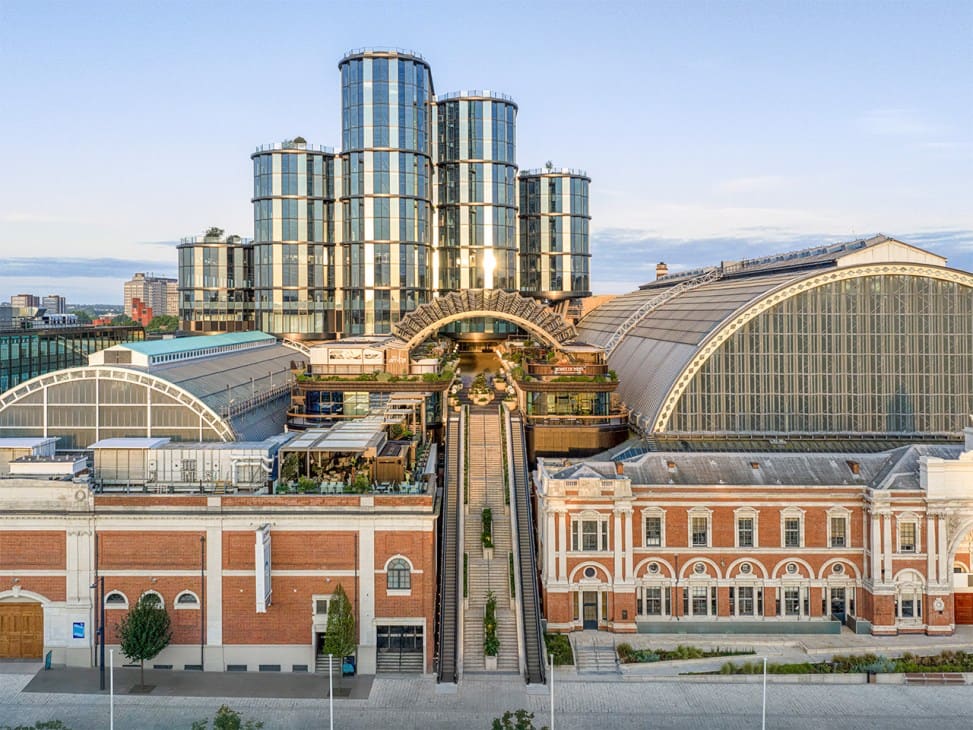
Heatherwick's latest completed work, the Olympia redevelopment, illustrates what he means by architectural generosity. The project involved the adaptive reuse of a Victorian entertainment and exhibition complex in west London, a site that had reached the end of its functional life. Rather than demolition, Heatherwick Studio introduced an elevated street that traverses the rooftops, a gesture that transforms circulation into spectacle and makes public space genuinely accessible.
The Victorians who originally built Olympia, Heatherwick notes, operated from a position of cultural confidence. They believed in grandeur not as extravagance but as civic duty. That confidence allowed them to take risks, to invest in ornamentation and spatial drama even when the economics were uncertain. Heatherwick sees this historical precedent as both inspiration and rebuke. Contemporary practice, by contrast, too often retreats into safety, producing buildings that are commercially risk-averse and emotionally inert.
The danger in that retreat is not merely aesthetic. Buildings designed to offend no one often fail to engage anyone. They struggle to attract tenants, age poorly, and eventually become candidates for demolition within a generation. This cycle is both culturally wasteful and ecologically ruinous. The carbon cost of repeated demolition and reconstruction is unsustainable. We need architecture that invites attachment, that people will fight to preserve.
The Case for a Manifesto
Heatherwick's method for maintaining design integrity over the long, grinding course of a project is to begin with a manifesto. Not a mood board or a list of aesthetic preferences, but a set of core values that can withstand the inevitable pressures to compromise. At Olympia, the guiding principle was the democratization of public space. That commitment clarified decision-making when budgets tightened or timelines stretched. It provided a litmus test: does this choice advance or undermine our stated purpose?
This approach is particularly valuable in projects that span multiple years and involve numerous stakeholders. Without a clear ethical framework, design teams can drift, making incremental adjustments that cumulatively erode the original vision. A manifesto functions as both anchor and compass. It reminds everyone involved what they are working toward and why it matters.
Heatherwick acknowledges that ambition carries risk. Novel designs can exceed budgets, provoke backlash, or simply fail to resonate. His own portfolio has weathered all three criticisms at various points. But he contends that the greater risk lies in timidity. When designers prioritize safety over significance, they produce environments that inspire neither love nor loyalty. These are the buildings that disappear from collective memory even while they remain standing.
Humanise and the Data Imperative
The launch of Humanise marks a strategic pivot. Rather than relying solely on subjective arguments about beauty or meaning, Heatherwick aims to arm developers and architects with empirical evidence. The organization is investigating how built environments influence mental health, social cohesion, and physiological stress. Early research draws parallels between architectural monotony and the public health consequences of poor nutrition, a comparison that reframes design as a determinant of well-being rather than a matter of taste.
This evidence-based approach could shift the terms of debate within the industry. Developers accustomed to evaluating projects through return on investment or construction timelines may begin to consider metrics like user satisfaction or neighborhood vitality. Architects trained to prioritize form and function might integrate psychological impact into their design briefs. The goal is not to impose a single aesthetic standard but to establish that design quality has measurable consequences.
Heatherwick's critique extends beyond individual buildings to systemic attitudes. He observes that the architecture profession has historically dismissed public dissatisfaction as ignorance rather than engaging with it as legitimate critique. This defensive posture has insulated designers from accountability while alienating the communities their work is meant to serve. Humanise represents an attempt to bridge that divide, to create a shared language of value that includes but is not limited to professional judgment.
Precedent and Parallel
The comparison to fast food is apt but incomplete. Ultra-processed food succeeds commercially because it is cheap, convenient, and engineered to trigger cravings. Banal architecture, by contrast, rarely wins popular affection. It persists not because people prefer it but because it minimizes upfront risk for developers and requires less design labor. The parallel lies not in consumer demand but in the externalization of harm. Just as processed food imposes long-term health costs that are not reflected in its price, uninspired buildings degrade urban life in ways that balance sheets ignore.
We might also consider precedents within architecture itself. The Brutalist movement of the mid-20th century produced structures that were often reviled during their lifespans but have since been reassessed. Some have been demolished; others are now protected as heritage. The difference often hinges on material quality and spatial generosity. Brutalist buildings that used concrete inventively, that created unexpected public spaces or framed views with care, have aged into beloved landmarks. Those that treated concrete as mere expedience have not.
Heatherwick's work at Azabudai Hills in Tokyo offers another case study. The wave-form retail canopy is unambiguously sculptural, a piece of architecture that announces itself. It has drawn both praise for its formal innovation and criticism for its cost and complexity. But it has also become a destination, a place people visit not out of necessity but desire. That kind of magnetic quality, Heatherwick suggests, should be the baseline ambition for urban projects, not the exception.
The Ethics of Durability
One of Heatherwick's more provocative assertions is that buildings people do not care about are inherently unsustainable. This inverts the conventional sustainability calculus, which focuses on material efficiency and operational energy. Those factors matter, but they are insufficient if a building is demolished prematurely because it has become culturally obsolete. The most sustainable structure is one that people are willing to maintain, adapt, and defend over decades.
This argument aligns with the principles of adaptive reuse, which Olympia exemplifies. The original Victorian structures were not torn down but reinterpreted, their bones preserved while their functions and spatial relationships were reimagined. This approach honors both material and cultural continuity. It also requires a different kind of design intelligence, one that works with constraints rather than erasing them.
The challenge is scaling this ethos beyond landmark projects. Adaptive reuse is easier to justify for heritage buildings with established cultural significance. How do we instill that same sense of value in new construction? Heatherwick's answer is that we must design with the assumption that our work will outlast us, that future generations will inherit and judge what we build. That long view demands a level of care and ambition that short-term commercial logic often discourages.
Forward
Heatherwick's call for architectural confidence is ultimately a call for a different kind of professionalism. One that accepts public engagement as part of the design process rather than an obstacle to it. One that measures success not only in awards or fees but in how spaces are inhabited and remembered. And one that treats the built environment as a determinant of collective health, subject to the same scrutiny we apply to food systems or public infrastructure.
Whether Humanise can generate the data to support this shift remains to be seen. But the framing itself is valuable. It repositions architecture as a practice with ethical stakes that extend far beyond the client relationship. Every building contributes to or detracts from the public realm, and designers bear some responsibility for that cumulative impact. Recognizing that responsibility is the first step toward fulfilling it.
Save this story. A free account keeps your reading list and the 07:00 email in one place.
CREATE FREE ACCOUNT →SIGN IN