
A Small Typology with Outsized Influence
The nightstand occupies a peculiar position in the furniture canon. Too small to command attention, too essential to omit, it hovers at the edge of consciousness - literally and architecturally. Yet the piece's modest footprint belies its capacity to inflect an entire room's spatial character. At World Archi Design, we've been tracking how designers and manufacturers approach this humble typology, and what emerges is a taxonomy of material expression, joinery innovation, and quietly radical ideas about storage.
What follows is an examination of eleven pieces that resist the commodity sameness of mass-market bedroom furniture. Some lean on modernist precedent; others draw from vernacular craft traditions. All of them treat the bedside table as an opportunity to articulate a design position.
Thuma's Joinery as Statement
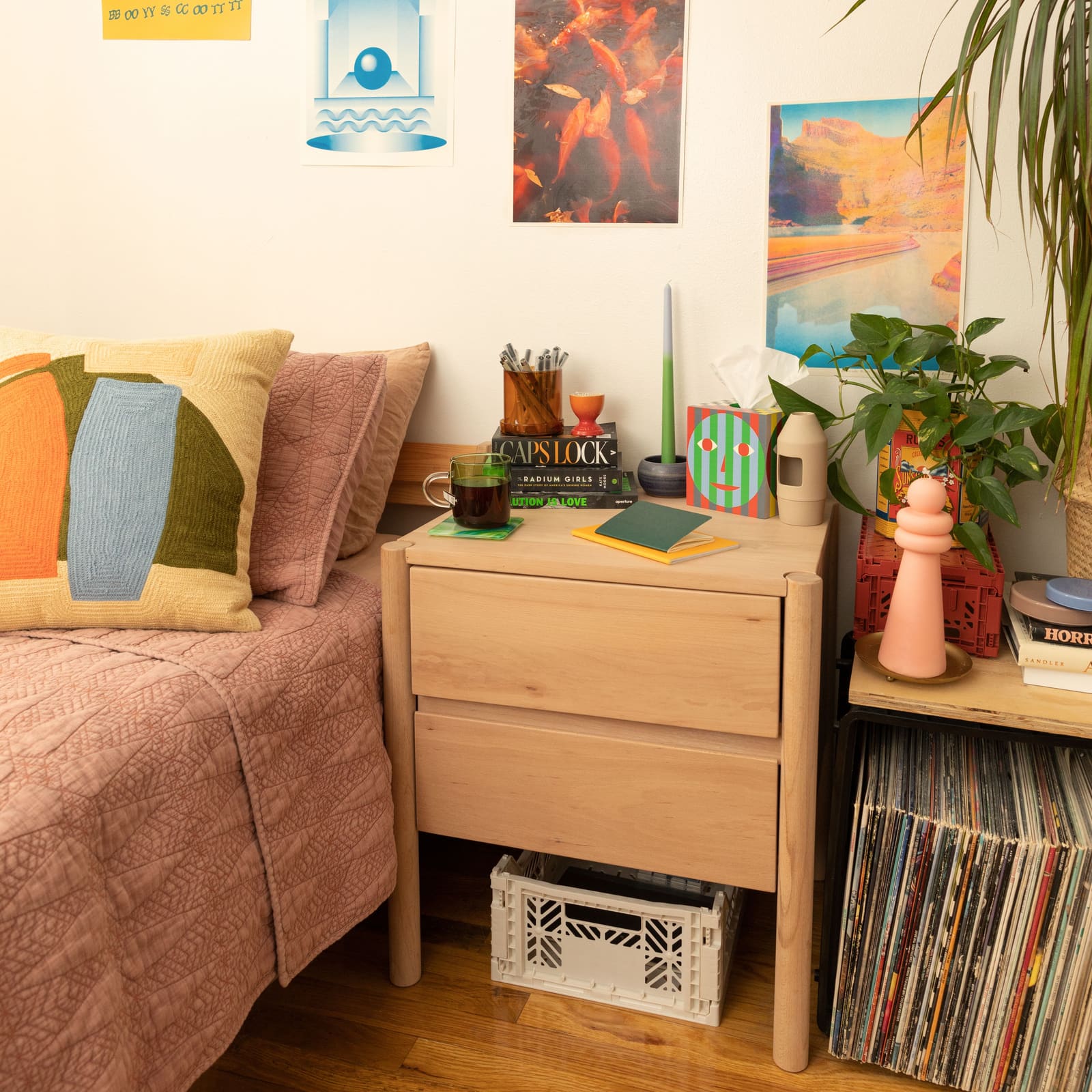
Thuma's classic nightstand deploys Japanese-inspired joinery to eliminate hardware entirely. The drawer slides without metal tracks, relying instead on tolerances tight enough to feel like a demonstration of craft confidence. Solid wood throughout, beveled edges prevent objects from migrating off the surface - a small ergonomic gesture that speaks to actual use rather than catalog styling.
The optional cork-padded legs raise the profile by several inches, transforming the piece from low-slung platform companion to mid-height storage. A bottom shelf adds capacity without visual bulk. The result is a modular logic that recalls Enzo Mari's autoprogettazione ethos: furniture as kit of parts, assembled without fuss, adaptable to circumstance.
Thuma's Element variant extends the concept vertically, offering two drawers within curved, softened edges. For those requiring closed storage - a growing cohort as bedrooms shed open shelving in favor of visual calm - the Element addresses capacity without abandoning the brand's lock-in-place construction.
Rattan's Return to the Bedroom
Natural fiber has re-entered the bedroom not as nostalgia but as textural counterpoint to the hard surfaces that dominate contemporary interiors. Serena & Lily's scalloped side table layers wicker over a mahogany frame, the scallop motif adding rhythmic detail that reads as both coastal and vaguely Postmodern. The piece includes a top-level tray and lower shelf, addressing the perennial tension between surface display and concealed storage.
GreenRow's Jovie wicker table takes a different tack, embedding handwoven rattan within a walnut frame. The diamond weave is intricate enough to function as primary ornament, which raises a design question: when the material itself carries this much visual information, how much can you place atop it before the composition collapses? The piece rewards restraint - a lamp, a single book, nothing more.
Swiss Modularity Meets the Bedside
USM Haller's P bedside table imports the brand's iconic modular system into the bedroom. Chrome frame, powder-coated steel panels, a single drawer paired with an open cubby. The form dates to Fritz Haller and Paul Schaerer's early 1960s work, and it remains in production in Switzerland today. Haller's grid logic was originally conceived for office and institutional settings, where flexibility and reconfiguration were paramount. Translating that language to domestic space produces an aesthetic friction - industrial minimalism in the room most associated with softness and repose.
The piece is available in a range of colors; bright yellow turns the nightstand into chromatic punctuation, a jolt of saturation that can anchor or destabilize depending on context. At close to two thousand dollars, it sits at the upper end of the price spectrum here, but the cost reflects both material durability and design pedigree. This is furniture as long-term investment, not disposable bedroom set.
Storage Density in Compact Form
West Elm's Pierce & Ward burl wood nightstand compresses four soft-close drawers into a compact footprint. Solid mango wood, burl veneer on drawer fronts. The piece functions less as bedside companion and more as miniature dresser, capable of absorbing the miscellany that accumulates in small living spaces - chargers, medications, books, accessories. The vertical stacking of drawers maximizes capacity without expanding the piece's horizontal reach, a spatial strategy familiar from urban apartment design.
Lulu & Georgia's Hanson nightstand offers two drawers behind push-to-open fronts, eliminating hardware to foreground the relief pattern carved into each drawer face. The detail nods to Brutalist texture without the weight, adding visual depth to what might otherwise read as a simple rectilinear volume. The wood tone skews warm without tipping into orange, a chromatic balance that requires careful material selection and finishing.
When the Nightstand Floats
Article's Lenia floating nightstand mounts to the wall, lifting the piece off the floor plane entirely. The move reduces visual clutter - no legs, no base - and opens up floor area in tight quarters. Lacquered MDF, steel plinth, dark walnut tones. One drawer, one open shelf. The built-in drawer pull is integrated into the drawer front itself, a detail that maintains the piece's clean profile.
Wall-mounting introduces structural considerations absent from freestanding furniture. The piece must be anchored securely, and weight capacity becomes a real constraint. This is not the place for a stack of oversized art books. But for bedrooms where floor space is at a premium, the floating typology offers spatial relief.
Midcentury Precedent, Platform Logic
Herman Miller's Eames Wire Base Low Table was never designed as a nightstand, but its proportions align perfectly with low platform beds. Metal wire frame, oak-veneer top, stackable construction. The piece embodies Charles and Ray Eames's material economy - minimal structure, maximum utility. The top panel unscrews, allowing for finish swaps over time. It's a rare example of designed obsolescence in reverse: the piece accommodates change rather than resisting it.
Arhaus's Frances nightstand moves in the opposite direction, embracing traditional cabinetry forms. Turned wood legs, rounded edges, dark mahogany veneer in bookmatched configuration, hanging brass hardware. The piece reads as chest-of-drawers scaled down, a move that imports bedroom storage typologies into the bedside zone. It's furniture for rooms with higher ceilings and more generous floor plans, where scale and proportion can accommodate a heavier silhouette.
Material Honesty and Surface Detail
Lulu & Georgia's Merrit nightstand, designed by Sarah Sherman Samuel, pairs an angular base with a curved tabletop - a formal tension that recalls Art Deco's love of geometric contrast. Mango wood, engineered hardwood, one generous drawer. The piece appeared in designer Mandy Moore's Altadena home, lending it a degree of celebrity endorsement, but the design holds up independent of that association.
The question of material honesty surfaces here. Engineered hardwood allows for cost control and dimensional stability, but it also introduces a hybrid construction that purists might question. The piece negotiates that tension through form: the curves and angles distract from substrate, foregrounding silhouette over material purity.
The Case for No Storage
Not every nightstand needs a drawer. The Eames low table demonstrates this, as does any number of simple side tables repurposed for bedside duty. When the bedroom already contains ample storage - closets, dressers, under-bed drawers - the nightstand can revert to pure surface. A platform for lamp, book, glass of water. Nothing more.
This minimalist position has spatial advantages. Without drawers or shelves, the piece can shrink in depth and width, opening up circulation space around the bed. It also imposes a discipline: if there's nowhere to hide clutter, clutter doesn't accumulate. The nightstand becomes a forcing function for bedroom organization.
What the Nightstand Reveals
Across the projects we've covered this year, a pattern emerges: the nightstand is a bellwether for broader design attitudes. Maximalists layer texture and color; minimalists strip to essential geometry. Those concerned with sustainability choose solid wood and natural fiber; those prioritizing flexibility opt for modular systems. The piece is small enough to take risks with - a bright color, an unconventional material, an experimental joint - but visible enough to register as deliberate choice.
The best examples on this list share a commitment to material and construction quality. Solid wood over particleboard, metal over plastic, joinery over hardware. These are pieces designed to last, to be moved from home to home, to age visibly rather than disintegrate invisibly. In an era of disposable furniture, that longevity itself becomes a design statement.
Precedent and Proportion
The nightstand's dimensions are largely standardized - height aligned with mattress top, width sufficient for a lamp and book, depth shallow enough to avoid blocking circulation. Yet within those constraints, designers find room for variation. A floating piece compresses depth; a four-drawer unit extends height; a modular system allows reconfiguration over time.
The typology also invites precedent study. Haller's grid, the Eameses' wire base, traditional cabinetry forms - all reappear in contemporary iterations, sometimes acknowledged, sometimes absorbed. This design lineage matters. It connects the bedside table to larger conversations about modernism, craft, and the domestic interior.
The nightstand will never command the attention of a statement sofa or a dramatic pendant light. But its quiet presence shapes the bedroom's spatial and material character in ways that louder pieces cannot. It's furniture at human scale, designed for reach and touch, for the gestures that bookend sleep. And in that intimacy lies its architectural significance.
Save this story. A free account keeps your reading list and the 07:00 email in one place.
CREATE FREE ACCOUNT →SIGN IN